How to Adopt AI in Your Organization Without Making the Most Common Mistakes

Success and Failure Patterns, and a Practical Decision Framework
A standalone article from the series “AI in Business: Expectations vs. Reality”
The three previous articles in this series analyzed the interests of each stakeholder, the technical reality of what AI can and cannot do, and the real costs including the new pricing paradox. This article closes the series with the most practical part: what to actually do with all of that.
The most direct way to start is with what doesn’t work. Because the most common mistakes in AI adoption aren’t technical — they’re strategic. And they repeat with remarkable consistency across companies of every size and sector.
And I think the best way to appreciate this is by being aware of the extreme cases — the utopia and the dystopia — so we can find the shade of grey that works best for us and move along that scale as we adapt.
Two Failure Patterns
Pattern A: “All AI, Right Now — The Market Won’t Wait”
The pattern unfolds like this: leadership sees competitors adopting AI and feels urgency. The decision is made to “integrate AI into every possible process.” Ambitious usage targets are set (percentage of code generated by AI, time saved per tool) without ever fully defining what specific problem is being solved. Teams receive pressure to use more AI without having been given the training, time, or context to do it well.
What happens in practice? Part of the team uses AI for low-value tasks because that’s easiest to justify. Another part has no time to explore it because they’re still responsible for delivering their projects at the same pace as before. Some use it well. Others produce fast code that nobody understands — nobody being nobody, not even the person who produced it, and not even the AI once it loses the context. Executives still don’t see the returns they expected and demand greater adoption.
The cycle closes without anyone having defined “greater adoption of what, to achieve what.”
Symptoms of this pattern:
- Vanity metrics (“X% of code was generated by AI”) without impact metrics (delivery time, bugs in production, incident resolution speed).
- Teams using AI because they’re obligated to, not because it helps them.
- Token costs rising without proportional ROI improvement.
- Widespread frustration: developers feel surveilled, many workers fear replacement, managers see no results, executives don’t understand why it isn’t working.
- Many AI projects get started that make no sense or are duplicates — driven by pressure from people who don’t understand the technical foundation beneath them, without giving the team time or resources to adapt it. Very few projects are actually finished; the rest get thrown away.
- Restructuring for Velocity: a culture where implementation agility is valued over architectural soundness. If a team or responsible person doesn’t deliver tangible AI results within a few months, they’re perceived as a “bottleneck” for the company’s survival, triggering rapid reassignments or replacements.
- Silent replacement by AI-native profiles: replacing a “traditional professional” with an “augmented professional” (someone who already comes with AI integrated into their methodology). Companies are forcing this transition aggressively: if you can’t demonstrate that AI makes you 40% faster within a quarter, the assumption is that a less experienced but more “tech-hungry” profile will.
- Loss of domain knowledge (the company’s deep know-how) in exchange for a superficial speed that generates massive technical debt.
- Erosion of job security through expectations of exponential productivity.
- Programmed obsolescence of talent: demanding an adaptation pace that ignores human learning curves.
Pattern B: “We Don’t Use That — It’s Hype”
The opposite pattern is equally real and has its own pathologies. Here, the organization — or part of it — sometimes for legitimate technical reasons, sometimes for cultural ones, sometimes due to privacy or infrastructure constraints, decides not to adopt AI tools or indefinitely delays adoption.
Symptoms of this pattern:
- Developers who feel at a disadvantage compared to their counterparts at other companies.
- Inability to compete on speed with organizations that have adopted AI where it makes sense.
- Talent flight toward companies with better tools.
- Manual work on tasks where AI could free up time for higher-value activities.
- Loss of information control due to shadow AI (employees or departments using AI tools without the knowledge, approval, or oversight of the IT or security team).
- Responsibility displacement: shifting the burden of blame onto the employee, leaving them in a defenseless position. If the employee doesn’t use AI, they’re blamed for inefficiency or for not meeting targets. If they do use AI and something goes wrong, they’re blamed for breaking the rules.
What They Have in Common
Both patterns share the same root failure: the absence of a clear strategy for what AI is actually going to be used for, with what criteria, and with what limits.
This isn’t a technology problem. It’s a management problem. And the solution isn’t technical: it’s about first defining what problem you’re trying to solve, and then evaluating whether AI is the best tool for solving it.
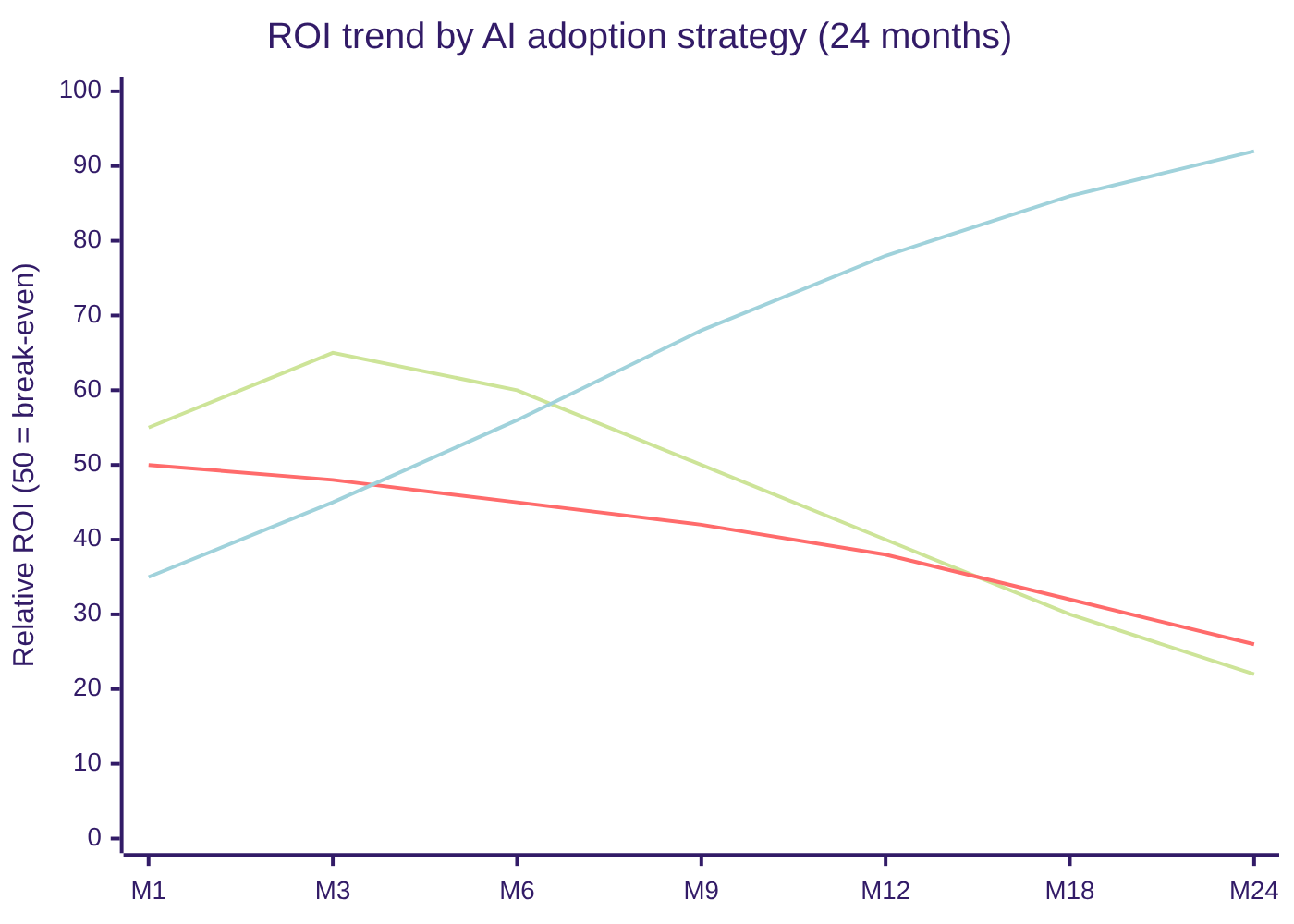
The curves in this chart are conceptual and reflect the qualitative evolution of the described scenarios, not data from a real study. Here’s the logic behind each trend:
- 🟢 All-AI without strategy: Starts above break-even (55) and reaches a quick peak at month 3 (65) driven by hype and automation of simple tasks. From month 6, it starts declining due to rising token costs, team frustration, and failed projects — ending at month 24 below even doing nothing.
- 🔴 No-AI: Starts right at break-even (50) and shows that gradual, constant decline in competitiveness described in Pattern B.
- 🔵 Selective adoption: Starts lower (35) because it requires upfront investment in training, infrastructure, and analysis of real use cases (which initially penalizes ROI). However, it takes off steadily, crosses the “All-AI” line between months 6 and 9, and consolidates as the only strategy with high long-term returns.
Start Small, Measure, Expand
The AI adoption that works follows a recognizable pattern: it starts in a specific area with a well-defined use case, measures real impact, and only expands to other areas if results justify it.
This sounds obvious. And yet it’s violated constantly, because market pressure, hype, and fear of falling behind push organizations to “adopt everything at once.”
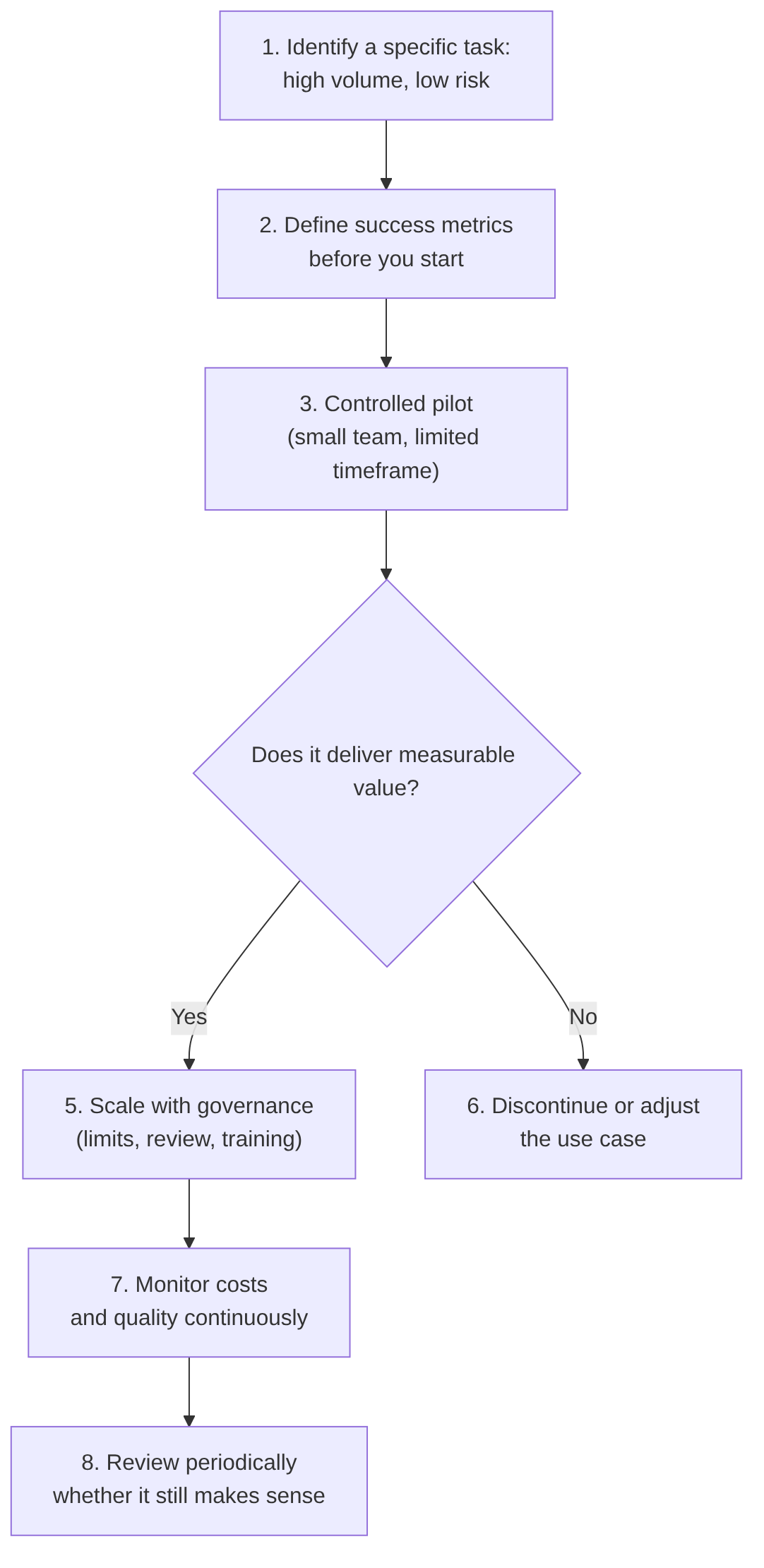
Step 2 is the most ignored. Many companies launch pilots without having defined upfront what result would make them say “this works” or “this doesn’t.” Without that prior definition, any result can be interpreted as success.
The Use Cases Where It Makes Most Sense to Start
Not all use cases have the same benefit-to-risk ratio. These are the ones that present the most favorable combination for getting started, because impact is high and the risk of harm is low:
Boilerplate and Scaffolding Generation
The initial code for a project (folder structure, base configurations, example files) is necessary and tedious. AI generates it well and fast. If it’s wrong, it’s detected in seconds because it’s simple, familiar code. Risk: low. Impact: high.
Automated Tests
Generating unit tests from existing code. AI-generated tests aren’t perfect (they tend to cover obvious cases and miss the subtler edge cases) but they’re a solid starting point that a developer can complete. Risk: low (if reviewed before merging). Impact: high.
Legacy Code Documentation
One of the most practical uses. Take a module that’s been in production for ten years and that nobody documented, and ask AI to explain what it does. It doesn’t always get it right, but as a starting point for recovering lost knowledge it’s invaluable. Risk: low (it’s documentation, not production code). Impact: very high on projects with technical debt.
Architectural Spikes
Before committing to an important technical decision, generate two or three quick prototypes with AI that explore different approaches. Not for use in production, but for understanding the implications of each option before deciding. This is one of the best possible uses of AI in a technical context. Risk: none (the code is throwaway by design). Impact: very high on the quality of architectural decisions.
Modernization and Refactoring
Updating code from an old framework version to a newer one, converting code from one pattern to another. AI is especially good at this because these are transformations with clear, documented patterns. Risk: low with human review. Impact: high on projects with technical debt.
What NOT to Delegate to AI (Yet)
Just as important as knowing where to use AI is knowing where not to use it autonomously.
The design of critical system architecture: the decision of how to structure a system isn’t only technical. It involves budget, team culture, long-term company goals, legal constraints, and the specific technical debt of the project. An AI has no context about any of those factors. It can help explore options, but the final decision and the responsibility are human.
Security and compliance: AI can detect known vulnerabilities, but the decision of what level of risk is acceptable for the company — and how to design a data governance policy that complies with GDPR, the AI Act, or sector-specific regulations — requires human judgment, legal knowledge, and professional responsibility.
Critical production incident management: when something fails in production at 3 a.m. with user and business impact, AI can provide clues, but it cannot assume responsibility or make decisions under high pressure with incomplete information. That remains human territory.
Decisions about people: performance evaluation, hiring decisions, team restructuring. Even if AI can contribute data or analysis, decisions that affect people must have direct, clear human oversight. Beyond being ethically necessary, it’s a legal requirement under the EU AI Act in many cases.
Decision Framework: Does It Make Sense to Use AI Here?
Before adopting AI for a specific use case, it’s worth answering these questions:
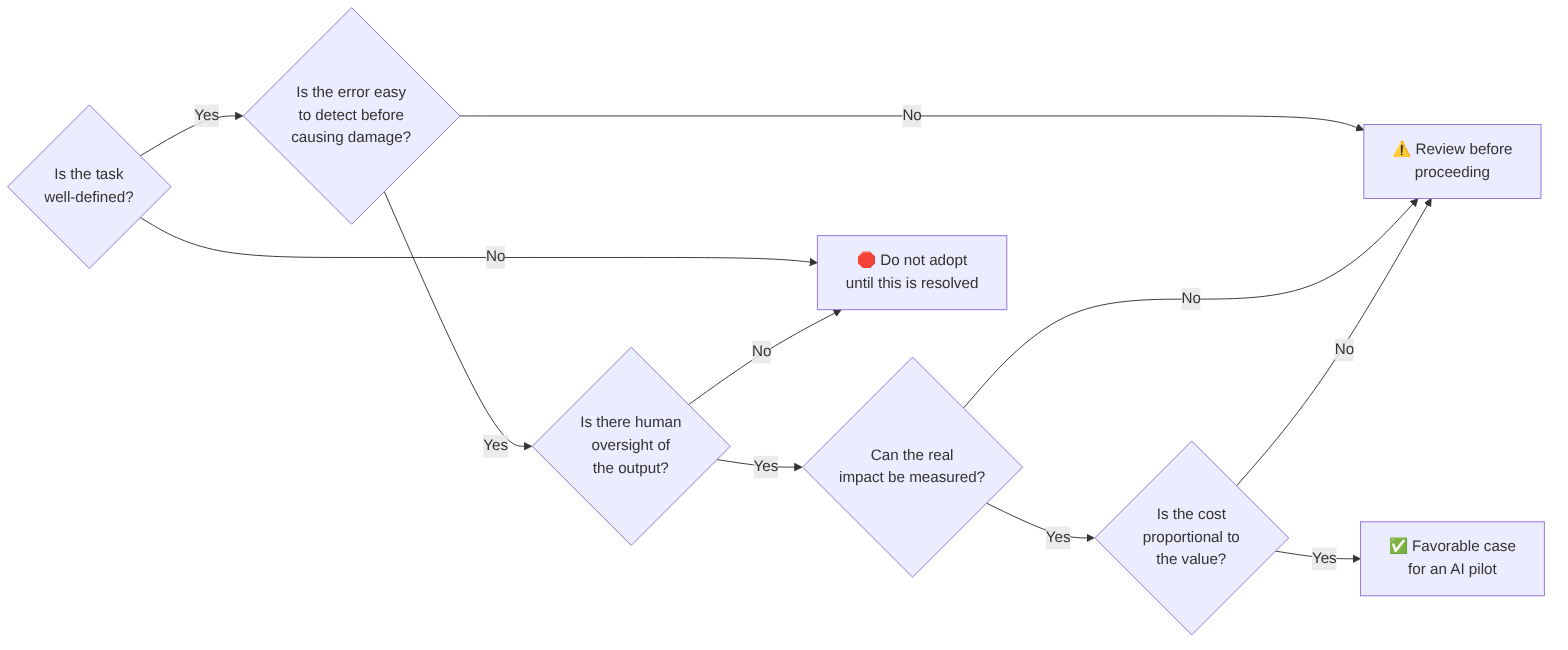
The critical questions:
Is the task well-defined? If you can’t clearly describe what input the AI will receive and what output is expected, the result will be unpredictable. AI needs precise context to work well.
Is the error easy to detect before causing damage? In test code, documentation, boilerplate: an error is easy to see. In security configurations, critical business code, decisions affecting users: an error can travel far before being detected.
Is there human oversight of the output? If AI is going to generate something that goes directly to production without any human reviewing it, the risk is very high. Human oversight doesn’t have to be exhaustive, but it has to exist.
Can the real impact be measured? If there’s no way to know whether AI is adding value or creating problems, it’s impossible to make informed decisions about whether to keep using it. Define the metrics before you start.
Is the cost proportional to the value? Including all costs: tokens, training, governance, review time, and the potential cost of errors.
The Risk vs. Value Matrix
A practical tool for prioritizing which use cases to tackle first:
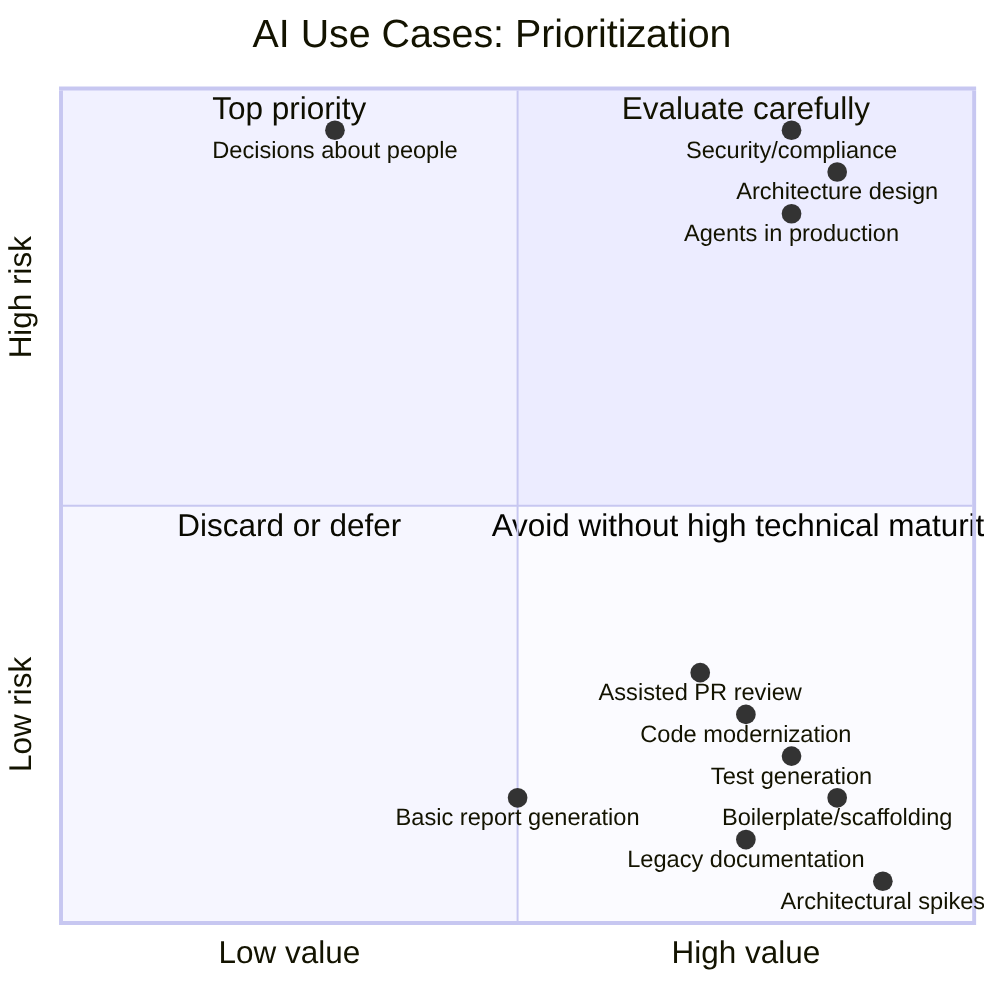
The reading is simple: start with the high-value, low-risk quadrant. High-value, high-risk cases require technical maturity and solid governance before tackling them. Low-value, high-risk cases: don’t tackle them at all.
Minimum Viable Governance
AI governance doesn’t have to be a six-month project. It can start with a minimum set of rules that any team can adopt in a week:
1. Define what AI can and cannot do: In writing, in the project repository. Not the code of conduct for the entire universe — the concrete rules for this team and this project. E.g.: “AI can generate tests and documentation. It cannot merge to main without human review. It cannot access production credentials.”
2. Set spending limits: Configure alerts in the billing tool when consumption exceeds a threshold. If you don’t know how much you’re spending in real time, you can’t manage the budget.
3. Mandatory human review: All AI-generated code that goes into the repository goes through human review. The reviewer doesn’t have to read every line in detail, but they do need to understand what the change does and why.
4. Log AI-related incidents: If AI produces a bug that reaches production, or a hallucination that almost slipped through unnoticed, log it. That data is valuable for calibrating in which contexts you trust AI and in which you don’t.
5. Periodic review: Every quarter, review whether the use cases you adopted still make sense and whether costs remain proportional to value. AI changes fast and what worked six months ago may not be the best option today.
How to Measure Real ROI
The ROI of AI is not measured in “percentage of code generated by AI” or “number of tools adopted.” It’s measured in impact on the indicators that matter to the business:
| What management measures | What should actually be measured |
|---|---|
| % of code generated by AI | Average feature delivery time (with and without AI) |
| Number of tools adopted | Frequency of bugs in production (before and after) |
| Hours of AI “usage” | Total cost per sprint / deliverable (including reviews and fixes) |
| Speed of code generation | Onboarding time for new developers joining the project |
Keep Goodhart’s Law in mind — it summarizes it better than any argument: “when a measure becomes a target, it ceases to be a good measure.”
A concrete example: introduce an AI usage leaderboard in a company. The goal of incentivizing AI use can lead to tokenmaxxing, where employees try to maximize token consumption to improve their leaderboard ranking, regardless of real impact on business productivity. We covered this in detail when discussing the tokenmaxxing case.
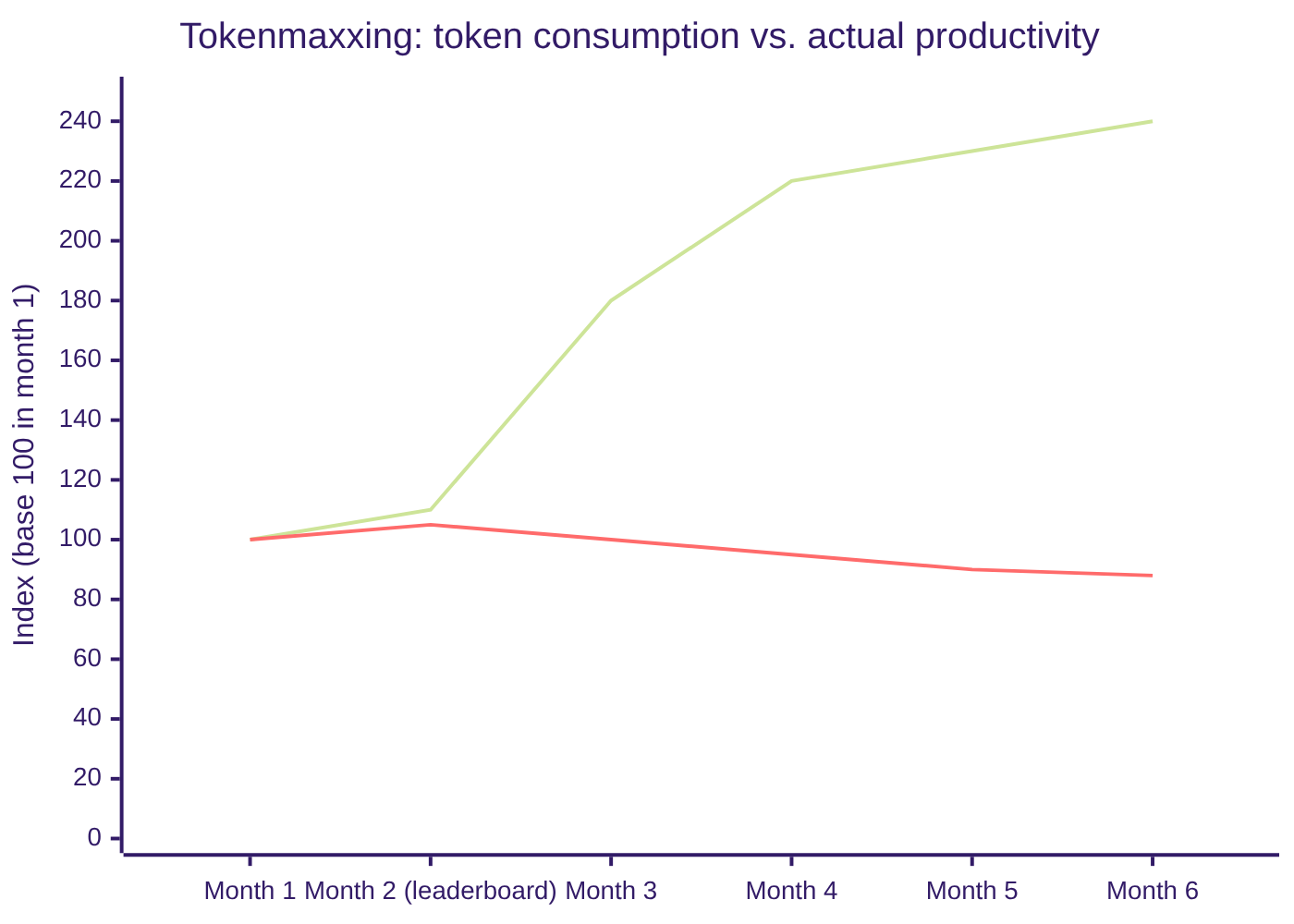
Conceptual illustration of the tokenmaxxing pattern described above. Values are invented to show the shape of the curve, not real metrics.
- 🟢 Token consumption (spikes sharply after introducing the leaderboard)
- 🔴 Actual productivity measured in deliveries (stagnates and declines)
The most ignored and most important metric: developer onboarding time on a project. A project where AI generated most of the code without solid documentation has a very high onboarding cost. A project where the code is readable, comprehensible, and another person can walk you through it has a low one. That difference is real economic value.
Recommendations by Profile
If You’re a CEO or Executive
Don’t set AI usage targets without first defining the specific business problem being solved. “Use more AI” isn’t a strategy — it’s an instruction without purpose.
Always ask: how will we know this is working? If nobody in the room can answer that with concrete metrics, the adoption project isn’t ready to begin.
And protect internal know-how: the speed you gain from AI disappears entirely if you lose the people who understand the critical systems.
If You’re a CTO or Architect
Your job with AI is the same as always: make technical decisions that are good in the long term, not just fast in the short term. AI can be a powerful tool in that process, but the responsibility for the decisions remains yours.
Design the governance before the team needs to improvise. Define the limits of what AI can do autonomously before someone makes the mistake of crossing them.
If You’re a Developer
Use AI for what frees you up to think more, not for what allows you to avoid thinking. If you accept suggestions you don’t understand because “AI says it works,” you’re transferring your technical judgment to a tool. That judgment is what makes you valuable.
Maintain your ability to work without AI. Not as an exercise in purism, but as insurance: the day AI fails, the system goes down, or the provider changes its terms, you’ll still be capable of solving the problems.
If You’re a Manager or PM
Redefine your team performance metrics. Traditional metrics (lines of code, tickets closed) are distorted by AI. What matters is still what it always was: is the team delivering real value? Is the system working well? Can the team maintain and improve what it has built?
Don’t push for “more AI usage.” Push for better results. If AI helps achieve them, the team will use it. If not, review the use case — don’t increase the pressure.
The Summary That Works for Everyone
No tool, however powerful, replaces a clear strategy. AI is extraordinarily capable in specific domains and quite poor in others. The work of any organization that wants to benefit from it isn’t “adopt AI” — it’s understanding what it does well, what it does poorly, what it costs, and what it means for the people on the team.
The formula isn’t AI vs. Human. It’s:
[Human who knows what they’re doing + well-directed AI] > either one alone
But that formula only works if the human knows what they’re doing. If the human delegates judgment to AI, the formula collapses. The human becomes a multiplier of AI’s errors instead of the filter that catches them.
There’s no single answer about whether AI is good or bad for your company, your team, or your career. The answer depends on what you use it for, with what judgment, with what governance, and in what context.
What does exist is enough information to ask better questions and make more informed decisions. That’s exactly what these articles set out to provide.
Sources cited in this article:
- Tokenmaxxing at Amazon and Meta (May 2026): The Decoder · TechSpot · Tom’s Hardware
- Goodhart’s Law and AI metrics in enterprises: PYMNTS — Enterprises Look Beyond Token Counts
- Holded — responsible AI adoption strategies: Aprovechar la IA sin perder la ventaja humana (article in Spanish)
- The Conversation — AI and organizational learning: La IA facilita pero no garantiza el aprendizaje (article in Spanish — The Conversation also publishes in English: theconversation.com)
Previous article: The Real Cost of AI: From the Democratic Promise to the Enterprise Model
Back to the index: Series Introduction
