
The Real Cost of AI: From the Democratic Promise to the Enterprise Model
Copilot moves to token billing, JetBrains cuts quotas, Claude raises costs with new tokenizer. Analysis of the economic divide AI is opening in 2026.
Series: AI in Business: Expectations vs. Reality part 3 of 4

Why the AI That Was Supposed to Be for Everyone Is Becoming an Elite Tool
A standalone article from the series “AI in Business: Expectations vs. Reality”
A few years ago, the promise was clear: artificial intelligence was going to democratize technology. Any developer, any startup, any small team would have access to the same tools as the largest corporations. AI was going to level the playing field.
Now, that promise is in tension with reality. AI tools remain accessible in their basic versions, but intensive use — the kind that genuinely delivers value at enterprise scale — is becoming more expensive in ways that aren’t always obvious at first glance.
This article analyzes that paradox: how the AI business model is evolving, what it means for different types of users, and what gap is beginning to open between those who can afford it and those who can’t.
The Original Story: AI for Everyone
The years 2022–2023 marked the explosion of accessible AI tools. ChatGPT went viral with a free plan. GitHub Copilot offered generous allowances for $10 a month. JetBrains, when integrating their AI assistant, set high usage quotas because they had “little real usage data and wanted to be generous.” Claude, from Anthropic, had free tiers with access to capable models.
For an individual developer, the message was: for the price of a pizza a month, you have a coding assistant that would previously have cost hiring a part-time junior.
It was a compelling argument. And for a while, it was more or less true.
What’s Happening in 2026: The Shift to a Consumption Model
That era is ending. Not dramatically, but gradually — and, notably, quite well orchestrated.
GitHub Copilot: From Flat Pricing to Token-Based Billing
GitHub announced that starting June 1, 2026, all Copilot plans will migrate to usage-based billing. Instead of accessing a fixed number of requests, users consume AI Credits calculated by tokens processed — both the text sent and the response received.
Subscription prices aren’t nominally going up. But developers are already reacting: across GitHub forums, the prevailing sentiment is captured in a phrase circulating in Visual Studio Magazine: “you will get less, but pay the same price.”
What does this mean in practice? Basic usage — autocompletion, simple code suggestions — doesn’t get more expensive. But advanced usage — contextual chat with large files, agentic coding sessions, deep code reviews — burns through tokens quickly. And that’s precisely the usage that generates real value at scale.
As for Windows: after putting Copilot everywhere, Microsoft is now removing it from more and more applications where it doesn’t deliver on its promise.
JetBrains: The Silent Cutback of August 2025
In August 2025, JetBrains revised its AI quota system with a technically honest explanation: they had initially set much higher quotas because they had no real usage data. Once they measured actual usage, they adjusted the limits to make the service sustainable.
The result: the free tier dropped to 3 credits per month. The AI Pro plan gives 10 credits. One credit is equivalent to $1 of token consumption from LLM providers. In practical terms, users report that credits run out significantly faster than before, especially when using Junie (the coding agent) or in long conversations with broad context.
Anthropic / Claude: The Tokenizer That Raises Costs Without Raising Prices
Anthropic’s strategy is more subtle. Claude API prices haven’t directly increased in the 2025–2026 period. But Claude Opus 4.7 introduced a new tokenizer that can produce up to 35% more tokens for the same input text.
What does this mean? The same prompt that previously cost $1 can now cost $1.35, even though the price per token hasn’t changed. The “price” stays the same; the “real cost” goes up.
Google AI Ultra: Price as a Market Signal
Google launched its AI Ultra plan at $249.99 per month. It’s not the highest-volume product, but the price is a signal of where the market wants to position itself: maximum-capability AI as an elite good, similar to how premium enterprise data service subscriptions have been positioned.
The Agentic Use Paradox
This is the core of the problem, and it’s worth understanding clearly because it directly affects the direction many companies are heading.
Basic AI usage (autocompletion, one-off questions, generating short functions) consumes few tokens. It’s cheap, predictable, and easy to budget.
Agentic usage (the agent reads multiple files, executes commands, iterates on the results, asks follow-up questions, generates tests, runs them, fixes failures…) can easily consume 50–100× more tokens than basic usage in the same session.
And here’s the paradox: the CEOs and executives who push to “use more AI” are typically thinking about agentic usage — the kind that automates entire workflows. But that’s precisely the usage that drives costs up exponentially.
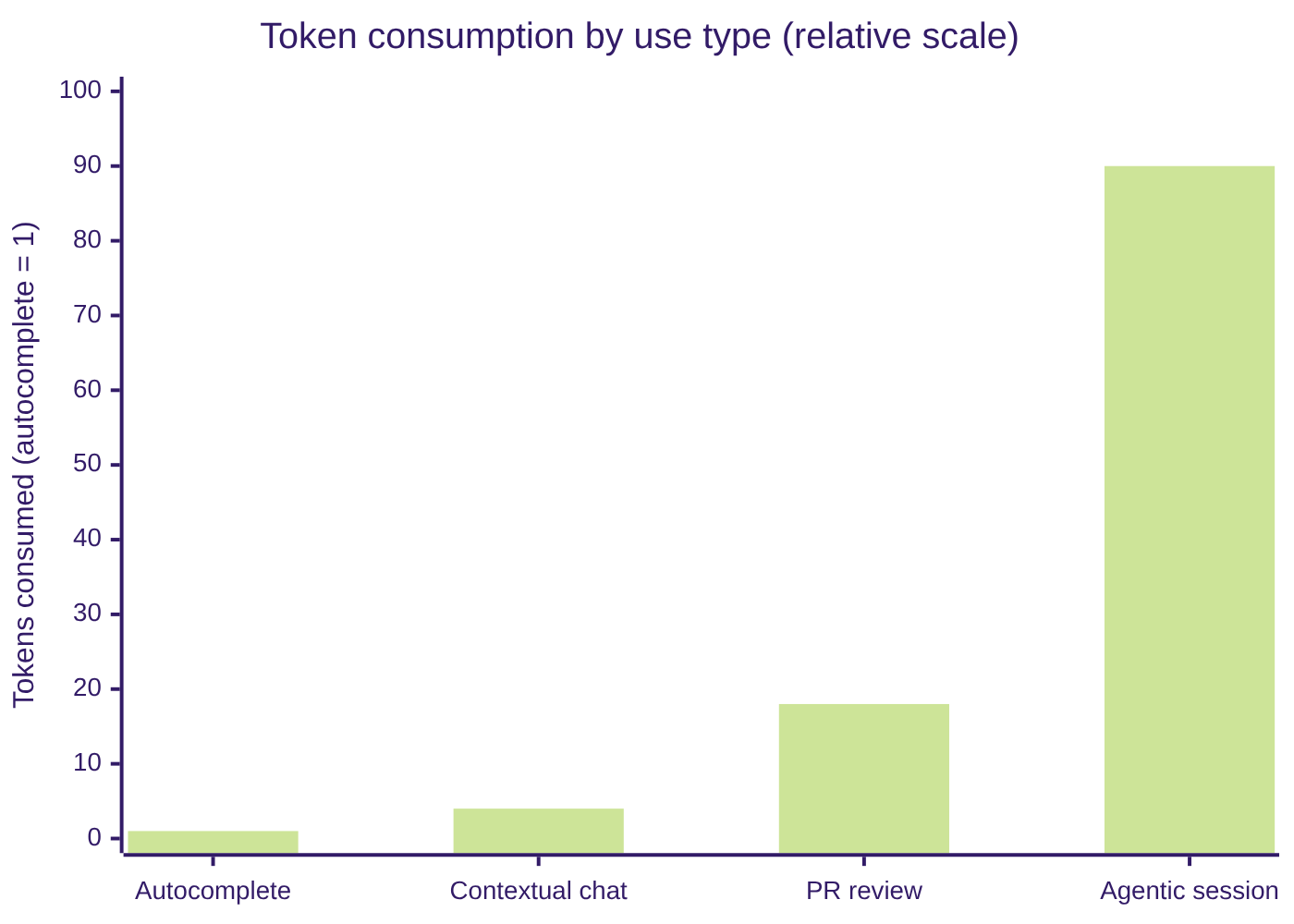
Conceptual and illustrative scale — values are invented and don’t correspond to a specific measurement, but reflect the order of magnitude described above. The agentic session bar reflects the 50–100× range mentioned.
The documented consequence: a development team working intensively with AI agents can spend far more than expected. One case cited in specialist media describes $28,000 per person per month in token consumption (article in Spanish — English-language coverage on this topic available from major tech outlets) in teams with very intensive use. It’s an extreme case, but it illustrates the scale of the problem when there’s no spend governance in place.
The Gap That’s Opening
The result of all the above is a market segmentation that wasn’t part of the original democratization narrative.
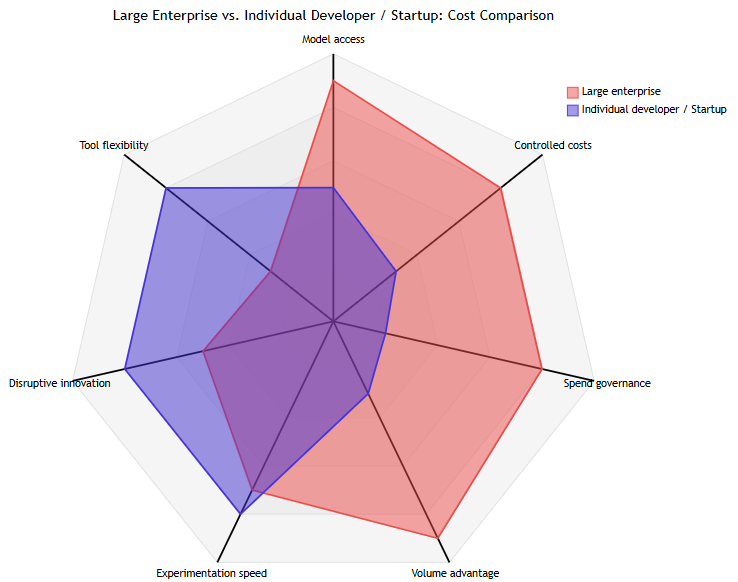
The Radar: Large Enterprise vs. Individual Developer / Small Startup
We compare two extreme profiles in terms of their position relative to AI cost:
- Large enterprise [LE]: dedicated budget, specialized team, ability to negotiate contracts with providers, can amortize costs at volume.
- Individual developer / small startup [SP]: limited budget, no preferential contract, variable and unpredictable cost, no dedicated team to manage consumption.
(Note: for “Entry barriers” and “Predictable costs,” a higher score is worse — indicating a greater barrier or greater unpredictability.)
Why These Scores
Access to higher-capability models (LE 9 / SP 5): Large enterprises can negotiate early access to preview models, greater context windows, and service priority. The enterprise plans from OpenAI, Anthropic, or Microsoft don’t have the same restrictions as standard consumer plans.
Predictable and negotiable costs (LE 8 / SP 3): An enterprise with a volume contract can negotiate fixed prices guaranteed for one or two years. An individual developer or startup is on a pay-as-you-go model with variable pricing that can change at any time.
Spend governance and control (LE 8 / SP 2): A large company can assign a team to manage consumption, implement per-team limits, monitor usage in real time, and detect spikes before they become surprise invoices. A small operation has almost none of that control infrastructure.
Experimentation speed (LE 7 / SP 8): Paradoxically, individuals and small startups have an advantage here: they can try new tools, switch providers, and experiment without internal approval processes. A large company can take months to approve a new vendor due to security and compliance processes.
Capacity for disruptive innovation (LE 5 / SP 8): Tech history is clear: most disruptive innovations come from small teams with the freedom to experiment. The individual who can try things without bureaucracy generates ideas that enterprises can’t — despite having far more resources.
Flexibility to change tools (LE 3 / SP 8): When Microsoft raises Copilot’s prices or changes terms, a company with 5,000 licenses faces a massive migration problem. An individual developer can switch editors and tools over a weekend.
What This Means for Industry Innovation
The history of the technology industry has a clear pattern: tools that become accessible only to large enterprises stop being catalysts for innovation and become competitive fortresses instead.
Historically, many of the most important technological transformations began with individuals or small teams who had free access to powerful tools. When those tools become expensive enough that only large players can use them intensively, innovation concentrates — and so does power.
This isn’t alarmism: it’s simply observing that if advanced AI access requires mid-to-large enterprise budgets, the next technological paradigms will be born in enterprise environments, not in garages.
What Regulation Says (and What It Doesn’t Say Yet)
The regulatory response to the labor and economic transformation brought by AI is still in a very early state.
China passed a regulation prohibiting companies from firing employees solely because an AI can perform their work (article in Spanish — English-language coverage available from major international media). It’s a direct labor protection measure, though its practical enforcement in global technology companies is complex.
The European Union has had the AI Act in force since 2024, but its primary focus is on safety and fundamental rights in high-risk applications (credit systems, hiring, surveillance) — not directly on prices or access. It tries not to restrict AI development. What does exist, and is relevant, is the AI Act framework regarding enterprise AI use: if a company uses AI systems to make decisions affecting employees (performance evaluation, project assignment, etc.), it’s entering regulated territory and needs documentation, human oversight, and rights for those affected.
In Spain, the regulatory response focuses on preventing exclusion of smaller businesses (Spanish government source — see avance.digital.gob.es). The goal is to democratize access through shared infrastructure initiatives and the Data Economy, helping SMEs avoid falling behind the enterprise model.
The TCO We Need to Calculate Correctly, Even with AI
TCO stands for Total Cost of Ownership: the real cost of a technology over time, including all visible and invisible factors.
When companies calculate the cost of adopting AI, they typically include only licenses. The real TCO is considerably larger:
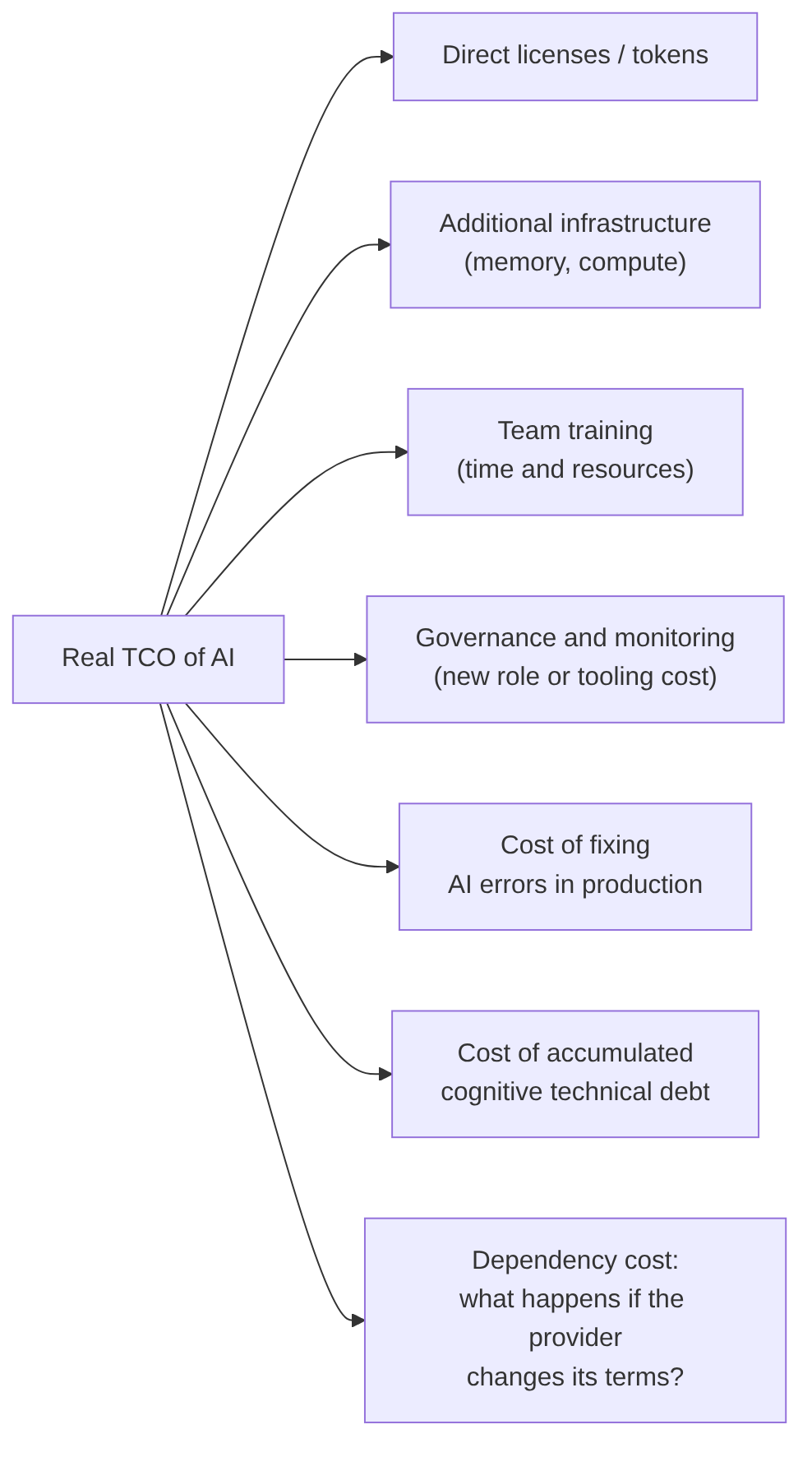
The most ignored element is the cost of cognitive technical debt: if the team loses understanding of its own systems because “AI generated it,” the cost of recovering that knowledge — or of surviving a serious incident without it — can be enormous. But that cost doesn’t appear on any AI tool invoice, and there may not be a salary high enough to hire engineers willing to take responsibility for fixing such a legacy.
The Comparison That Actually Matters
The relevant question isn’t how much does the AI tool cost? The question is: how much is what it delivers actually worth, net of all real costs?
| Type of cost | Easy to calculate | Hard to calculate |
|---|---|---|
| Monthly licenses | ✅ | |
| Tokens consumed | ✅ (with monitoring) | |
| Training time | ✅ | |
| Quality of generated code | ⚠️ Requires specific metrics | |
| Accumulated technical debt | ⚠️ Manifests months later | |
| Cost of an AI-caused incident | ❌ Impossible to predict | |
| Impact on talent attraction | ❌ Qualitative and deferred |
The typical trap is calculating costs using only the easy row. You look at the licenses and tokens, compare it to the salary cost of the automated tasks, and conclude that AI is profitable. But the equation only closes if the values in the second column aren’t large — and they often are.
Where Is This Heading?
The observable trend points in one direction: high-performance AI is increasingly behaving like other enterprise technology infrastructure — Azure, AWS, Salesforce — powerful, indispensable for those who already use it, and economically accessible only beyond a certain company size.
This doesn’t mean AI will stop being useful for individuals or small businesses. It means the gap between what an individual can do with the tools they can afford and what a large enterprise can do with volume contracts will grow.
The implications vary:
- For large enterprises, AI spend management will become its own discipline, similar to how cloud spend is managed. Specialized FinOps roles for AI already exist.
- For startups, the AI tools budget will be a cost line that needs active planning and management — not a $20/month subscription.
- For individual developers, there are decisions to make: which tools to keep paying for as prices rise, which open-source alternatives can cover basic needs, and how to stay competitive without taking on unsustainable costs.
Conclusion: Democratization Wasn’t the Business Model
The promise of AI democratization wasn’t false. It was real during the period when providers were in market-expansion mode, prioritizing adoption over profitability.
Now that adoption has reached critical mass, the business model is maturing and prices are adjusting toward what the market can sustain. That’s basic economics, and there’s nothing particularly wrong with it.
What is worth pointing out is that the democratization narrative is still the sales pitch, even as the real business model increasingly resembles enterprise infrastructure. And that gap between the story and the reality deserves attention — especially for those making investment and budgeting decisions.
AI will continue to be a powerful tool. But it’s increasingly going to be a tool for organizations that can afford intensive usage, rather than a universal equalizer. Understanding that is part of making informed decisions about how much to adopt, and how.
Sources cited in this article:
- GitHub Copilot migration to usage-based billing (June 2026): GitHub Blog
- Developer reaction to the Copilot change: Visual Studio Magazine, April 2026
- JetBrains AI quota change (August 2025): JetBrains AI Blog
- Claude Opus 4.7 tokenizer and real cost: Finout Blog
- Google AI Ultra and the AI class divide: Winsome Marketing
- AI cost vs. employee salaries: El Economista, May 2026 (article in Spanish)
- China regulation on AI-related layoffs: El Confidencial, May 2026 (article in Spanish)
- EU AI Act explorer: artificialintelligenceact.eu
- European Commission on AI policy: digital-strategy.ec.europa.eu
“The Real Cost of AI: From the Democratic Promise to the Enterprise Model” by Ramón Invarato at jarroba.com, licensed under Creative Commons Attribution-NonCommercial-ShareAlike 3.0. Registered at Safe Creative.

You may also like

The Free Agent Trap
CRMArena-Pro measures 35% success in multi-turn. DELEGATE-52 confirms 25% silent corruption. Why leaving an AI agent on its own is still risky.

Why You Lose With (and Against) AI
What is getting cheaper, what is rising in value, and the Jevons paradox applied to knowledge work. Why mass layoffs and record salaries coexist.

How to Avoid Being Replaced Without Selling Out to AI
Four profiles facing AI, two bad extremes, and four personal strategies that actually work in 2026. No alarmism, no evangelism.

AI and You: the Complete Series for Getting an Edge Without Losing Yourself
How to use AI well in your work and your life without turning into an evangelist or a denier. A complete ten-article series, no hype.
Leave a comment