“I don’t want anything made with AI” – The consumer paradox

Why we reject AI art, AI music, and AI-generated Magic cards
A standalone article from the series “AI and You”.
In January 2024, Wizards of the Coast published a promotional image for Ravnica Remastered, a Magic: The Gathering expansion.
The controversial image was a steampunk apothecary desk with five new cards laid out on it (if you’re curious, you can still find the image online, for example in this Vice article). The community noticed very quickly: impossible filaments in a lightbulb, dials with mismatched markings, cables that didn’t end anywhere. Fans spotted what AI still gets wrong: the small details.
The company denied it. “This artwork was created by humans, not AI,” they posted in a tweet they later deleted. Days afterwards, they corrected themselves: the image came from an external vendor that had indeed used generative tools. “We made a mistake earlier”. In May 2024, Wizards updated its contracts to explicitly prohibit the use of generative AI in art and text for both Magic and Dungeons & Dragons. Almost simultaneously, Hasbro’s CEO (the parent company) confirmed at a conference that they were already using AI internally for product development.
That story condenses the paradox that gives this article its name. People vehemently reject products where AI is noticeable. At the same time, almost without blinking, they accept other forms of invisible AI in their daily lives. The line between “rejected” and “accepted” doesn’t seem coherent at first glance, but it has patterns. Understanding them serves for much more than winning forum arguments: it helps you decide how to use AI yourself, without your output ending up on the rejection pile.
Note about Wizards of the Coast: a quick aside to clarify that neither this brand nor any of the others cited here sponsors me. Although the introduction might suggest some unease toward the company, the opposite is true: I think they do excellent work and have great artists. That doesn’t take away from the fact that a one-off, already-corrected action from the past makes a useful theoretical example to learn from about how to use AI and which mistakes to avoid.
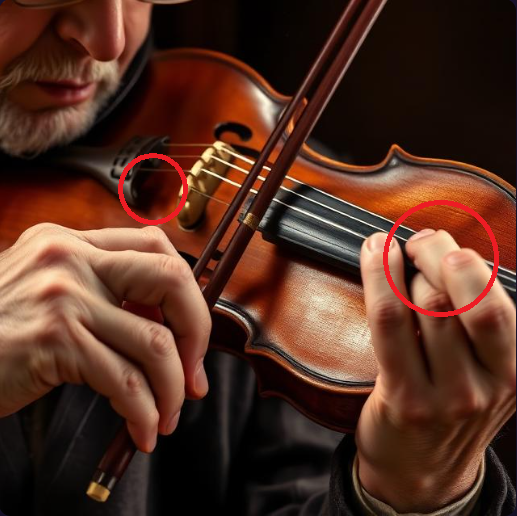
Example of an AI-generated image with visible defects
Rejection kicks in when it shows
Consumers don’t reject AI on principle. They reject the product when something makes them think “this was made by a machine.” And that “something” is always concrete. The signals that give AI away can even be categorized:
-
In images: Eyes with duplicated pupils or looking in different directions. Hands with six fingers or impossible joints. Backgrounds where perspective doesn’t close and objects melt into each other. Text embedded in the image that looks like writing but says nothing when you read it. Lightbulb filaments that wave like spaghetti, dials with inconsistent markings, bricks that don’t align.
-
In voice: Intonation that’s too uniform. Pauses landing in strange places. Nonexistent or fake breathing. Emphasis placed at random. Sentences that sound spoken rather than felt. In music with generated voice, there’s a particular sensation: words are all pronounced with the same emotional weight, and verses sometimes end without taking a breath.
-
In text: Soft syntax. Repeated closing formulas (“in summary,” “it’s important to note,” “in conclusion”). Filler words that sound like high-school essays. Sentences that are grammatically impeccable but lack edges, without a single unexpected turn. AI-generated text is often correct and forgettable at the same time.
-
In logic: Internal inconsistencies that reveal there’s no author. In a novel: a character’s eye color changes mid-book. In code: a variable is named one way in one place and differently in another. In an article: two contradictory figures in the same paragraph.
-
In technical quality: Things a human professional in the field would never have let through. In art, extra fingers or clocks that don’t show real units. In music, abrupt transitions no producer would sign off on. In a financial text, ratios that don’t add up because the AI didn’t check.
When the reader, viewer, or listener detects any of these signals, their brain goes click. It’s like discovering that a famous painting you’ve seen in person was actually a reproduction: the physical object hasn’t changed, but the experience in front of it is altered forever.
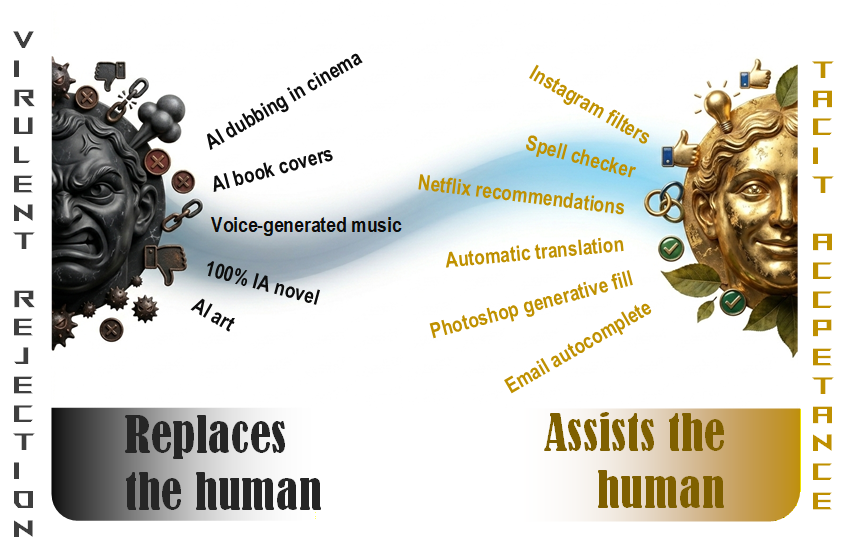
Conceptual spectrum of the consumer in front of AI, representing the gradient between virulent rejection (left) and tacit acceptance (right).
“But this AI doesn’t bother me”
It’s worth looking at the other side and being consistent with our own rejections. We all use AI and accept it without protest in plenty of contexts:
- The phone’s spell checker changes words automatically and we don’t mind.
- Google Translate converts an entire conversation and nobody asks us to redo the translation by hand.
- Photoshop’s generative fill erases an object from a photo’s background and the result is accepted as “a retouched photo.”
- Email autocomplete finishes sentences, and if the sentence is good, it stays.
- Netflix, Spotify, and YouTube’s recommendation algorithms use AI to decide what we’re shown, and nobody asks for a “hand-picked” recommendation.
- Instagram filters apply neural networks to smooth skin, and the result gets posted as your own.
- When we take a phone snapshot of a group of people and “coincidentally” everyone comes out looking good with their eyes open and smiling — would you rather come out badly or repeat the group photo a thousand times until everyone happens to have their eyes open by sheer luck?
Why are these forms of AI not rejected? There’s a clear pattern: AI is rejected when it replaces, not when it assists. Autocomplete helps the person writing; it doesn’t write for them. The translator converts a text that already exists; it doesn’t invent content. The Instagram filter polishes what’s already there; it doesn’t generate a different person.
The line, in one sentence: AI is accepted as a tool and rejected when it takes the author’s seat.
What science says about this rejection
There’s a study published in 2023 in Cognitive Research: Principles and Implications (Bellaiche et al., Duke University and other institutions) that’s worth citing because it puts numbers to something most of us already intuited.
The authors showed participants artworks and asked them to rate them on four criteria: how much they liked them, what beauty they conveyed, what depth they perceived in them, and how much they thought they were worth. The catch: all the works were generated by AI, but the researchers randomly labeled them as “created by humans” or “created by AI.”
The result was consistent and emphatic: the same works, when labeled as human, received higher ratings on all four criteria at once. Participants weren’t judging the work; they were judging the label. The authors’ hypothesis: viewers value art as a communicative act loaded with human effort and experience, and that collapses when they’re told there’s nobody behind it.
The bias is well documented in other formats: music, creative writing, dance, poetry. The pattern is always the same: the public prefers the human when given a “human” option and an “AI” option, even when the “human” one isn’t really human.
This has two implications worth holding on to. First: the rejection isn’t only aesthetic. It’s cognitive. Even if the AI work’s technical quality were perfect (which it isn’t), the observer’s bias would place it below the human one. Second: by the same reasoning, labeling honestly as “made with AI” carries a perception cost. Whoever declares it accepts an upfront discount on how their work will be received.
A thought experiment for you: go back for a moment to the start of the article and look carefully at the cover image. Before you do, here’s an important spoiler: it’s 100% AI-generated (with Gemini’s NanoBanana, specifically), and it even keeps its watermark in the bottom-right corner to give it proper credit. How does it feel now to know no human touched a single pixel? The machine created it in a couple of seconds. Would you have experienced it the same way if you’d been told I drew it by hand? After all, you could argue I “sculpted” it via language, writing the prompt and pivoting with Gemini until I landed exactly on the concept I had in mind.
Why does it really get rejected?
Beyond the study, there are five reasons that cross over and reinforce each other:
Suspicion of fraud: If a product is sold as human-made and turns out to have been made by a machine, the consumer feels they’ve been charged for work that wasn’t done. It happens in any craft where the client pays for the effort, not just the result: illustration, writing, music, artisan work. If a person or brand swears “this was made by a human” and it later emerges that AI made it — even if they backtrack after someone spots the non-human seams — they lose more than money: they break the implicit contract with their audience.
Loss of aura: Walter Benjamin wrote about how the mechanical reproduction of art (photography, cinema, the printing press) destroyed the “aura” of the original object. AI generation is the next turn of the screw: it’s no longer reproduction, it’s production without an author. For an audience that values the aura, this is the definitive loss.
Identity threatened: Illustrators, writers, musicians, and screenwriters watch their style being replicated without consent and the market they’ve dedicated whole lives to shrinking. The rejection from inside those communities isn’t only professional: it’s existential. And it spreads to the audience that follows them.
Actually lower quality: The five giveaway signals above are measurable. In 2026, AI still makes errors that a human professional in the craft wouldn’t make. Buying a product “made by AI” is, statistically, buying a worse product in the details. The rejection here is rational.
Sense of community: Many cultural products are consumed not just for their content but for the bond with whoever made them. A book by an author you follow. An illustrated novel by an artist you know. A song by a musician whose story interests you. AI breaks that bond because there’s nobody behind it to bond with.
Concrete cases of rejection (and where the line shifts)
The theories are fine, but it’s worth seeing where this is happening today without having to look far. I’ve chosen the following cases because they show both the rejection when there’s full replacement and the nuance when AI coexists with human work.
YouTube and the “AI slop” category: Since March 2024, YouTube has required creators to disclose synthetic or altered content that looks realistic. In July 2025, the platform went further: it renamed its “repetitious content” policy to “inauthentic content” and tightened monetization requirements against what the creator community itself calls “AI slop.” The reason is very concrete: channels uploading dozens of nearly identical, fully automated videos a day, with no human presence or editorial judgment, were draining recommendations away from real creators. Videos of characters with plastic faces, robotic voices, and generic narration that drift around YouTube’s recommendation lists are that phenomenon; the platform demonetizes and downranks them when detected. The market signal is clear: there’s a ceiling on how much slop the ecosystem accepts before it starts pushing it down.
Music on Spotify and SoundCloud: Detectable “100% AI” songs have been climbing, and the platforms have had to act. Spotify has pulled massive amounts of Suno-generated tracks when they’ve been used to impersonate real artists or artificially inflate plays. Audiences, meanwhile, complain about the “noise” of playlists with voices that sing without ever having learned to breathe.
Novels on Amazon Kindle: Amazon had to cap KDP self-publishing at three books per author per day, after the platform filled with auto-generated novels. The problem wasn’t only quantitative: readers were buying books that looked human-made, finishing with a bad experience, and leaving negative reviews. That hurt Amazon’s reputation, not just the ghost authors’.
Steam has had to regulate: Valve updated its store rules in 2024 to require any game with AI-generated content to declare it in a visible section called “AI Generated Content Disclosure” on its store page. There are two categories: pre-generated content (art, code, sounds created with AI during development) and live-generated content (AI produces content while the player plays). In 2025, nearly 8,000 titles went through this disclosure in six months, versus about 1,000 in the prior period. In 2026, Valve refined the policy clarifying that efficiency tools (code autocomplete, bug-finding) do not require disclosure, only content the player sees. Tim Sweeney, Epic Games’ CEO, even suggested that AI labels should be removed because “AI will be in almost all future production.” Steam, for now, keeps the requirement: the buyer decides with what information.
Hologram concerts (two different endings): The same technical format (an artist not physically on stage) has very different reception depending on how it’s staged. ABBA Voyage, in London, has been running since 2022 with 2D digital avatars of ABBA members rendered from real motion capture (a $175 million project with Industrial Light & Magic), accompanied by a live band of musicians on stage. Critical reception has been positive and it has surpassed four million attendees as of April 2026. On the other end, hologram-only tours (of nonexistent or deceased singers) without meaningful human accompaniment have had much shorter commercial runs and mixed reviews. The difference isn’t the technology; it’s that ABBA Voyage keeps a human core on stage, and hologram-only tours remove the human entirely. The rule recurs: AI as companion is liked, AI as substitute is uncomfortable.
Dubbing in cinema and video games: Here the rejection is more nuanced. There’s acceptance when AI dubs an actor whose voice is reconstructed with their permission (the case of actor Val Kilmer (Spanish source — Val Kilmer’s AI voice recovery for Top Gun: Maverick was also widely covered in English-language media), who lost his voice to illness and recovered it with AI for his own work), or when users rely on YouTube’s ephemeral autodubbing (despite the voice being heavily robotic and sometimes not even matching gender). There’s rejection when the voice is imitated without consent, or when living voice actors are replaced to cut costs.
Board games, editorial illustration, social media: The pattern repeats everywhere: forums like BoardGameGeek downrate games whose illustrations are identified as AI; kickstarters for games with synthetic art get pulled after an avalanche of comments; illustrators with social-media presence lose commissions when a client discovers that all the work was AI-made and it becomes public. The rejection is cross-sector and doesn’t seem to be cooling down.
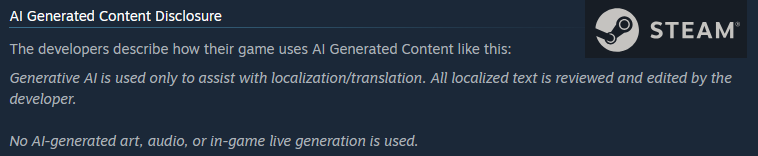
An example of a correct and honest disclosure about AI-generated content for the game Dave the Diver on Steam
The line: “assisted by AI” vs “made by AI”
The most useful thing to take from this article is the operative line. There’s a spectrum between “assisted by AI” and “made by AI,” and rejection kicks in when one crosses to the wrong side.
| Accepted side: assisted by AI | Rejected side: made by AI |
|---|---|
| A writer runs their draft through an AI-based style linter | A 100% generated novel from a prompt |
| A musician uses AI to clean up the audio of a recording | A song with synthetic voice, lyrics, and melody sold as human-made |
| An illustrator generates quick references to compose their work | A 100% generated illustration sold without disclosure |
| A photographer erases a cable from the background with generative fill | A synthetic photograph passed off as real |
| A programmer uses autocomplete to write faster | A project uploaded entirely from prompts with no review |
| A journalist uses AI to transcribe interviews | A 100% automated news article with no byline |
| A live show with an artist on stage and avatars on screen | A hologram tour replacing a deceased artist with no human core |
| A YouTube channel uses AI for subtitles and thumbnails | A channel uploading twenty AI-generated videos a day from end to end |
The criterion isn’t how much AI is used. The criterion is who made the decisions: on the “accepted side” there’s a human with judgment directing every important step; on the “rejected side” there isn’t.
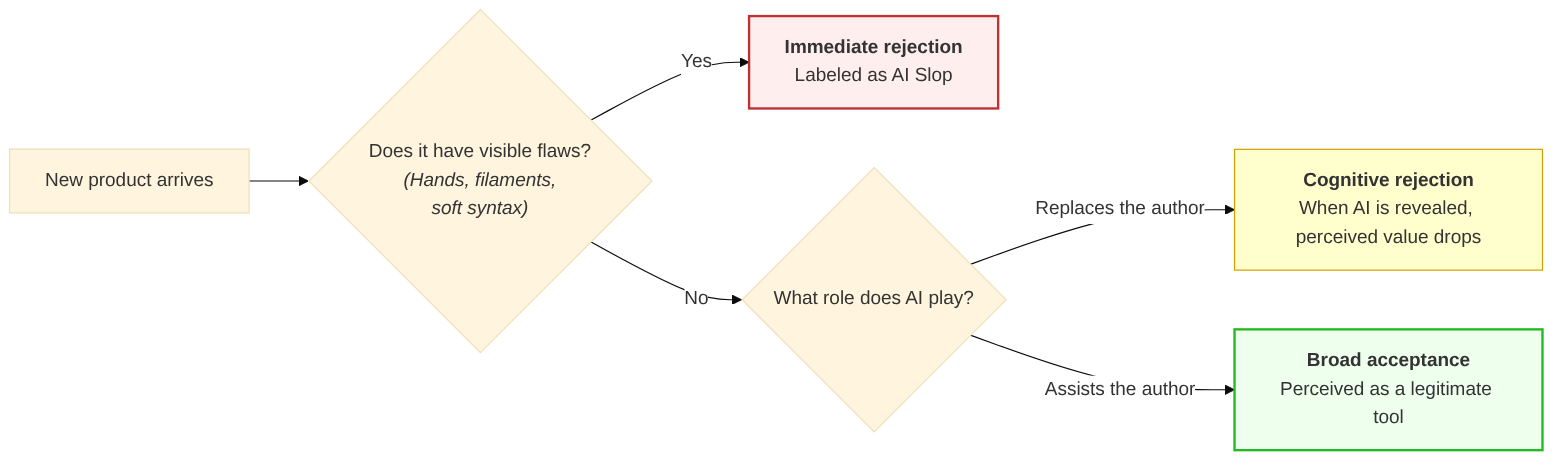
Decision tree and consumer heuristic when facing a product with AI. The diagram shows how the user’s brain first evaluates technical quality and then the role of the technology (replacement vs. assistance) before issuing a judgment.
How to spot slop when you’re consuming it
Given that the rejection is real and well-founded, it’s useful to have a handful of practical criteria for distinguishing human content (even when supported by AI) from content emptied of human judgment. They work for text, video, image, or music:
- Is there any irreplaceable anecdote? A story that could only have happened to the author, with date, place, and concrete details. AI has no biography; if everything the content shares is generic, interchangeable across authors, it’s usually a signal.
- Does it take a stance? Slop is notoriously neutral. If the text, song, or video doesn’t commit to anything, doesn’t criticize anything, doesn’t dare to say “this is worse” or “this is better,” probably nobody with judgment directed it, or policy didn’t allow it.
- Does it cite verifiable sources? When data appear, is there a link to a paper, a report, an auditable figure — or is it all “studies say” with no link? Slop tends to cite generic institutions without links.
- Do details appear that only someone in the field would know? A precise technical nuance, an inside reference, a piece of data only an expert would catch. That specificity is very expensive to fake.
- Are there edges? Unexpected phrases, strange comparisons, turns that aren’t the average. Slop sounds impeccable and forgettable. Human content has roughness that the statistical model tends to smooth out.
If several of these signals fail, what you have in front of you is probably content of low editorial cost — either generated en masse with AI, or accepted by a human without review. In both cases, the reasonable move is to distrust the data it claims and not return to the source.
This criterion works, by the way, for evaluating what you produce yourself before publishing it.
And this is where I turn the lens on my own work: what do you make of this article you’re reading, built almost entirely with the help of AI? Yes, the technology has been present in almost the whole process (see disclaimer in the index). Between my original idea and the word you’re reading right now, AI has intervened in a thousand ways; even so, the framing, the judgment, the structure, and the selection of information are strictly my own. It’s been a symbiotic effort — so much so that I’ve spent more time arguing with and rewriting alongside the model than I would have spent drafting it alone from a blank page. So let me throw the question back to you for reflection: do you consider this article to be slop?
What this tells you about how to use AI
If you’re a general reader, this article helps you do three things: spot slop, evaluate products with judgment, and above all, avoid falling on the wrong side when you produce something yourself.
If you produce content with AI, the survival rules are three:
- Keep human decisions at the center. You choose the “what.” You choose the “for whom.” You decide the “how it’s told.” AI handles parts of “how it’s written,” “how it’s illustrated,” or “how it’s composed,” but it isn’t the author.
- Review the details. The five categories of signals (image, voice, text, logic, technical quality) are where the audience will judge you. If you publish something without reviewing hands, dials, transitions, citations, and figures, you’re handing ammunition to the rejection.
- Be transparent when it matters. You don’t have to put “made with AI” on every piece, but you do on works where the audience is buying a human experience (a novel, an illustration, an essay, a song). The perception discount the study described exists, but the discount for being found out after the purchase is bigger.
What to take with you
People don’t reject AI. They reject being sold as human something that isn’t, and being offered an inferior product with AI as the excuse. When AI assists without replacing and keeps a human with judgment behind it, there’s no paradox: there’s a better, faster product made with a modern tool. When AI takes the author’s seat and nobody reviews the result, there’s a rejection with aesthetic, cognitive, and economic foundations.
Hold on to one idea: public rejection isn’t a fad or a passing mood. It’s a signal of what people value in others’ work, and by reflection, a signal of what people are going to value (and pay for) in your work. If you understand why it gets rejected, you know which way to move your own work.
What the public doesn’t forgive isn’t AI: it’s being shown a product where nobody bothered to review the hands.
Verified sources
- Bellaiche, Shahi, Turpin, Ragnhildstveit, Sprockett, Barr, Christensen & Seli (2023). Humans versus AI: whether and why we prefer human-created compared to AI-created artwork. Cognitive Research: Principles and Implications, 8, 42. DOI 10.1186/s41235-023-00499-6 · PubMed
- Wizards of the Coast — Ravnica Remastered controversy (January 2024) and policy update (May 2024). Aggregated coverage: PC Gamer · GeekWire · Decrypt — on the AI art ban in MTG
- Steam — AI content disclosure policy (Valve 2024, 2026 update). Coverage: VGC · PC Gamer · GeekWire
- YouTube — disclosure policy and “inauthentic content” (March 2024 / July 2025). Official blog · Support: disclosing altered or synthetic content
- ABBA Voyage — Industrial Light & Magic, live 10-musician band. Data on technology, budget ($175M), and attendance (4M+ visitors as of April 2026). Wikipedia · academic analysis in The Conversation
Opinion reading
- Hasbro CEO Confirms Company Has ‘Already Been Using AI’ — Game Rant.
- A Collector’s Dilemma: AI or Human Art? — Psychology Today, April 2024.
Back to the index: Series introduction · Next article: Why you lose with (and against) AI →
