
Why You Lose With (and Against) AI
What is getting cheaper, what is rising in value, and the Jevons paradox applied to knowledge work. Why mass layoffs and record salaries coexist.
Series: AI and You part 2 of 9
- Introduction
- 1“I don’t want anything made with AI” – The consumer paradox
- 2Why You Lose With (and Against) AI
- 3What You Have and AI Lacks
- 4The Free Agent Trap
- 5At Machine Speed: How AI Has Broken the Cybersecurity Balance
- 6AI Regulation: The Dilemma Between Protecting and Falling Behind
- 7How to Avoid Being Replaced Without Selling Out to AI
- 8Tricks for Using AI Well
- 9“If It Works, Don’t Touch It” and Other Excuses That No Longer Hold

The Game Changer
Independent reading article from the series “AI and You”.
There is a question that many professionals have been asking themselves lately: “Will my job be affected by AI?”. The short answer is yes, but it is deceptive because most people imagine it as a binary scenario (either you are replaced or you are not). The reality is far stranger and much less comfortable: you are not replaced by a system, you are replaced by a colleague who knows how to use the system. At the same time, what was valuable about your work three years ago is no longer valuable today, meaning it no longer makes sense to pay you for it, while new capabilities emerge for which no one paid anything before.
This article is about that shift. About how AI redraws the knowledge map of what is valuable in a profession, why certain profiles lose while others win at the same time within the same company, and what signals you need to look out for before the change catches up with you, leaving you with no time to react.
What Is Becoming Cheaper Is Not Your Job, But a Part of Your Job
It is worth clearing up a common misconception right from the start. Generative AI does not lower the cost of “the journalist’s job,” “the lawyer’s job,” or “the programmer’s job.” It lowers the cost of specific tasks within those jobs: the repetitive ones, those with a clear pattern, and those that produce an output that can be reviewed at a glance. Your entire job does not devalue overnight; certain pieces of it do, and that reshuffles the relative importance of what remains.
Let’s consider a journalist. Five years ago, transcribing interviews meant an hour of manual work for every hour recorded. Today, an AI does it in minutes with more than acceptable accuracy. This does not mean the journalist is obsolete. It means the hour saved on transcription becomes available for something else, and the relative importance of that “something else” skyrockets. If that something else is “verifying sources,” “finding the angle” (that is, choosing the unique perspective, thesis, or particular point of view from which you are going to tell a story), or “having the source that nobody else has,” the journalist capable of doing those three things becomes far more valuable. If what the journalist did besides transcribing was simply “drafting based on the transcription,” then yes, their entire role is at risk because AI can also handle a first draft.
This logic repeats across dozens of trades. The mechanical part decreases in cost. The judgment part increases in importance. Those whose roles consisted mostly of mechanical tasks lose. Those whose roles consisted mostly of professional judgment win. And those with a mix see their daily routine completely redrawn.
This is not an abstract or outdated economic theory. Demis Hassabis himself, CEO of Google DeepMind, addressed this directly, calling it a “lack of imagination” to think that if AI makes a developer 300% or 400% more efficient, the logical consequence for a company must be to cut three-quarters of its workforce.
Software and knowledge are not resources with a fixed consumption limit. What happens in the real market is that almost all organizations operate with an infinite backlog: an endless list of projects, optimizations, internal tools, refactoring, and security audits that never get built due to a lack of time or budget. By radically lowering the cost of executing mechanical production tasks, global demand does not fall; it multiplies to absorb and release all that historically accumulated value.
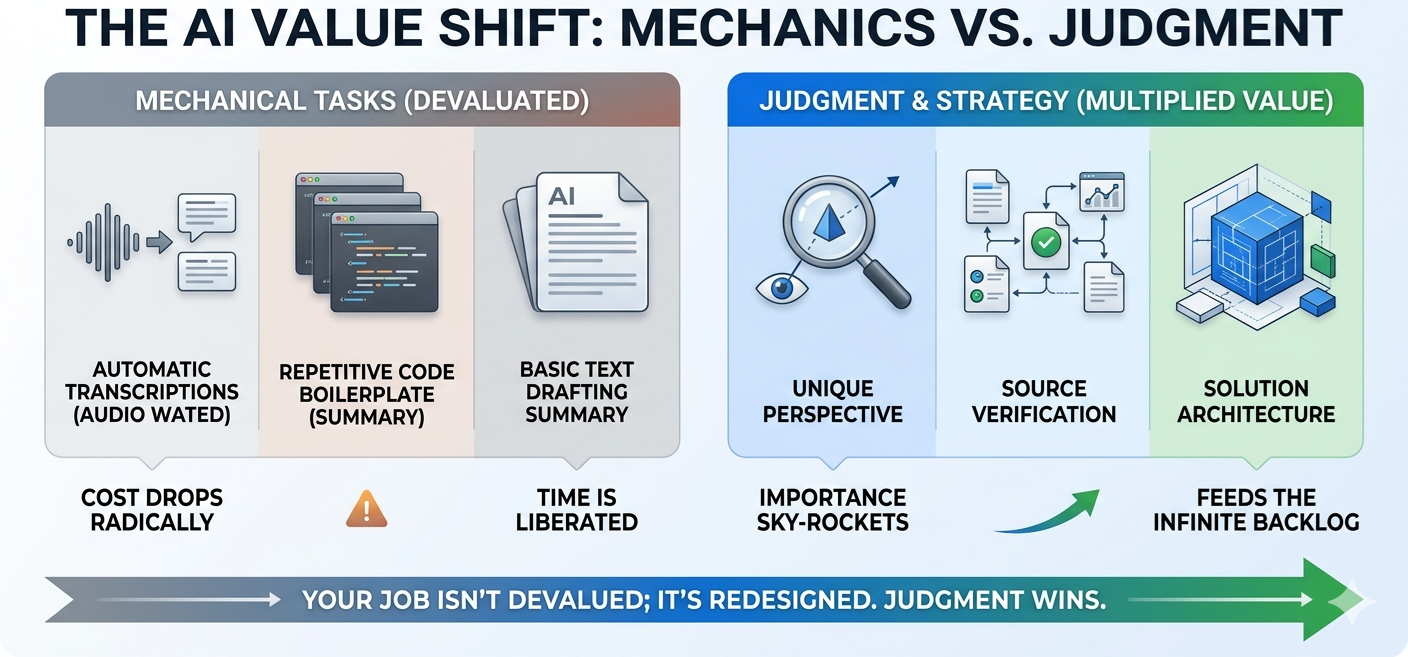
Role redesign under the AI shift: the radical automation of mechanical execution liberates time and skyrockets the value of human criteria to feed the infinite backlog.
The Jevons Paradox Applied to Knowledge
In 1865, an English economist named William Stanley Jevons published The Coal Question, where he put forward an observation that has entered economics textbooks under his name. When technology makes a resource more efficient to use, the total consumption of that resource usually increases rather than decreases. The steam engine made every hundredweight of coal yield more; the result was not that England used less coal, but that it used vastly more, because it was now worth burning it in places where it was previously unfeasible.
The paradox has been applied to electricity, computing, and now, AI. When producing written content, code, or illustration becomes cheaper, total demand does not drop: it explodes. Things that were previously unfeasible because they cost too much money or time now become viable. Your small business would never have paid for a custom internal dashboard because it was assumed that the value a developer produced elsewhere was worth more than the dashboard (assuming you had to choose between one or the other based on price vs. value added). Today, that dashboard is built in an afternoon with AI, and suddenly any company orders it.
The net result for professionals is not “less work.” It is redistributed work: less demand for the mechanical tasks that AI does well, and much more demand for the tasks that AI does poorly or cannot do at all. This is why massive layoffs in one part of a sector paradoxically coexist with record salaries in another part of the same sector. It is not contradictory: it is the Jevons paradox operating in real-time.
But this paradox does not only operate on the intangible plane of cognitive demand; its most critical impact is biophysical and material. As Luccioni, Strubell, and Crawford demonstrate in their analysis of rebound effects in technology, algorithmic efficiency does not reduce AI’s ecological impact; it multiplies it. By lowering the cost per token, adoption explodes. This explains why, even though 2026 models are infinitely more efficient than those from three years ago, global data center electricity demand will double by the end of this year, surpassing the national consumption of Canada. It also explains why giants like Google and Microsoft have seen their greenhouse gas emissions skyrocket (by 48% and 29.1% respectively) due to the insatiable infrastructure of generative AI. The hardware is more efficient, but we are burning a lot more digital coal.
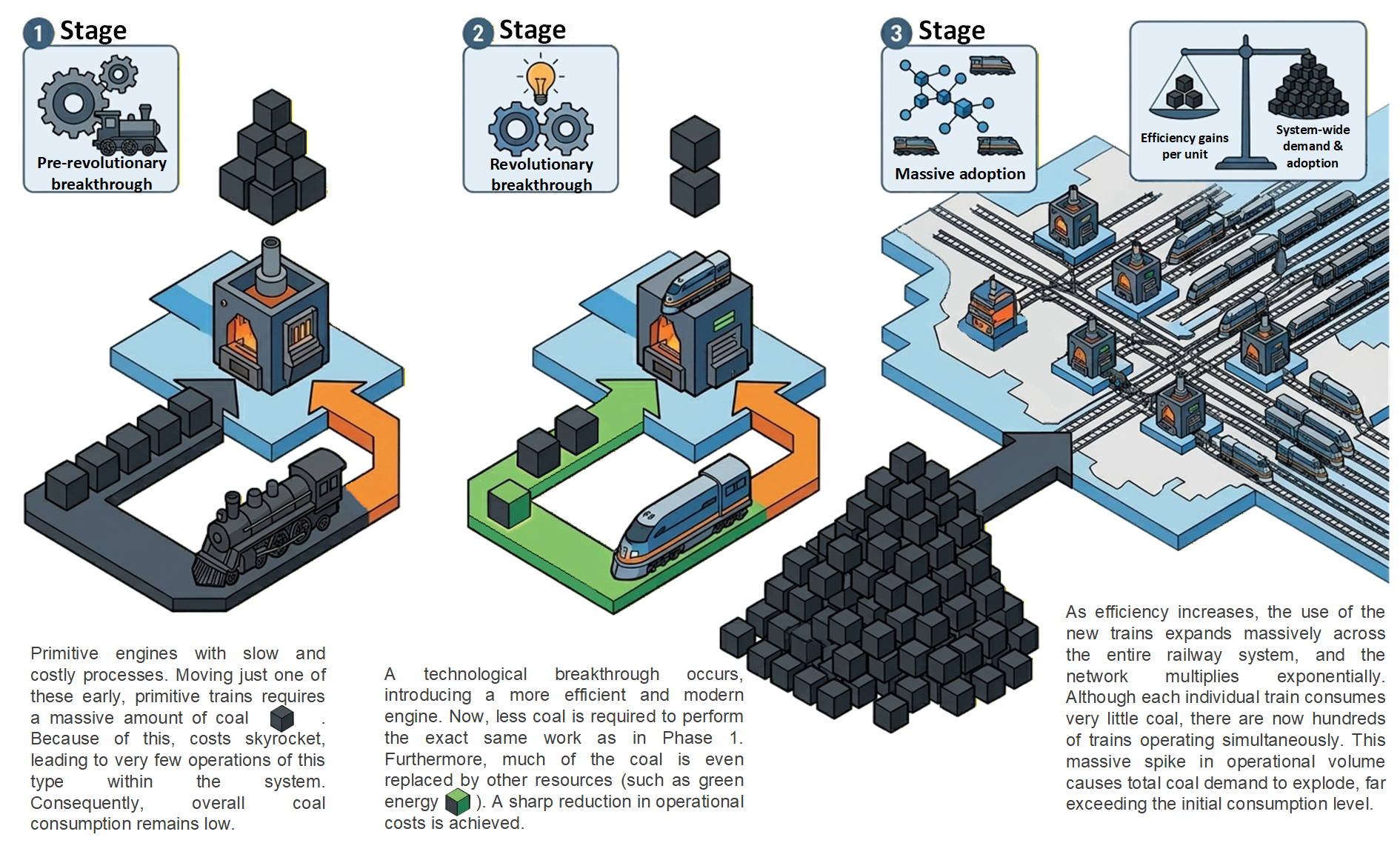
Representation of the Jevons paradox and its phases: Phase 1 (Pre-revolutionary breakthrough), Phase 2 (Revolutionary breakthrough with efficiency gains), and Phase 3 (Mass adoption)
The Democratization Cascade
We can view the Jevons paradox as an inverse pyramid of accessibility. Think of space travel: at first, it was economically out of reach for anyone. Later, it became the exclusive milestone of sovereign states, the only ones capable of financing rockets without looking for an immediate return on investment. Even later, aerospace corporations and billionaires entered the game, turning it into an extreme luxury. If costs continue to fall, tomorrow it will reach the middle class and, eventually, transform into ubiquitous transportation for everyone.
It always happens the same way with technology: volume explodes when the cost crosses the threshold of what each layer of the pyramid is willing to pay.
The only difference is that with generative AI, big tech companies have jumped to the same level as (or even ahead of) nation-states at the top of the pyramid, due to the massive deployment of infrastructure required. But the law of economic gravity remains the same: when the cost (per token for AI) falls below the viability threshold of the pyramid’s base, what was once an unfeasible project for a multinational becomes a daily task that any SMB automates in an afternoon. Efficiency does not save the resource; it opens the floodgates so that consumption cascades down across the entire market.
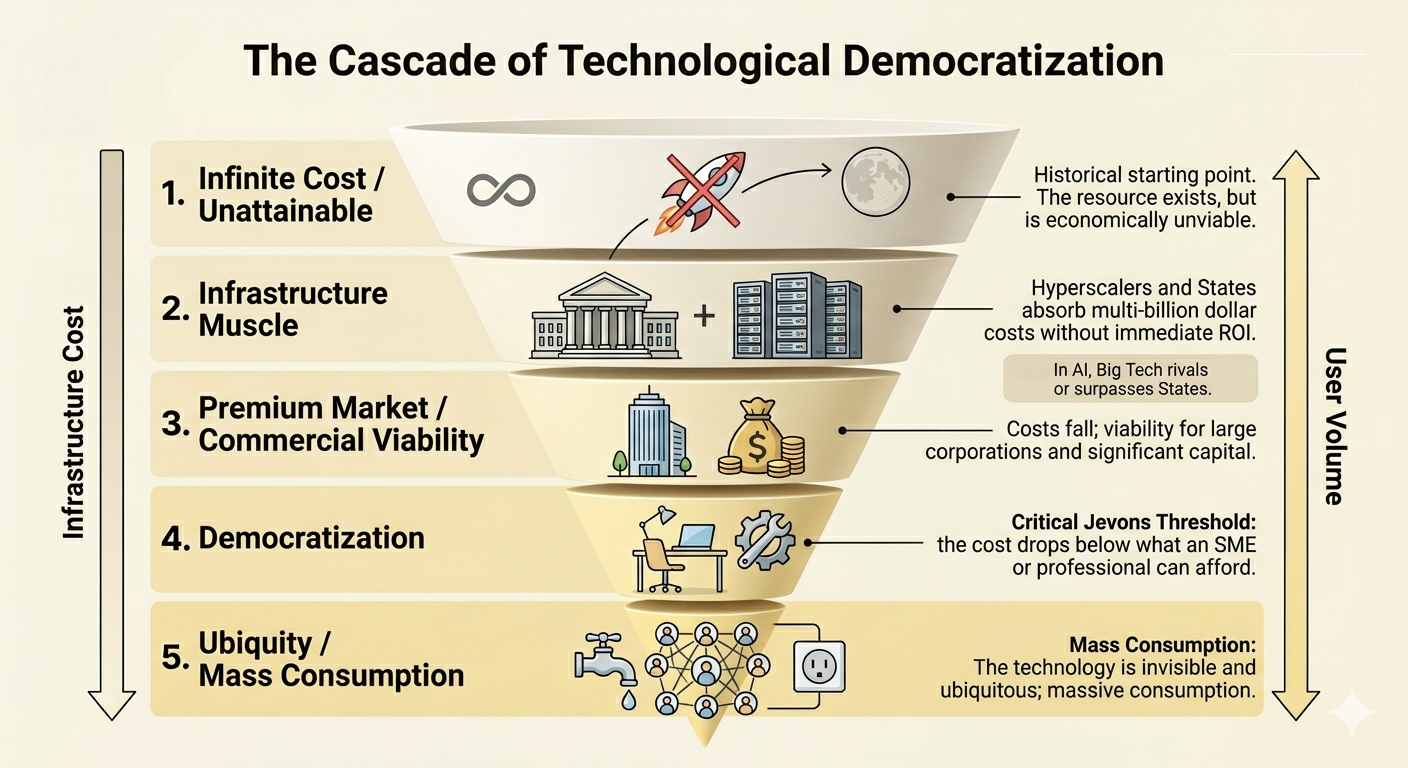
Evolution of the economic accessibility threshold in the technology maturity cycle: from infinite cost to mass-market ubiquity under the Jevons Paradox.
Which Tasks Are Devalued: Three Patterns
Without entering specific sectors, there are certain patterns that repeat across all professions:
-
Standardized output tasks: Anything where the expected result is reasonably uniform and a body of prior examples exists. Drafting a standard contract, generating meeting minutes summaries, translating technical text, or writing a first version of a quarterly report. AI does this well and fast, and a human reviews it in a fraction of the time it used to take to build it from scratch.
-
Data-to-text transformation tasks: Taking an Excel spreadsheet and describing it in prose; converting a recording into a summary; transforming an interview into a rough draft for an article. AI excels at these transformations because they follow clear patterns. The part about “interpreting what actually matters out of all those data points” remains human work; the part about “turning individual decisions into a smooth text” is delegated to AI.
-
Search and assembly tasks: Looking up references in literature, assembling a comparative dossier of different products, or mapping stakeholders in a sector. AI radically accelerates the search phase and the initial consolidation, and the human validates, discards hallucinations, and applies the final judgment.
Where Value Is Gained
In contrast to the above, certain profiles increase in value when AI is properly adopted:
-
Decisions under ambiguity: Any moment where you must choose between alternatives that are not clearly defined, carrying significant consequences and minimal information. This requires professional judgment, not processing. AI can list options, but it cannot bear the consequences of making a bad choice.
-
Lived-context knowledge: What you know because you were in the room, spoke to that person, or have known the project’s history for years. This knowledge isn’t on the internet or in any database, so it cannot train a model; therefore, AI cannot reproduce it since it doesn’t know it exists. Those who possess this knowledge become more valuable the more mechanical the surrounding tasks become.
-
Human relationships: The ability to convince a client, calm an angry boss, boost team morale, or read a room. For now, AI is incapable of doing any of this; however, AI frees up time to focus on it. Thus, the balance shifts: if previously 80% of your job was execution and 20% was relationship management, you can now reverse those percentages.
-
Novel synthesis: Connecting dots that no one has connected before. AI is good at connecting patterns that already exist within its corpus; it is poor at connecting things that haven’t been linked yet. Originality remains human, at least for now.
-
Accountability and sign-off: When something needs to be signed off (accountability), someone has to answer for it. AI does not sign its name. The person who signs still earns money for the sign-off, not just for the production.
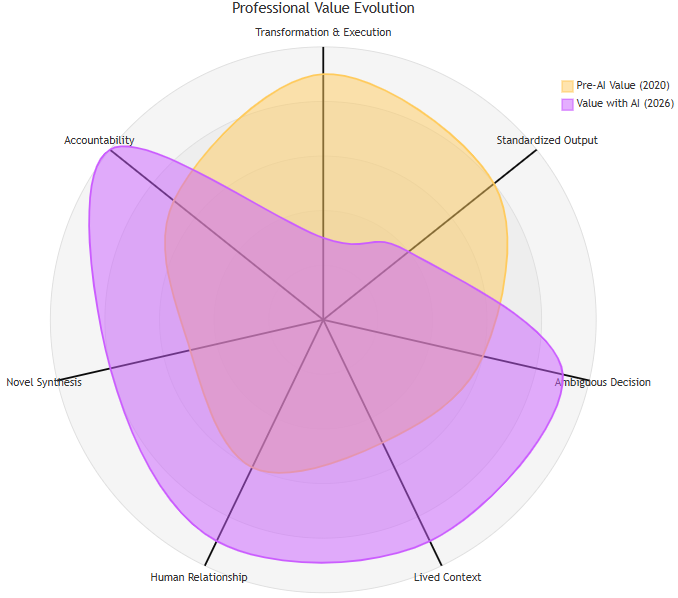
Graph: Shift in professional value (2020 vs. 2026). While some tasks drop due to automation, the market strongly rewards judgment in the face of ambiguity, lived context, and final accountability.
Why these values in the graph? The score assigned to each axis in this graph is not intended to be an exact mathematical metric, but rather a qualitative representation of the profound shift in labor market priorities. If we analyze the extremes of both curves, the message is clear:
- The collapse in transformation & execution (from 9 to 3) and standardized output (from 8 to 4): This reflects that tasks that once consumed most of our workday and justified our salary (translating, writing code, drafting reports) have ceased to be a differentiating factor. They remain necessary, but their production cost has plummeted because AI resolves them in seconds.
- The surge in ambiguity and context (from 5/6 to 9): This represents professional shielding. Making a critical decision when data is fuzzy or applying that informal knowledge only obtained by “having been in the room” has shifted from being a nice-to-have to becoming the hard core of our value.
- The absolute value of accountability (from 7 to 10): In a world saturated with AI-generated drafts and proposals, the most expensive and sought-after bottleneck in the process is the signature. AI can optimize the path, but the person who assumes the legal, reputational, and commercial risk of the outcome is the one who retains true bargaining power.
- Reinvesting time into human relationships (from 6 to 9) and synthesis (from 5 to 8): By delegating the heavy lifting of data and text to language models, professionals gain a time surplus. This time shifts heavily toward what truly scales a business: empathizing, leading, convincing, and connecting radically new ideas.
Why Market Data Confirms This
The Stanford AI Index 2026 published a very comprehensive report this year showing three things that align with the above:
- Employment of young workers (ages 22-25) in AI-exposed professions has fallen by 20% since 2024. This drop is specific to that age bracket; older workers in the same sectors have stayed flat or grown.
- One-third of organizations expect to reduce headcount in the coming year due to AI, with highest expectations in service operations, supply chain, and software engineering.
- AI adoption in at least one business function has risen to 88% within two years, and 70% of organizations are already using it across their business functions (in production).
The interpretation: companies are adopting AI very quickly, halting the hiring of profiles whose core function was the mechanical part of the work (junior devs, support, transcription, administrative assistance), but they do not stop needing more professionals with judgment. This is why vacancies are simultaneously growing for roles that orchestrate AI, govern its adoption, and validate its output.
Added to this is the weight of historical data against doomsday narratives. A rigorous analysis published in the Harvard Data Science Review by researchers Thomas Davenport and Miguel Paredes examined AI job loss predictions systematically issued since 2017. Their conclusion was clear: forecasts of a “labor apocalypse” have historically been inaccurate and exaggerated.
The reality in sectors with the highest rates of technological adoption does not show waves of mass layoffs caused by pure automation, sino an internal reallocation of roles. The actual impact of technology is not the destruction of the trade, but its comprehensive redesign toward supervisory tasks, workflow design, and quality control of the output generated by machines.
Data from the European and Spanish markets confirm this very same pattern of fracture and opportunity. According to a recent sector report analyzed by the Economics desk of Cadena COPE in May 2026, we are not experiencing a unemployment apocalypse, but rather a “profound reorganization.”
While pure technical profiles specializing in AI are already climbing to gross salaries between €55,000 and €65,000 annually, the true massive phenomenon is occurring in so-called “hybrid profiles”: workers in traditional positions who actively incorporate AI into their workflows and are achieving salary increases of up to 25%.
The consulting firm McKinsey pegs the number of work hours susceptible to automation in Spain at 60%. The takeaway is exactly what Hassabis sensed: the market is not destroying jobs due to a lack of budget; it is restructuring them strategically to shift capital toward those who provide supervisory judgment. Where three people executing mechanically were once needed, today companies seek a single individual who commands the tool and signs off on the result.
Typical Mistakes When Anticipating the Shift
This isn’t theory; I have experienced the following mistakes to a greater or lesser extent, and quite possibly you have too. That is why it is worth cataloging them:
- Mistake 1: “AI won’t affect me because my work is highly specialized”: It is usually true that highly specialized jobs are less affected in terms of “being replaced.” But all jobs have low-level tasks that AI does well (answering emails, writing first drafts, looking up references). If your day consists mostly of those tasks, your job is affected, no matter how sophisticated or “impossible for an AI to replicate” the core of the trade may be.
- Mistake 2: “AI won’t affect me because I don’t use it”: This is a variation of “I don’t see the problem, therefore it doesn’t exist.” Even if you do not use AI, your colleagues who do are redefining the expected standard of productivity in your profession. The day your boss discovers that a younger profile using AI completes in an afternoon what takes you three days, what will happen? At the very least, a problem you weren’t prepared for.
- Mistake 3: “AI affects me so much that I’m going to delegate everything to it”: The opposite error. Upon seeing the power of AI, some decide to become pure prompt operators and stop thinking for themselves. This strips away your differential value: if all you bring to the table is sending prompts and accepting the output, anyone with the same access to the tool can replace you. The value lies in what you add on top of what the AI produces, not in the AI production itself.
What to Do About This If You Are a Knowledge Professional
There are three defensive moves that seem sensible to consider, without falling into extremes:
- Learn to use AI well in your sector: Not just “knowing ChatGPT exists.” Knowing what it does well in your field, where it fails, where it hallucinates, where it gets it right, which prompts work, how to review what it spits out, which models suit each part best, and which AI tools verified by you actually improve your workflow. This isn’t learned in a weekend course; it is learned by using AI for many hours in your actual day-to-day work.
- Identify your mechanical tasks and start delegating them with judgment: Let AI handle transcriptions, first drafts, summaries, and self-writing emails. You save hours that you can invest precisely in upgrading the aforementioned skills and delivering value that makes you worth paying for.
- Identify and reinforce your non-mechanical side: The five capabilities listed above (under “Where Value Is Gained”: decision-making, lived context, relationships, synthesis, accountability). See which ones are your strengths, which ones you can develop further, and where you can lean on other people or teams.
What does not work is ignoring the change. Nor staying quiet hoping it will blow over.
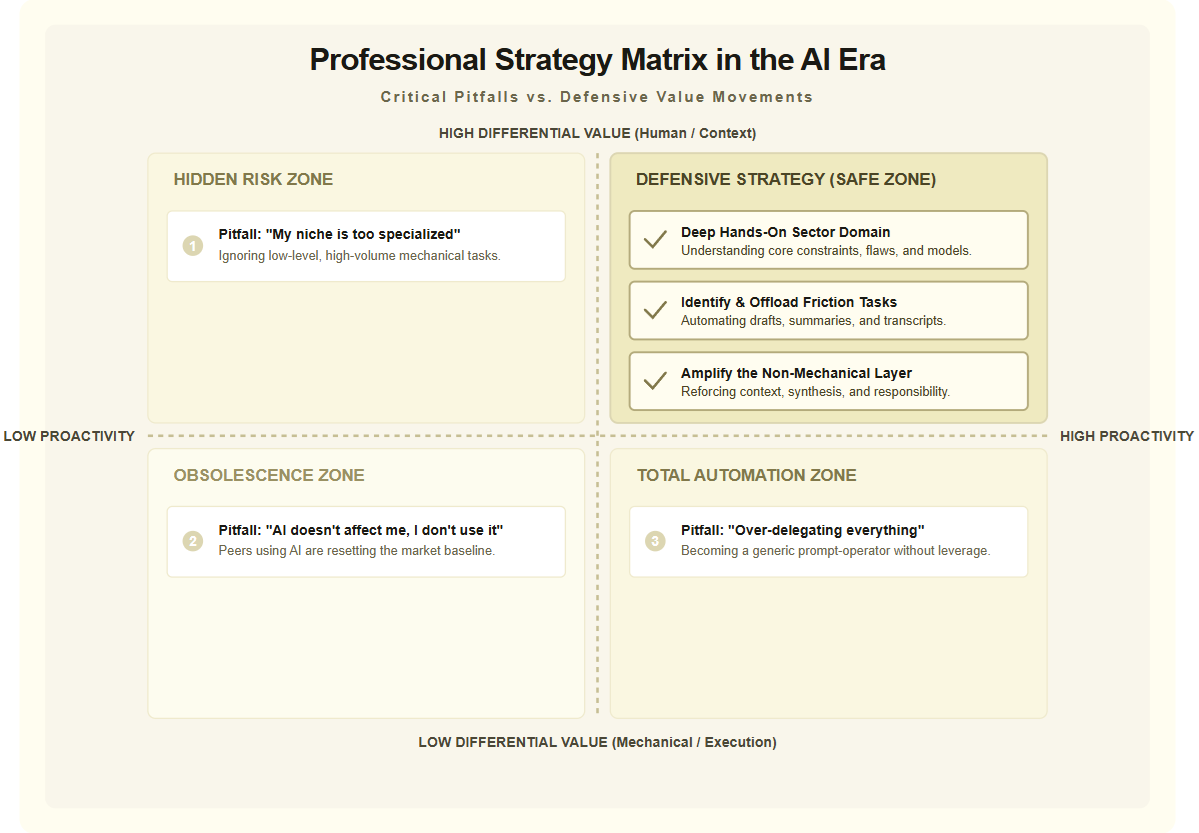
Professional strategy matrix in the AI era. A quadrant chart mapping task differential value against professional proactivity, positioning the three critical perceptual pitfalls against the defensive movements required to secure market relevance.
Key Takeaways
The shift AI is bringing is not best understood by asking “Will it replace me?”. It is better understood by asking “Which part of what I do will become so cheap that I won’t be paid for it, and which part of what I do will appreciate to the point where I am paid more for it?”. Both things happen simultaneously, in the same job, within the same year.
The Jevons paradox explains why we shouldn’t expect less work, but more: what becomes cheaper is consumed more, and thus a greater total volume of professionals who know how to direct the tool properly is required. But the internal composition of work changes for everyone, without warning (which is no surprise either; it has been happening at least since the computer was invented). To avoid falling behind, you don’t need to become an AI evangelist; you need to understand which side of the scale you are on and redistribute your day-to-day work accordingly.
It’s not about competing with AI. It’s about not getting stuck doing exactly what it does, and starting to do exactly what it cannot.
Verified Sources
- Stanford AI Index 2026 — Stanford HAI. Dev/professional employment ages 22-25, headcount reduction expectations, organizational adoption at 88%. Full PDF Report · Economy Chapter · IEEE Spectrum Coverage
- Reuters Institute — Generative AI and News Report 2025 (Felix Simon, Rasmus Kleis Nielsen, Richard Fletcher). Data on AI usage in journalism and public comfort with AI-only news (12%) vs. human-led news (62%). Official PDF · Summary
- Jevons, W. S. (1865). The Coal Question. Original source of the paradox, available in the public domain. Arxiv Archive Wikipedia
- Hassabis, D. / WIRED (May 2026). Exclusive interview with the CEO of Google DeepMind ahead of Google I/O. Primary source outlining the “infinite backlog” thesis and calling it a lack of imagination to base corporate strategy on downsizing engineering teams. Wired Article
- Davenport, T. & Paredes, M. (2025). Can We Predict What Jobs AI Will Take? Harvard Data Science Review. Academic primary source analyzing the historical inaccuracy of AI unemployment predictions and criticizing the simplistic “task-based automation” approach. Available at: Harvard Data Science Review
- Luccioni, A. S., Strubell, E., & Crawford, K. (2025). From Efficiency Gains to Rebound Effects: The Problem of Jevons’ Paradox in AI’s Polarized Environmental Debate. A fundamental interdisciplinary analysis demonstrating how rebound effects and market dynamics negate technical optimization benefits in AI, transforming efficiency into increased resource consumption. Arxiv
- Cadena COPE — AI Labor and Salary Impact Analysis (May 2026). Salary bracket data in Spain (€55k-€65k), the 25% bonus for traditional hybrid profiles, and work hours automation projections by McKinsey Spain (60%). Link
Further Reading (Opinion & Analysis)
- Laid Off or Millionaires: The New Invisible Fracture Among Developers — Enrique Dans, May 2026. Link
- Reports of an AI Job Apocalypse Have Been Greatly Exaggerated — Joe McKendrick, Forbes (December 2025). Informative analysis on the gap between sensationalist headlines of job replacement and real reallocation data from the Harvard Data Science Review study. Link
“Why You Lose With (and Against) AI” by Ramón Invarato at jarroba.com, licensed under Creative Commons Attribution-NonCommercial-ShareAlike 3.0. Registered at Safe Creative.

You may also like

The Real Cost of AI: From the Democratic Promise to the Enterprise Model
Copilot moves to token billing, JetBrains cuts quotas, Claude raises costs with new tokenizer. Analysis of the economic divide AI is opening in 2026.

AI in Business: Expectations vs. Reality — Who Benefits, and at What Cost?
Article series on what each stakeholder gains and loses from enterprise AI: CEO, developers, managers, and users. Informed opinion, no hype.
Leave a comment