
AI and You: the Complete Series for Getting an Edge Without Losing Yourself
How to use AI well in your work and your life without turning into an evangelist or a denier. A complete ten-article series, no hype.
Series: AI and You Introduction · 9 parts
- Introduction
- 1“I don’t want anything made with AI” – The consumer paradox
- 2Why You Lose With (and Against) AI
- 3What You Have and AI Lacks
- 4The Free Agent Trap
- 5At Machine Speed: How AI Has Broken the Cybersecurity Balance
- 6AI Regulation: The Dilemma Between Protecting and Falling Behind
- 7How to Avoid Being Replaced Without Selling Out to AI
- 8Tricks for Using AI Well
- 9“If It Works, Don’t Touch It” and Other Excuses That No Longer Hold

Reading Map, Sources, and Method of the Series
Master index for the series “AI and You”, written for anyone, and especially for any working professional in any field.
Generative AI has become one of those topics that everyone has an opinion on but no one quite settles. Some people use it for everything, others reject it entirely. Some fear losing their job, others have integrated it so naturally that they no longer know how to work without it. And above all, there’s a vast amount of dispersed, noisy, and sometimes outright false information that doesn’t help anyone decide anything.
This series is not a manifesto, nor a manual of magical prompts. It’s a walk through the questions that genuinely matter when someone wants to use AI in their work (any kind of work) and in their life without becoming either an evangelist or a denialist: what it does well, what it does badly, where the seams show, how to avoid letting it diminish you, what it lacks, what shortcomings of yours it amplifies, and what kind of work will still hold value when everyone has access to the same tool.
It’s designed so each article can be read on its own. If you land here from Google searching “why are they telling me AI will replace me,” you can jump straight to the article that addresses that question, without being forced to read the other eight. But if you have time, there’s a suggested order and cross-links so the reading gets richer.
Suggested reading order
The articles have no strict dependencies. The suggested order moves from the problem (why does AI repel so many people?) to the phenomenon (what is actually changing?), to the limitations (what can’t it do?), to personal strategy (what do I do with this?), to practice (how do I use it well without atrophying?), and finally to the concrete cases (how does it land in my profession, and in physical trades?).
The series in ten articles
1 — “I don’t want anything made with AI” – The consumer paradox
There’s a curious pattern: people vehemently reject products made “with AI” when it shows, but they accept without question other products where the AI is invisible. This article explores the paradox with concrete cases: the controversy over AI-generated art, robotic music that sings without a soul, the slop videos flooding social media, the rejection in the board games community, and where the line lies between “using AI” and “delegating everything to AI.” If you understand that line, you understand why almost all the other articles matter.
2 — Why you lose with (and against) AI
What’s getting cheaper isn’t manual labor, it’s repetitive intellectual labor. And that means many things that made you valuable six months ago now go unnoticed. But it also means that other things you took for granted (your judgment, your memory, your ability to spot what’s odd) are becoming exactly the scarce asset. This article helps you understand what could happen to you before it does.
3 — What you have and AI doesn’t
Today’s AI has no biography, doesn’t get bored, doesn’t remember what grandma’s kitchen smelled like, and has never felt the panic of a Friday at three in the afternoon with a downed system. That isn’t romanticism: those are structural shortcomings that translate into specific things a human still does better. The article walks through the five most relevant ones and explains when and how they translate into real economic value.
4 — The free agent trap
The promise of “autonomous agents” is seductive: you let AI handle a multi-step task and come back when it’s done. What the real studies say is that the promise isn’t being kept yet. This article describes what fails, why it fails, and when it is (and isn’t) worth trusting an agent without supervision.
5 — At machine speed: AI has broken the cybersecurity balance
Average breakout time: 29 minutes. Fastest recorded in 2025: 27 seconds. Attackers now use AI to move faster than any human team can respond. And they are also directly attacking corporate AI agents through prompt injection. This article explains what has changed, what the data says (IBM, CrowdStrike, Verizon), and what it means for someone who isn’t a security specialist but works with systems that AI can compromise.
6 — AI regulation: the dilemma between protecting and not falling behind
The EU AI Act is already in force with its risk classification. The US revoked Biden’s Executive Order on the first day of the Trump administration. China regulates through state control. No model is working perfectly. This article analyzes the options, their real consequences, the tensions between protection and competitiveness, and what it means for those working with AI in Europe.
7 — How to avoid being replaced without selling yourself to AI
Two common extremes are both bad: the one who clings to their way of working from five years ago and boycotts any new tool, and the one who adopts whatever AI is put in front of them and stops thinking on their own. Here we analyze both profiles, their consequences, and why the useful place is in the middle: learning to use it well without losing your cognitive muscle.
8 — Tricks for using AI well
The practical toolkit: how to give AI the right context, how to refine what it produces, how to use a second AI to critique the first, how to apply your own “linter” before publishing anything, and when it’s a good idea to stop. These aren’t viral prompt-engineering tricks: they’re work patterns that hold up whether you use Claude, Gemini, ChatGPT, or whatever comes out next year.
9 — “If it works, don’t touch it” and other lines that no longer hold
Corporate excuse phrases — “don’t reinvent the wheel”, “if it works don’t touch it”, “we’ve always done it this way”, “now isn’t the right time” — and why the arrival of AI has made those excuses indefensible: the cost of improving has dropped while the cost of stagnating has risen. Includes the Shadow AI paradox: employees use unauthorized AI tools because the company bans the tool yet demands the speed only it delivers. Strategies for those working inside an inertia-prone organization.
< … more are coming …>
About the writing method of this series
This series talks about how to use AI well and, honestly, it’s written using AI. I, Ramón, contribute the questions to be answered, the direction, the bibliography curation, the dictation of the articles, and the final review before publishing; AI helps with drafts, prose, and structure suggestions. It’s the same pattern I defend in these articles: each does what each does best.
I’m a single person trying to offer you a complete and professional piece of work with the tools I have at home, because I do this in my spare time, for free, for the love of the craft. Even though I use AI, I spend as many hours on each article as I would without it (sometimes more), because I’m passionate about what’s new, about research, about technology, and about sharing what I know and have experienced.
Any long series can have occasional errors, badly copied citations, or paragraphs that slip through unreviewed. If you find one, I’ll be grateful for the correction.
Conventions and honesty about the data
Throughout the series you’ll see two types of sources clearly separated at the end of each article:
- Verified sources: scientific papers with DOI or arXiv, official documentation, data checked against the primary source. Every concrete figure cited comes from here.
- Opinion reading: opinion columns, blogs, LinkedIn infographics. They add perspective but aren’t evidence.
When a diagram has made-up values to illustrate the shape of a curve, I say so right under the chart. When I use an extreme case, it’s preceded by a warning. If you find a piece of data that doesn’t match its source, I’ll be grateful for the correction.
What this series is not
It’s not a prediction about when “AI will do X.” The industry moves so fast that any concrete prediction ages in six months. What I try to offer here are frameworks of thought that age slightly better: the questions worth asking, the real trade-offs, the recurring traps.
It’s also not a series about the next trendy model or tool. Specific tools are cited when they help; the focus is on how you relate to AI, not which one to use this week.
Disclaimer
Articles in this series often use extreme cases and comparative scenarios to make the consequences of a decision visible. They are a didactic tool, not a recipe.
What extreme cases mean in this text:
- Two or more possible extremes (utopia / dystopia, total rejection / total submission, etc.) are presented so the reader understands the range. The middle ground can be inferred and is usually where reality ends up.
- Radar diagrams, comparison tables, and trend charts are built to make the shape of a curve or trade-off visible, not to report empirical measurements. When numerical values are invented, this is explicitly noted below the chart.
- Figures from real studies are cited with their verified source in the “Verified sources” section. Figures from blogs, opinions, or anecdotes are cited separately in “Opinion pieces.”
What the extreme cases in this series are NOT:
- They are not operational recommendations. Applying an extreme case to your work without adapting it to your context is your responsibility.
- They are not predictions. The AI industry changes so fast that any specific prediction ages poorly; the extremes are useful for reasoning about directions, not dates.
- They are not moral judgments about those who hold specific positions. If an extreme case describes “a worker who completely rejects AI,” it is to understand that decision vector, not to point the finger at anyone.
Responsibility: the author publishes this series content out of educational interest and without compensation. The decision to apply (or not apply) any idea from these articles to a job, a company, or a career rests solely with the reader. The author assumes no responsibility for the outcomes of that decision.
Accuracy and review: the numerical data cited has been verified against its original source. If you find an incorrect or outdated figure, I appreciate you letting me know so I can correct it.
“AI and You: the Complete Series for Getting an Edge Without Losing Yourself” by Ramón Invarato at jarroba.com, licensed under Creative Commons Attribution-NonCommercial-ShareAlike 3.0. Registered at Safe Creative.

You may also like

AI in Business: Expectations vs. Reality — Who Benefits, and at What Cost?
Article series on what each stakeholder gains and loses from enterprise AI: CEO, developers, managers, and users. Informed opinion, no hype.

How to Adopt AI in Your Organization Without Making the Most Common Mistakes
Failure and success patterns in AI adoption, a practical decision framework, safe use cases, and minimum viable governance for development teams.
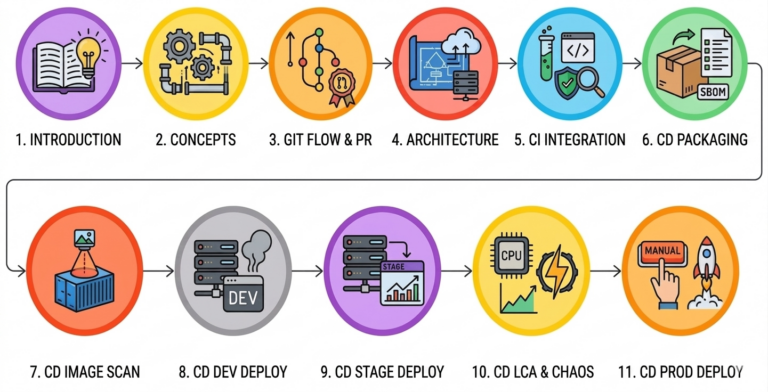
CI/CD and AI: From Theory to Practice — Series Index
Guía de navegación para la serie completa sobre CI/CD moderno con Inteligencia Artificial. Descubre qué artículos te interesan y en qué orden leerlos.

What AI Can and Cannot Do Today in Software Development
what AI actually does well in software development, what it can't do yet, and why. The 5 integration levels and the junior developer paradox.
Leave a comment