“If It Works, Don’t Touch It” and Other Excuses That No Longer Hold
Corporate inertia in the face of AI, and what you can do if you’re stuck in it

Standalone article from the series “AI and You”.
There is a handful of phrases that repeat across almost every company, regardless of industry, that almost always mean the opposite of what they say: “Don’t reinvent the wheel,” “If it works, don’t touch it,” “We’ve always done it this way,” “Now is not the right time.” They sound like prudence, experience, and a cool head. And most of the time, they are just a polished wrapper for something else: nobody wants to take on the risk, cost, or effort of changing something that has been working halfway for years.
This article is not about any specific technology. It is about organizational inertia: the force that makes companies resist change even when change is obviously beneficial. And it is about how the arrival of AI has made those excuse-phrases harder to defend, to the point where some companies have fallen into a curious contradiction: they demand the results of someone who uses AI, without providing an official way to use it properly. If you work somewhere like that — and the numbers suggest you probably do — the final section of this article is for you.
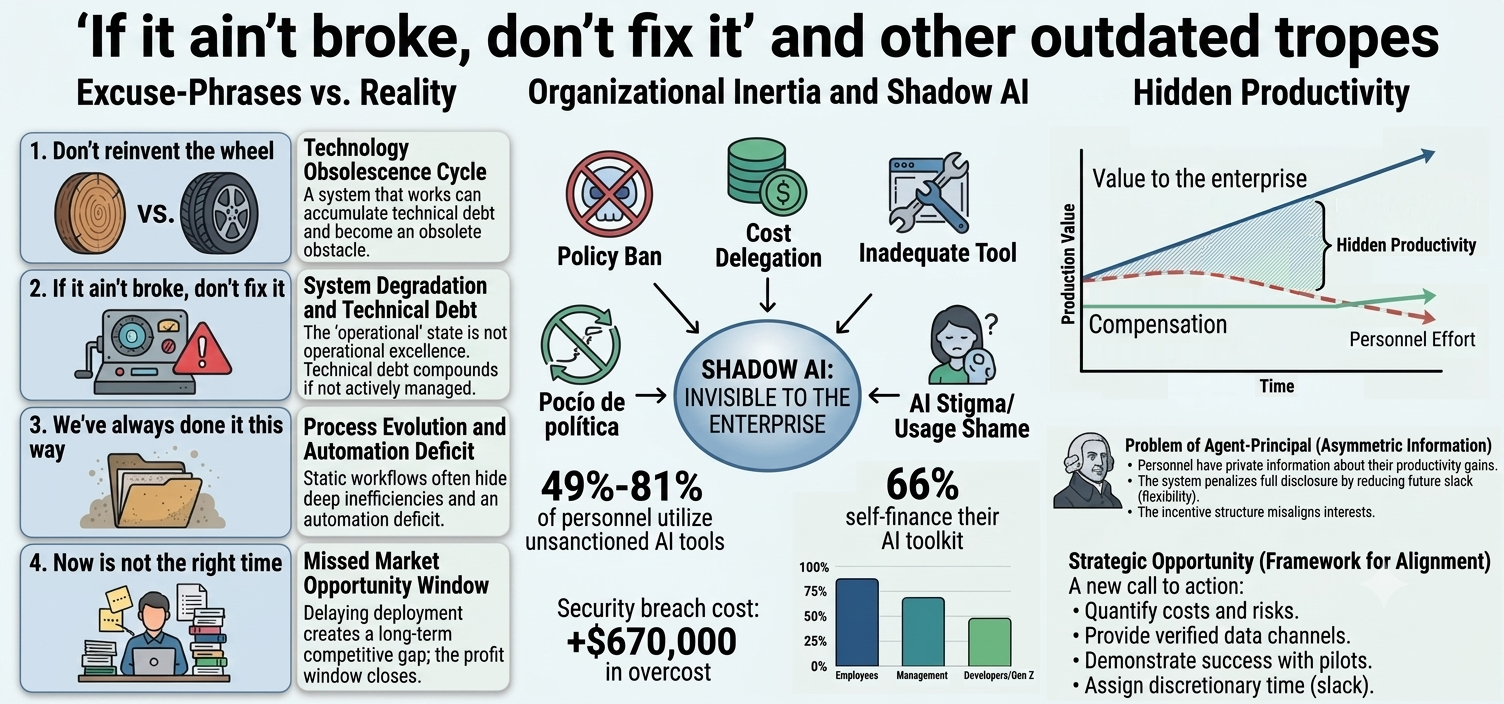
The excuse-phrases and what they conceal
It is worth dismantling them one by one, because each contains a grain of truth that makes it dangerous.
“Don’t reinvent the wheel.” The grain of truth: rebuilding from scratch something that already exists and works is usually a waste of time. The problem: the phrase is used to justify sticking with the wooden wheel from ten years ago while the rest of the world rides on pneumatic tires. There is an enormous difference between reinventing (rebuilding what already exists) and updating (using what exists in its modern form). The two are deliberately confused to avoid updating anything.
“If it works, don’t touch it.” The grain of truth: don’t break what puts food on the table without good reason. The problem: it turns every system into an untouchable black box that degrades in silence. And “works” usually means “hasn’t exploded yet.” In software, what is not updated doesn’t stay the same — it becomes insecure, because the rest of the world (attackers included) keeps moving.
“We’ve always done it this way.” The grain of truth: long-running processes can encapsulate lessons that are not obvious. The problem: they also encapsulate fossilized mistakes that nobody remembers the reason for anymore. “We’ve always done it this way” is, in most cases, a signature that nobody has reviewed that process since the person who set it up left.
“Now is not the right time” / “There’s no time.” The most honest-sounding and the most treacherous in practice. There is almost never a good moment to invest in improving something that already “works.” Improvement always competes against the urgent, and the urgent always wins — until the lack of improvement becomes the emergency.
The pattern the four share: all of them prioritize avoiding the visible risk of changing over the invisible risk of not changing. And the invisible risk is almost always greater, precisely because it stays hidden until it explodes.
Why these excuses existed (and why the calculus has changed)
Let’s start fairly: these phrases did not come from nowhere. For decades, change carried a very high cost. Updating a system meant weeks of manual work, a real risk of breaking things, and learning new tools without a safety net. In that world, “if it works, don’t touch it” was sometimes a rational decision: the expected cost of touching exceeded the expected benefit.
What has changed is not that change has become free, but that the cost of changing has fallen much faster than the cost of not changing. Two forces explain this:
- On one side, modern tools — AI among them — have made previously expensive tasks far cheaper: understanding code or processes that nobody documented, generating the test coverage needed to safely change something, translating the old into the new. What took weeks now takes days or hours.
- On the other, the cost of not changing has risen: technology cycles have accelerated, security breaches are more expensive, and good talent does not want to work with obsolete tools — people leave and take their knowledge with them.
When the two curves cross, excuses that were debatable before become indefensible. Not because change is easy, but because not changing has stopped being the safe option.
An important caveat, to avoid falling into the opposite extreme: this does not mean “change everything constantly.” The enthusiast who rebuilds their system every six months chasing the latest trend does as much damage as the immobilist. The point is not to change for change’s sake; it is that the balance has shifted, and many decisions that were previously settled with “better not touch it” now deserve, at minimum, to be reconsidered.
Corporate schizophrenia: five routes to the same blind spot
The term Shadow AI — the use of AI tools without formal approval — typically evokes a single image: the company that explicitly bans it while employees use it on the sly. That image is real and well-documented. But the data reveals at least four additional situations that produce exactly the same result: employees using AI outside official channels, without any organizational visibility.
-
Explicit prohibition: the company says “no” and the employee does it anyway. 49% of employees admit to using unapproved AI tools (CIO, 2025); other surveys put that figure as high as 81% (UpGuard — State of Shadow AI, 2025). Gartner reports that 69% of organizations suspect or have evidence of prohibited AI use and predicts that by 2030 more than 40% will have suffered a security or compliance incident linked to Shadow AI. Executives are among the most frequent offenders, prioritizing speed over the very policies they signed.
-
Cost delegated to the employee: the company permits AI but does not fund it. A Gusto survey of 1,000 American workers (2025) found that 66% of those who use AI at work pay for it out of their own pocket. This is not Shadow AI through disobedience: it is Shadow AI through neglect. The company offloads the expense — and the decision of which tool to use — to the person with the least bargaining power. By delegating the cost, the company also loses control over which tool the employee chooses: nothing stops them from picking the cheapest option on the market. And the market has very different tiers when it comes to data handling — from local AI where nothing leaves the device, through European providers with GDPR guarantees or US allies, to models that compete aggressively on price but process data on servers under jurisdictions that do not offer the same privacy agreements.
-
The official tool that doesn’t work: the company provides something, but it is a basic, stripped-down, or outdated version for real work. 88% of HR leaders declared that their organization had not obtained significant business value from the AI tools it deployed. The employee looks for an alternative not to break the rules, but because the official tool doesn’t do the job.
-
Policy vacuum: there is neither permission nor prohibition. 25% of organizations have no AI policy at all (ISACA AI Pulse Poll, 2026), and 41% of workers say their employer has done absolutely nothing to prepare them (Resume Now, May 2026). Employees go their own way not out of defiance, but because nobody has told them anything.
-
AI shame: the most counterintuitive situation. The employee may use AI — the company does not ban it — and hides it anyway. According to a WalkMe survey of more than 1,000 workers (2025), 48.8% admit to concealing their AI use to avoid being judged (Fortune, August 2025). C-suite executives (CEOs, CTOs, etc.) do this more than anyone: 53.4% hide their AI habits despite being the most frequent users.
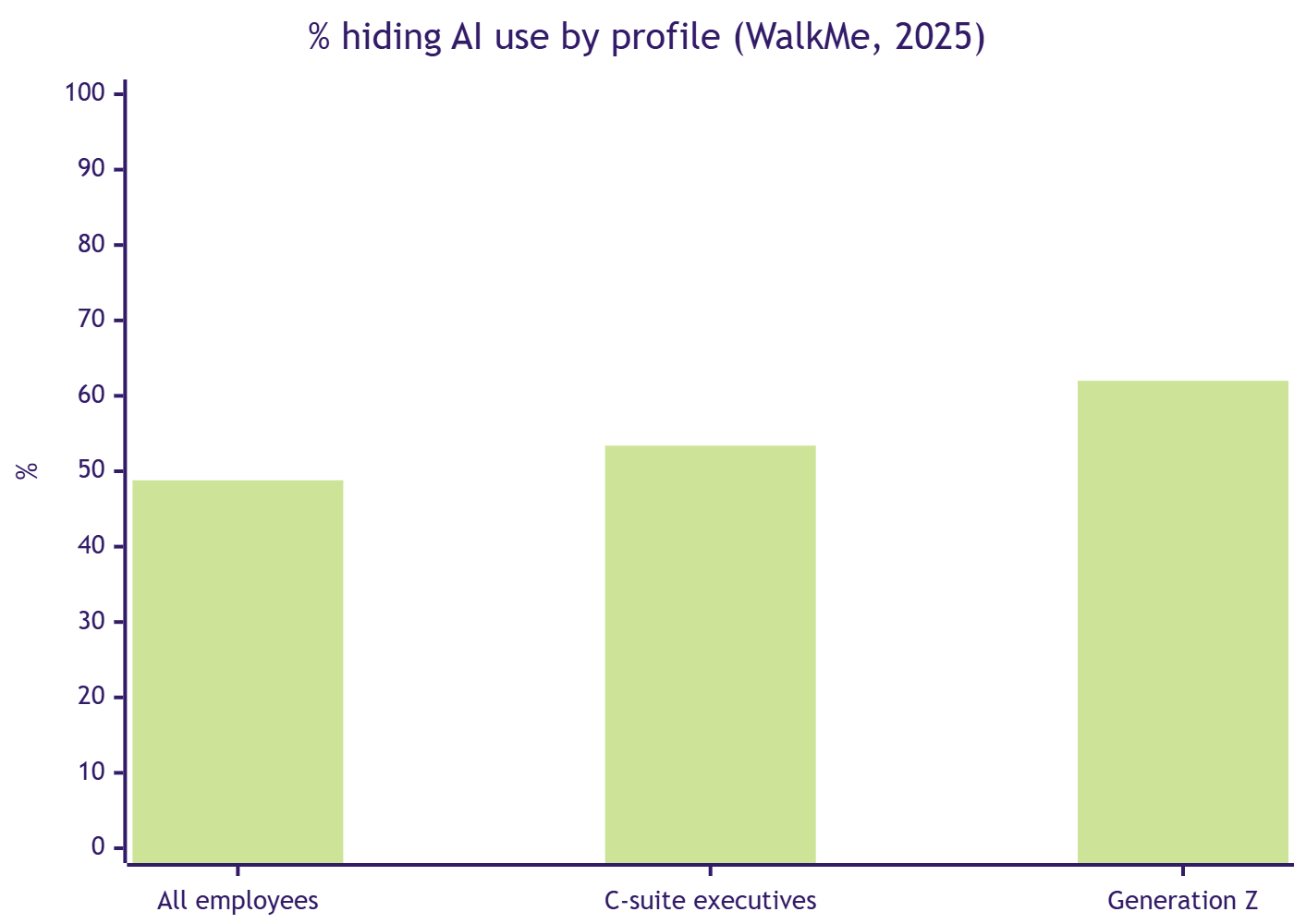
WalkMe and Fortune survey cited above. Concealment scales with hierarchy and generation.
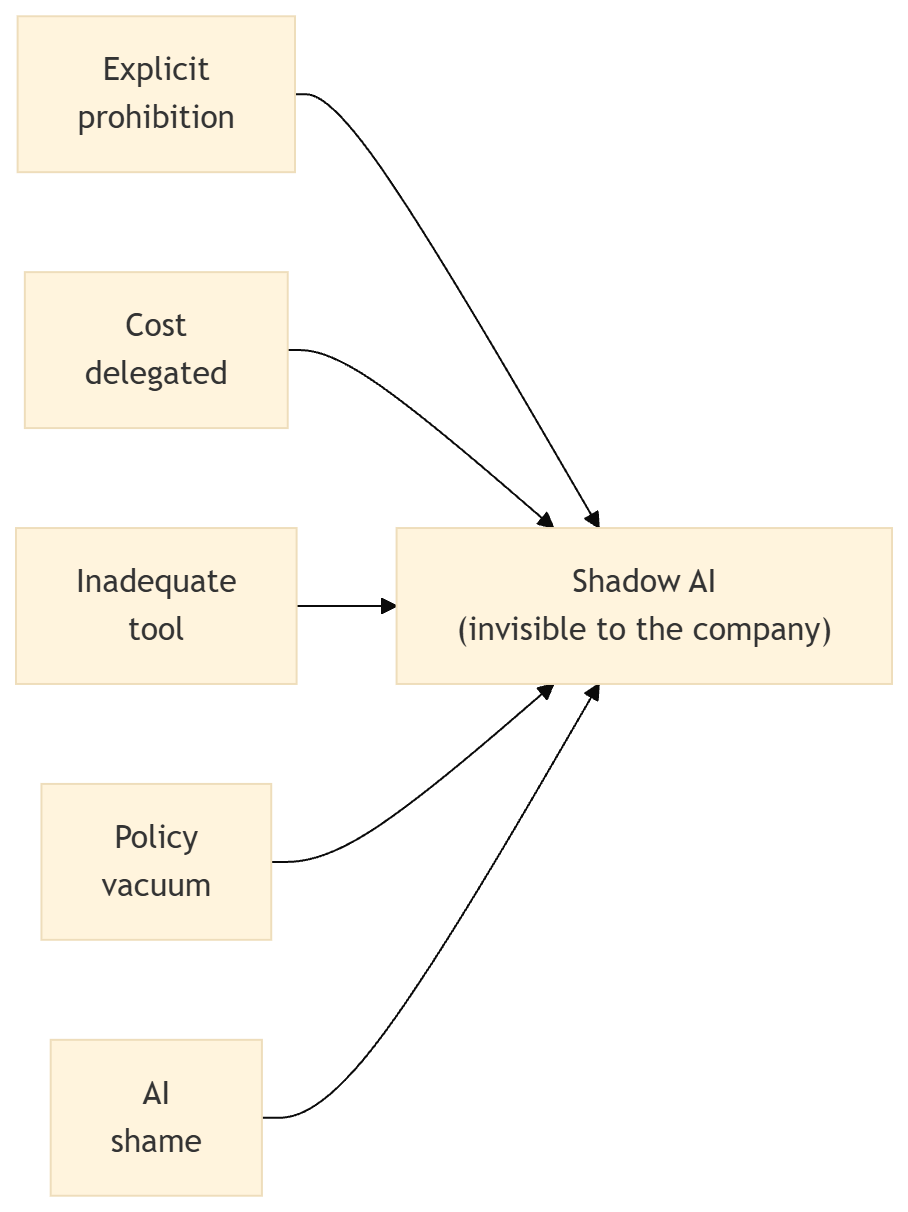
Five distinct situations that lead to the same result: AI use outside official channels, without organizational visibility.
The pattern shared by all five cases is the same: the company cannot see what is happening and cannot manage either the risk or the benefit. The most documented variant — and the costliest when it goes wrong — remains the explicit prohibition, with real data flowing through uncontrolled services.
Many companies have simultaneously adopted two incompatible stances: they officially ban AI (for data protection, fear, or caution) while at the same time demanding the delivery speed of someone who uses it. The employee lands in a trap: comply with the rule and miss the deadlines; meet the deadlines and break the rule. The problem with the hypocritical ban is not just the incoherence. It is that it worsens exactly the risk it claims to protect against: when you ban AI but demand AI-level results, people do not stop using it — they use it in secret, with free tools, pasting real company data into uncontrolled services. According to IBM’s 2025 report, organizations with high Shadow AI usage pay on average $670,000 more per breach than those with low or no usage. The “banned” policy does not eliminate use; it only eliminates visibility into use. Which is worse. This is just a summary — a dedicated article covers success and failure patterns along with a practical decision framework for AI adoption in companies (article in Spanish).
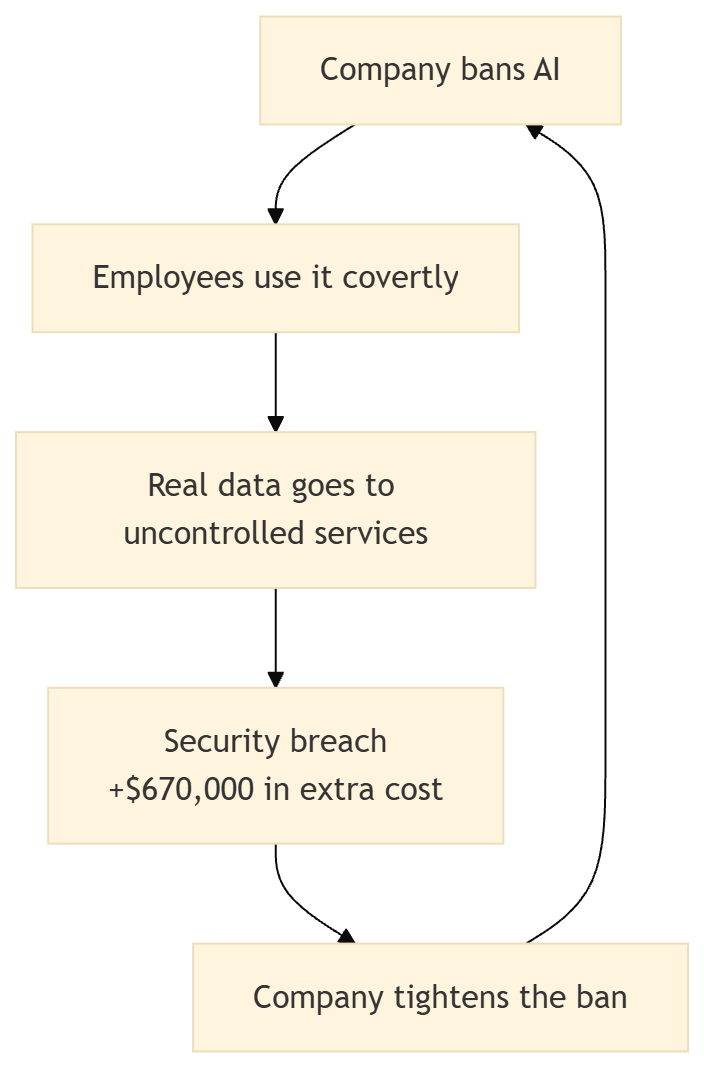
The prohibition policy without an alternative does not eliminate the risk: it conceals and worsens it.
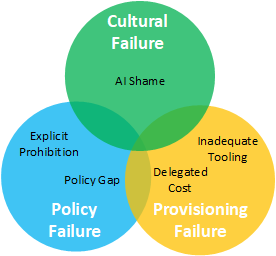
The five variants of Shadow AI group into three root causes. When an organization fails on all three at once, Shadow AI becomes systemic.
The misalignment shown in these five scenarios has a measured cost: the EY Work Reimagined Survey (15,000 employees, 1,500 employers, 29 countries) calculated that organizations that implement AI without aligning it with talent strategy, leadership, and a learning culture waste up to 40% of their productive potential. As the study puts it: “When AI tools are implemented on fragile organizational foundations — weak culture, insufficient training, poorly designed incentives — the efficiency benefits stagnate.”
The worker’s rational response: why declare that I finished early?
Corporate schizophrenia has a side effect that nobody will mention aloud and that is hard to admit: it pushes employees to hide productivity. Not out of bad faith, but out of basic logic.
If you finish a task in two hours instead of four thanks to AI, and saying so only results in another task being assigned immediately — or your manager revising downward the estimated time for all similar future tasks — what is the incentive to say anything? None that’s visible. The gain belongs to the employee if they stay quiet; the gain belongs to the company if they speak up. The result is more responsibility, more multitasking, and more mental load, without a proportional benefit to offset it: according to the EY Work Reimagined Survey 2025, 64% of employees experienced an increase in workload over the past twelve months despite using AI. If an employee who knows how to use AI produces, say, four times as much, where are the salaries multiplied by four? That is without counting the cases where the employee pays for AI out of their own pocket, or where access to AI tools is presented in the job interview as a perk — the way “cutting-edge technology” used to be touted — when in reality it is simply the tool with which the employee will generate value for the company. Nobody presents a laptop as a job benefit.
This is not a criticism of companies. In fact, it is the opposite: if an organization invests in expensive AI models and employees hide the additional productivity, the total value generated falls and part of the investment is lost. It is the classic value balance between employee and employer, present since labor relations first existed. When that balance breaks, all parties lose.
Economists — Adam Smith among them — have spent decades studying this phenomenon under the name of the principal-agent problem: when the agent (the employee) holds information that the principal (the company) does not have, and when interests are not aligned, the agent rationalizes keeping that information. What is new is the scale at which AI has generated that information differential in just a few months.
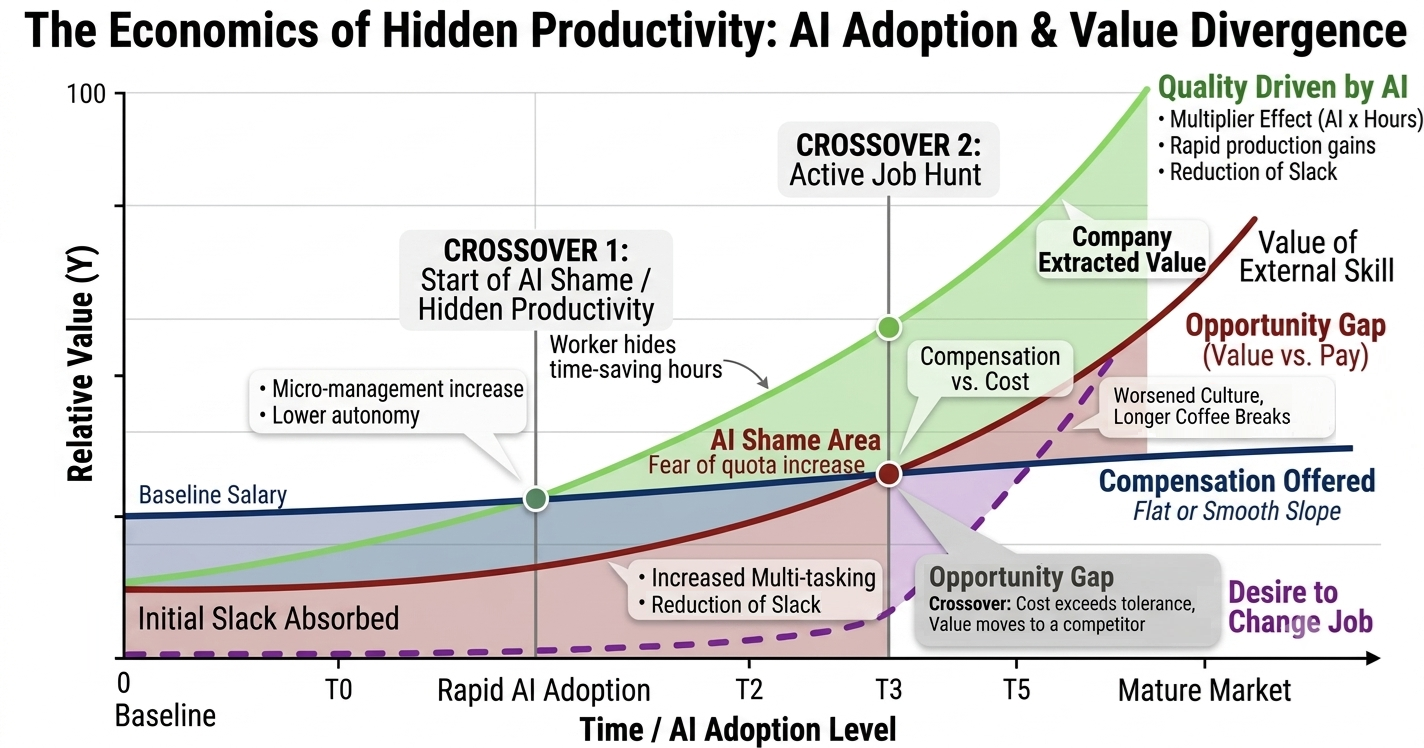
When AI enters without a corresponding compensation adjustment, the value extracted by the company (green) diverges from the cost borne by the employee (red) and from what the employee receives (blue). At the first crossover, hidden productivity begins; at the second, the employee starts looking elsewhere. The curves are conceptual and illustrate documented trends, not data from any single study. Note: “slack” here does not mean slacking off or doing nothing — it refers to something far more important for the health of any workflow: the margin of maneuver, the buffer time, or the breathing room an employee has between tasks.
The macroeconomic data reflects this indirectly and in a somewhat puzzling way. The St. Louis Federal Reserve calculated in 2025 that the average AI time saving is 5.4% of working hours (roughly 2.2 hours per week for a worker who uses AI regularly, in a representative August 2024 survey). That should appear in labor productivity statistics as a visible jump. And it does — but only in a few places: sectors with the highest AI exposure drove 1.7 percentage points of US labor productivity growth in 2025 (AEI and Morgan Stanley, 2025). The problem is that this gain is brutally concentrated: according to a global PwC study (2026) covering 1,217 executives across 25 sectors, 74% of the economic value generated by AI is captured by just 20% of organizations. For the remaining 80% — which is where most people work — the gain simply does not show up in their metrics. And they are right: in their case, it genuinely is not there. Part of this is explained by still-partial adoption. Another part — nobody knows exactly how much — is explained by the gain being absorbed in places no corporate metric captures:
- Expanded quality and scope: there used to be no time to write tests; now there is. Documentation used to be poor; now it is better. Work wraps up at the same hour, but what gets delivered is better.
- Recovered slack: those two extra hours go toward reading, learning, and reflecting. Nobody reports it because it is not billable “work.”
- Side projects: the professional who generates company value in four hours has four hours to invest in their own development or in external projects. Companies that do not share the benefit are, indirectly, funding the competition.
The paradox also operates in workers’ own perception. The People at Work 2026 report from ADP Research (39,000 employees, 36 countries) found that regular AI users are four times more likely to feel they are underperforming — and 30% of those who use it daily report being engaged with their work while simultaneously feeling less productive than before. The most likely explanation is not that they are working worse, but that AI has changed the type of tasks they tackle; in that transition, the employee does not feel they produce more, but differently. What is not perceived is also not reported.
This is the 2026 version of the Solow paradox: in the 1980s, economist Robert Solow observed that computers were visible everywhere except in productivity statistics. Today, AI is used everywhere except in the numbers companies try to measure. In February 2026, the NBER published a study of nearly 6,000 senior executives from the US, UK, Germany, and Australia (Yotzov, Barrero, Bloom et al.): 90% reported no measurable impact of AI on productivity or employment in the previous three years, even though 69% were already using it. Fortune summarized it without irony: “Thousands of CEOs just admitted AI has had no impact — and economists are resurrecting the Solow paradox.”
The CEO of OpenAI himself offers, in retrospect, the most striking testimony. In 2015, Sam Altman summarized his relationship with technological progress without mincing words: “My job is to help destroy jobs.” A decade later, in May 2026, he declared being “happy to have been wrong”: “I thought the elimination of entry-level administrative positions would already have had a bigger impact than it actually has.” The same man who built much of the labor-apocalypse narrative admits that AI — his own — has not destroyed jobs at the pace he himself anticipated.
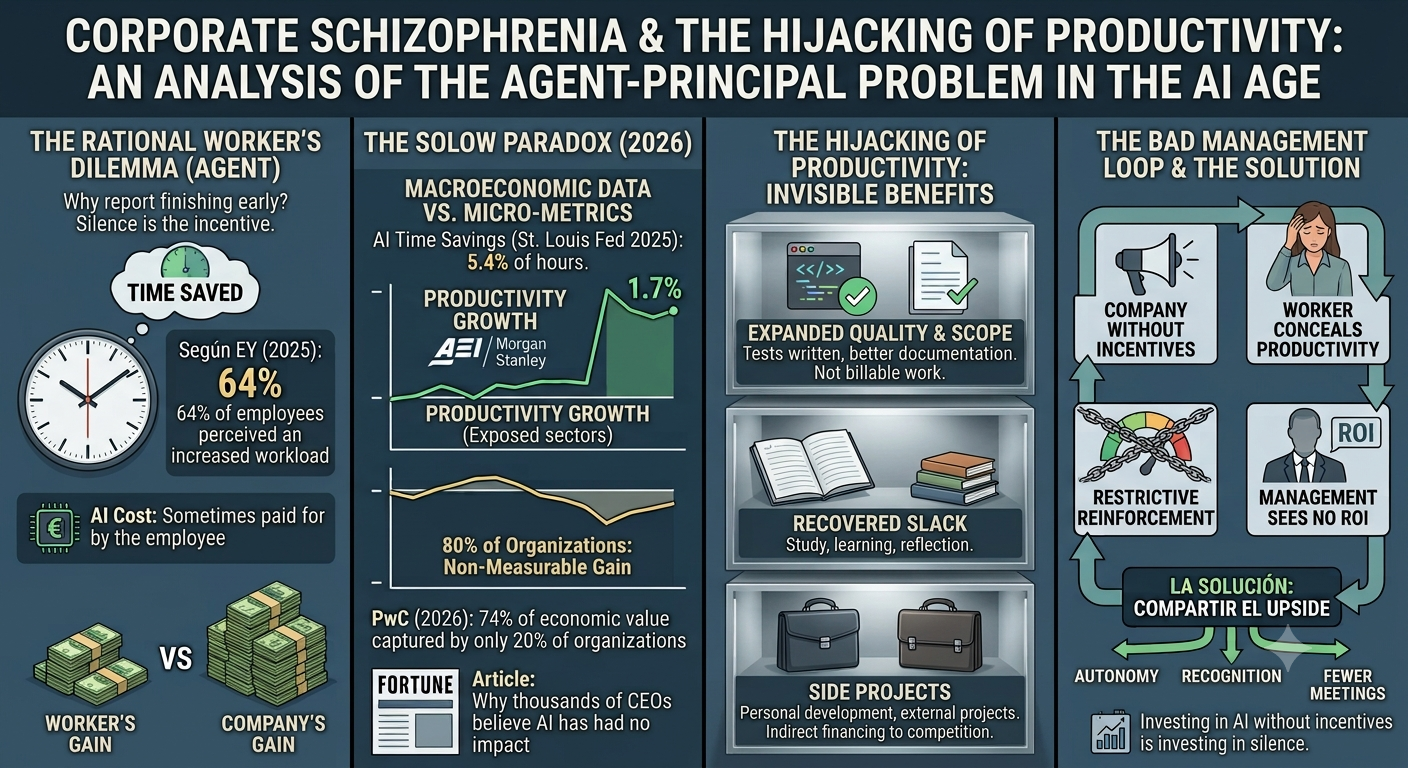
The organizational consequence is striking: the company that creates no incentives for employees to report the productivity gained builds exactly the system that later prevents it from justifying its AI investment. Management sees no ROI, concludes that “AI doesn’t work,” and tightens restrictive policies. The loop closes. The problem was not AI; it was the incentive structure.
The only way out of the loop is for the company to share the upside. Not necessarily in money: it can be autonomy, recognition, fewer meetings, or more interesting projects. But if extra productivity always converts into more work at the same price, the market for reporting productivity gains has a single equilibrium price: silence.
What you can do if you’re stuck in an inertia-bound organization
Let’s assume you are not the one setting policy. You are someone with sound judgment inside a resistant organization, and you want neither to burn yourself fighting windmills nor to resign yourself to doing things poorly. Here are some strategies to avoid falling into frustration:
1. Change the argument: from “it’s better” to “it’s cheaper / less risky.” Decision-makers are not moved by “this is more modern” or “this is more elegant.” They are moved by cost and risk. Do not ask for an update “to stay current”; ask for it to reduce a specific expense, close a specific security gap, or avoid losing the team that is getting bored. The same change, told in the language of whoever signs the check.
2. Let the data speak, not you. An opinion can be argued; a report gets attention. If you can show in numbers the cost of inertia — lost hours, accumulated risks, client complaints — your proposal stops being “what you think” and becomes “what the data says.” This neutralizes ego-driven debates.
3. Demonstrate on a small scale; don’t argue at scale. Don’t try to convince the organization to transform everything. Take a small, isolated, low-risk area, do it well the new way, and show the measured result. One example that works is worth more than ten presentations. And if it goes wrong, the damage is contained.
4. Protect your energy and your judgment. This is the most important one and the most often forgotten. In an organization that resists strongly, fighting every battle burns you out without changing anything. Choose where you invest your effort, document your recommendations (so it is on record that you made them, without needing to say “I told you so”), and do not confuse professional judgment with the need to be right. Sometimes the healthy answer is to do your part well, learn on your own what the company won’t let you learn on the clock, and save your energy for when you can actually move something.
An honest note on using AI on the sly: the answer to any of these five forms of Shadow AI is not to bypass data-protection rules. It is to push for the company to provide an official, safe channel (approved tools that actually work, models that don’t expose data), because covert use leaves you exposed if something goes wrong. The inconsistency is the company’s; the consequences, if you are caught using real data through uncontrolled services, can end up being yours.
What to take away
The corporate excuse-phrases — “don’t reinvent the wheel,” “if it works, don’t touch it,” “we’ve always done it this way” — were born in a world where change was expensive and risky. That world has changed: the cost of improving has fallen and the cost of stagnating has risen, and that turns many of yesterday’s excuses into today’s negligence. It is not about changing for change’s sake, but about recognizing that the balance has shifted and that “better not touch it” is no longer the automatically safe answer it once was.
The most revealing contradiction of the moment is not just the company that bans AI while demanding its results: Shadow AI also arises when the company does not fund the tools, when the ones it provides don’t work, when it has no policy, or when employees hide their usage out of fear of judgment — five different routes to the same blind spot. If you find yourself in any of these situations, your best move is neither a crusade nor resignation: translate your proposals into the language of cost and risk, demonstrate on a small scale, let the data speak, and above all, protect your judgment and your energy for the battles you can actually win.
“We’ve always done it this way” describes the past. It has never been an argument about the future.
Verified sources
- Shadow AI — unauthorized use figures (2025): between 49% and 81% of employees depending on the survey. UpGuard — State of Shadow AI · CIO — unsanctioned AI tools
- Gartner (November 2025) — 69% of organizations suspect or have evidence of prohibited generative AI use (survey of 302 CISOs, March–May 2025); forecast: more than 40% of companies affected by Shadow AI incidents by 2030. Gartner — GenAI Blind Spots
- Gartner (October 2025) — 88% of HR leaders declare that their organization has not obtained significant business value from the AI tools deployed. Gartner — HR Leaders AI Survey
- WalkMe — AI in the Workplace (2025) — survey of more than 1,000 workers (July 2025): 48.8% hide AI use to avoid being judged; 53.4% of C-suite executives hide their AI habits. GlobeNewswire — press release · Fortune, August 2025
- EY — Work Reimagined Survey (2025) — global survey (15,000 employees, 1,500 employers, 29 countries): 64% experienced an increase in workload despite using AI; organizations that do not align AI with talent strategy waste up to 40% of their productive potential. EY — Work Reimagined Survey · EY — Press release 40% AI productivity gap
- Gusto (2025) — survey of 1,000 American workers: two thirds of those who use AI at work pay for it out of their own pocket. Gusto — AI Workplace Anxiety
- ISACA AI Pulse Poll (2026) — survey of 3,400 IT audit, governance, and cybersecurity professionals: 25% of organizations have no AI policy; 90% use AI. ISACA — AI Pulse Poll
- Resume Now (May 2026) — survey of 1,020 American workers: 41% say their employer has done nothing to prepare them. PR Newswire
- IBM — Cost of a Data Breach 2025: organizations with high Shadow AI usage pay +$670K per breach compared to those with low or no usage (p. 4); global average cost of all breaches: $4.44M; US average: $10.22M. IBM Report
- St. Louis Federal Reserve (February 2025) — representative August 2024 survey: 28% of American workers use AI at work; average saving of 5.4% of weekly hours (≈2.2 h). St. Louis Fed — Impact of Generative AI on Work Productivity
- AEI and Morgan Stanley (2025) — sectors with the highest AI exposure drove ≈1.7 percentage points of US labor productivity growth in 2025; the analysis distinguishes between the AI investment boom and broader efficiency gains, which remain nascent. AEI — Hints of AI-Powered Efficiency Gains
- PwC — AI Performance Study (2026) — study of 1,217 executives across 25 sectors: 74% of the economic value generated by AI is captured by just 20% of organizations; the gap between leaders and laggards is 7.2x in revenues and efficiency attributable to AI. PwC — AI Performance Study 2026
- Yotzov, I., Barrero, J.M., Bloom, N., Bunn, P., Davis, S.J. et al. (2026). Firm Data on AI. NBER Working Paper 34836. Survey of ~6,000 executives from the US, UK, Germany, and Australia: 90% report no measurable impact on productivity or employment; 69% already use AI. NBER w34836
- ADP Research — People at Work 2026 — global survey (39,000 employees, 36 countries): 30% of daily AI users report being engaged with their work while simultaneously feeling less productive than before; regular AI users are four times more likely to feel they are underperforming. ADP — People at Work 2026
Opinion reads
- Management literature on organizational resistance to change and corporate inertia (provides a framework, not hard evidence).
- Thousands of CEOs just admitted AI had no impact on employment or productivity — Fortune, February 2026 — journalistic coverage of NBER w34836 with an explicit reference to the Solow paradox.
- Slack Workforce Lab — AI in the Workplace — many workers hide AI use out of fear of appearing to “be cheating.” (Internal Slack study, not peer-reviewed.)
- Sam Altman: “happy to have been wrong” about the labor apocalypse — Time, May 2026 — covers the May 2026 declarations at the Commonwealth Bank of Australia conference (Sydney). The 2015 quote (“My job is to help destroy jobs”) is documented in multiple outlets of the period.
- Linus Torvalds backs AI use in the Linux kernel where it provides real technical merit — El Chapuzas Informático, July 2026 (article in Spanish) — the creator of Linux rules out ideological opposition to the tool and demands that any integration reduce actual workload, not increase it. The same pragmatic logic as this article, applied to the longest-running software project in production.
← Previous article: Tricks for Using AI Well · Back to the index: Series overview
