
What Are Recommender Systems?
Learn what recommender systems are, how Amazon, YouTube and Filmaffinity use them, and the 4 types: content-based, demographic, collaborative and hybrid.
DEF: A recommender system is an intelligent system that gives users a series of personalized suggestions (recommendations) about a certain type of elements (items). Recommender systems study the characteristics of each user and, by processing the data, find a subset of items that may be of interest to the user.

In recent years, mainly because of the information overload we have on the internet, recommender systems have proliferated. They provide users with information, products, etc. that may be of interest to them, after carrying out a "study" of their profile, their tastes and even the way the user browses the internet.
Without going into much detail, and with just a little browsing, we can give some examples of websites that have recommender systems behind them. Amazon is perhaps the site with the best-known recommender system, since once the user signs up, it records how the user browses its products and what they buy. With this data it can offer the user products they may like, so the user doesn’t have to go through the thousands of products Amazon has. Another very well-known website with a recommender system is YouTube. It records the last videos a user has watched and recommends similar videos, most likely based on the content or on the characteristic "tags" of the videos. For example, if you’re watching "Messi’s goal" against Real Madrid on YouTube, it’s very likely (if not certain) that YouTube will show you videos of Messi’s goals or some video related to Real Madrid next to it.
So far, the examples we’ve given are websites that obtain implicit information (that is, information obtained from the user’s behavior) to recommend products or videos to users. But wouldn’t it be better if users rated the products or the videos (or items in general) so the system could recommend better? Well, that’s a very logical question that many of you have surely asked yourselves; and the answer is that the best recommender systems out there are those that base their recommendations on the information the user gives the system about their tastes (that is, explicit information). One of the websites with one of the best recommender systems is "filmaffinity.com". It recommends movies (and does it very well), but of course, you have to rate the movies you’ve already seen so the recommender can recommend to you. This recommender looks at your ratings, sees which users have rated more or less the same as you, and then recommends what users with tastes similar to yours have liked. This is the best way to make recommendations because (unless you’re a really, really weird person) there’s surely someone out there with tastes similar to yours.
With the examples we’ve seen so far (Amazon, YouTube, Filmaffinity), we can see that there are different ways of making recommendations: based on the users’ browsing or purchases, or based on what the user rates. Besides (and obviously), if we know the users’ characteristics (age, gender, occupation, etc.), we could also make recommendations based on those characteristics, for example recommending "such and such product" to men between 30 and 35 years old or to women between 18 and 25, etc. So, with these examples, we can now classify recommender systems, which fall into 4 types:
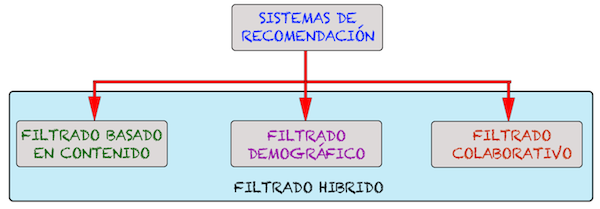
- RS with Content-Based Filtering: (e.g., YouTube) Recommendations are based on what is known about the items the user has rated (either implicitly or explicitly), and similar items the user may like or be interested in are recommended.
- RS with Demographic Filtering: These recommendations are made based on the users’ characteristics (age, gender, geographic location, occupation, etc.).
- RS based on Collaborative Filtering: (e.g., Filmaffinity) Collaborative filtering consists of finding which users are similar to the active user (the user we need to make recommendations for) and then recommending the items that the active user hasn’t rated and that similar users have rated highly.
- RS with Hybrid Filtering methods: (e.g., Amazon) They mix some of the three kinds of filtering mentioned above to make recommendations, and even combine them with other artificial intelligence techniques such as fuzzy logic or evolutionary computation.
So far we’ve seen a short introduction to what recommender systems are and we’ve classified them, giving some examples many people know, such as Amazon and YouTube. In future posts we’ll look at different techniques used to recommend, such as LSI or LDA for Content-Based Filtering, and K-Nearest Neighbors and SVD for Collaborative Filtering. We won’t talk about Demographic Filtering, since it’s a very obvious type of filtering that is done by "matching" the characteristics of the users and the items.
“What Are Recommender Systems?” by Ricardo Moya at jarroba.com, licensed under Creative Commons Attribution-NonCommercial-ShareAlike 3.0. Registered at Safe Creative.

You may also like


Recommender Systems Based on Collaborative Filtering (K-Nearest Neighbors)
Learn how collaborative filtering recommender systems work with the K-nearest neighbors technique, similarity metrics (MSD, Pearson, cosine) and a worked example.

“If It Works, Don’t Touch It” and Other Excuses That No Longer Hold
Four corporate excuse-phrases, why the calculus has changed with AI, and what to do if you're stuck in an inertia-bound organization.
Leave a comment