
How to Avoid Being Replaced Without Selling Out to AI
Four profiles facing AI, two bad extremes, and four personal strategies that actually work in 2026. No alarmism, no evangelism.
Series: AI and You part 7 of 9
- Introduction
- 1“I don’t want anything made with AI” – The consumer paradox
- 2Why You Lose With (and Against) AI
- 3What You Have and AI Lacks
- 4The Free Agent Trap
- 5At Machine Speed: How AI Has Broken the Cybersecurity Balance
- 6AI Regulation: The Dilemma Between Protecting and Falling Behind
- 7How to Avoid Being Replaced Without Selling Out to AI
- 8Tricks for Using AI Well
- 9“If It Works, Don’t Touch It” and Other Excuses That No Longer Hold
Learn, Adapt, and Don’t Cling — Without Becoming Its Slave

Standalone article from the series “AI and You”.
Imagine two professionals in the same field, similar in age and similar in technical ability. Let’s give them some original names: AntiAI and ForAI. AntiAI has decided that AI is hype, that their work is too important to trust to a machine, and that the fad will pass. They spend their days working exactly as they have for years. ForAI has decided the opposite: AI is the answer to everything, and, freed from their own work, they’ve started using it for every task — accepting whatever it produces without reviewing it and saving themselves the trouble of thinking.
In a few years, both will fall behind, for opposite reasons. AntiAI will fall behind because colleagues who use AI well produce three times as much at the same quality, and because the skills they refused to learn have become the standard. ForAI will fall behind because their judgment has atrophied, because they accept things that an expert would not, and because their differential value over anyone with the same AI access has evaporated. Both extremes lose. The useful place is in the middle — and it is not a comfortable one.
About the extreme cases in this article. Some comparisons, scenarios, and diagrams in this article are illustrative: they contrast extremes (utopia / dystopia) to make a range visible. They are not operational recommendations or predictions. The author takes no responsibility for how readers apply these ideas. Full disclaimer text here.
It is also worth learning to filter the noise around you. The panic over absolute near-term replacement is usually driven by highly motivated corporate narratives: key figures in the industry have openly signaled “the definitive end of technical professions,” but only to inflate funding rounds or justify aggressive restructurings in front of investors (not long ago, companies laid off thousands “because of AI” when AI was not yet deployed anywhere — you could smell that it was mostly a convenient excuse, with AI as the perfect scapegoat). Keeping your own judgment means understanding that the tool is here to multiply your capacity for output, not to empty offices. The tone correction came from Microsoft CEO Satya Nadella himself, in a June 2026 interview with the Wall Street Journal: “You can’t say all white-collar jobs are going to disappear and at the same time use every watt of power available to build data centers.” Nadella’s position is not disinterested — Microsoft has no frontier model of its own to compete with the most advanced ones — but that the correction came from one of AI’s biggest investors says something about where the discourse has arrived.
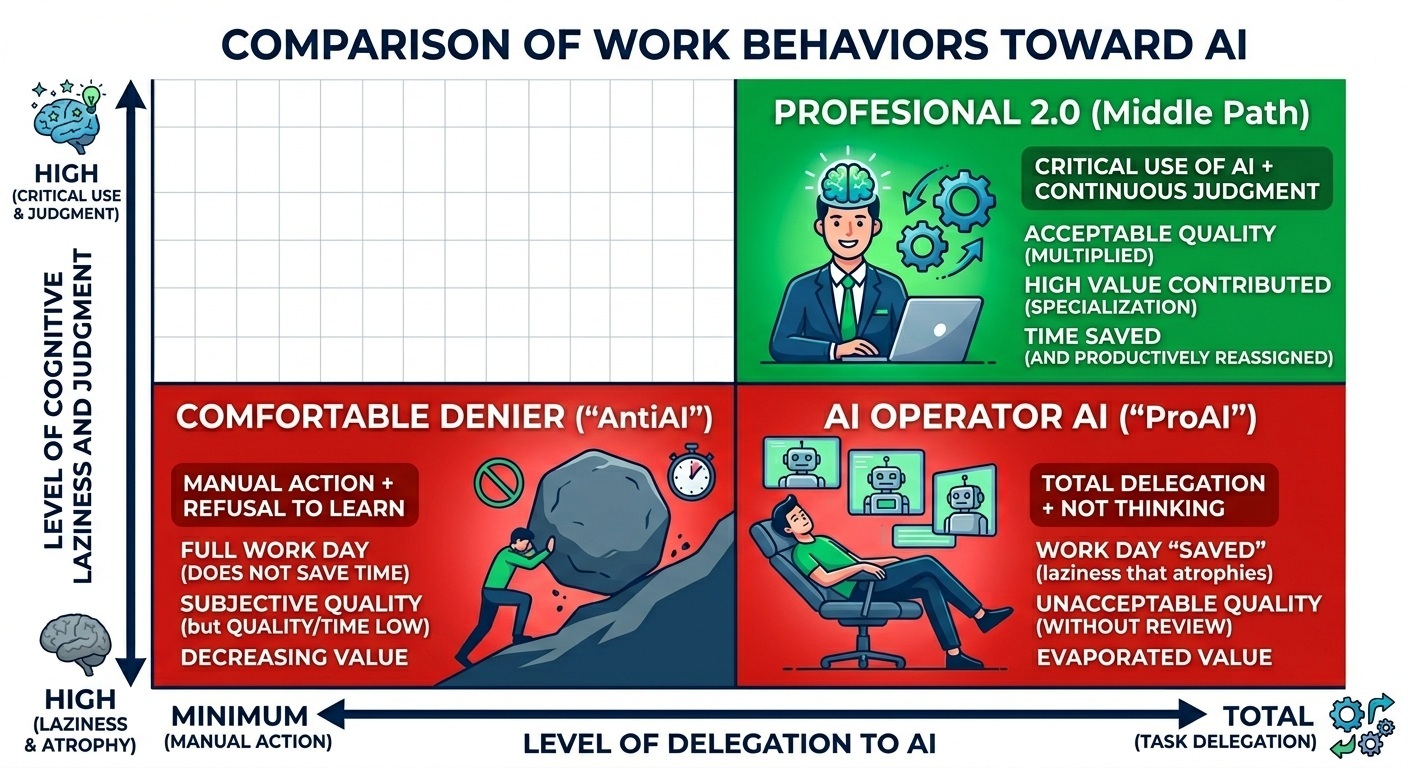
The Two Bad Extremes and Why They Fail
Both extremes have their own logic, and it is worth understanding each of them: we can move between them.
The “I don’t use it, I don’t need it” extreme. The justification usually mixes three arguments: “My work is highly specialized and AI doesn’t understand it,” “I’ve seen it make mistakes,” and “I prefer things done the traditional way.” All three arguments are partially true and completely misleading. Even specialized work has mechanical parts; AI makes mistakes, but it also gets things right — and we know its hit rate is better than random chance — while your competitor is using it to gain an edge, whether you see it or not; and preferring the old way is a legitimate personal taste but an irrelevant professional strategy.
The consequence is not that you get fired tomorrow. It is that you spend five hours on what your colleagues finish in one, without realizing that the gap will show the moment someone measures it. When that moment comes, all that remains is the frustrated defense (“But look at the quality of my work!”), except the metric your manager watches is not quality: it is quality per hour. That is where you lose.
— This is nothing new in AI or computing: many of us love doing things at the highest quality, almost as a form of artistic expression in itself. Psychologists call this “maximization”. The problem has not changed: whoever ships an acceptable-quality product already has more than whoever ships nothing because they are still chasing perfection.
The “I hand everything to AI” extreme. The justification is different: “If the tool can do it, why should I bother?” “If I save an entire workday and do nothing, who’s the fool?” “Clients only care about the result.” These arguments are again partially true and completely misleading. If AI can do something, let it — but reviewing what it produces is still your job (this is precisely where zero-quality output creeps in). Not thinking during the workday atrophies you. And clients don’t want “the result”: they want “an acceptable-quality result,” and the difference is where you add value — for example, the review that makes the output actually fit for purpose.
The consequence here is also not immediate dismissal. It is that your value becomes indistinguishable from that of anyone else with the same AI access, or from an autonomous AI doing all your work directly. When a company can replace you with someone cheaper who uses the same tool, or with an AI agent that handles your entire workload, it will start asking what it is paying you for — and redirect that cost to something that does add value.
Both extremes lose. The answer lies in neither of them, as we will analyze further on.
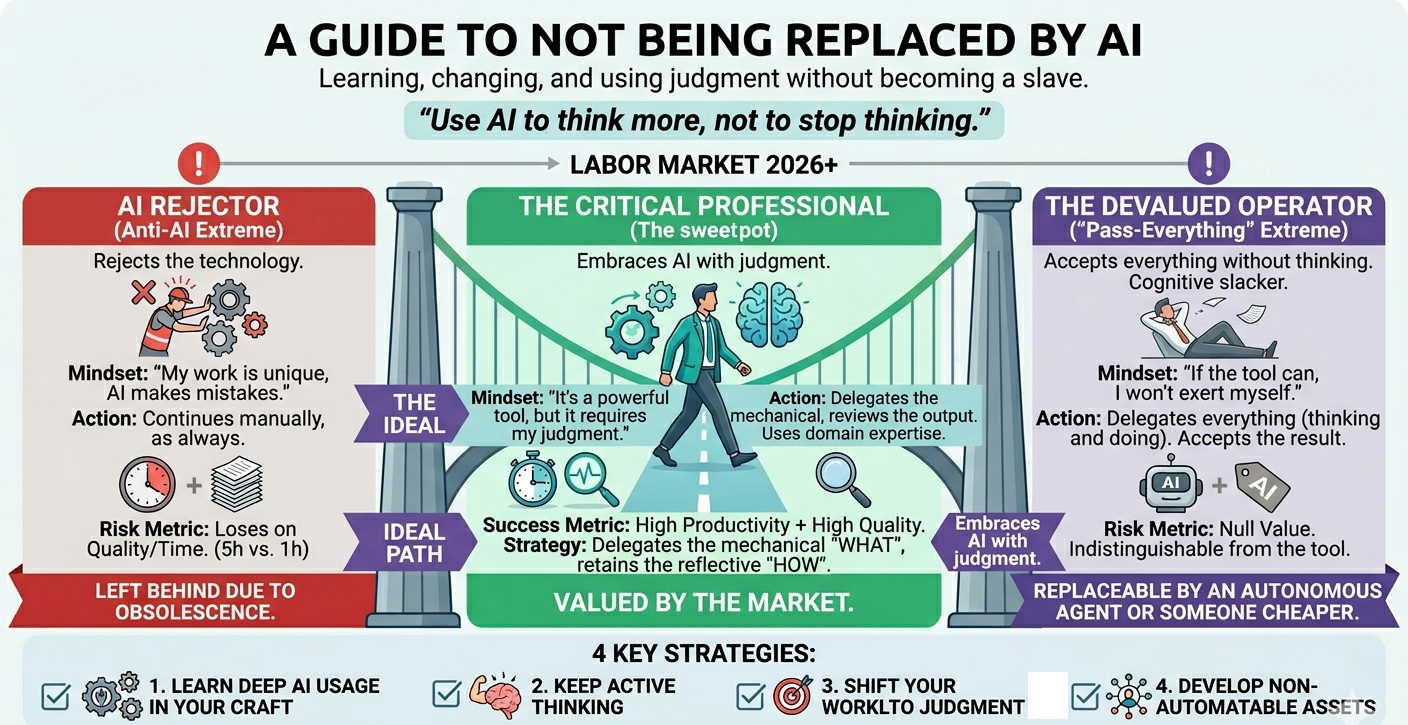
Four Profiles
Four profiles summarize the range of possible responses well, arranged on two axes: whether they embrace or reject AI, and whether they keep learning or settle into comfort. The intersection yields four figures that are easy to recognize in any knowledge-based trade. The quadrant below highlights the most defining ones, but there are many more:
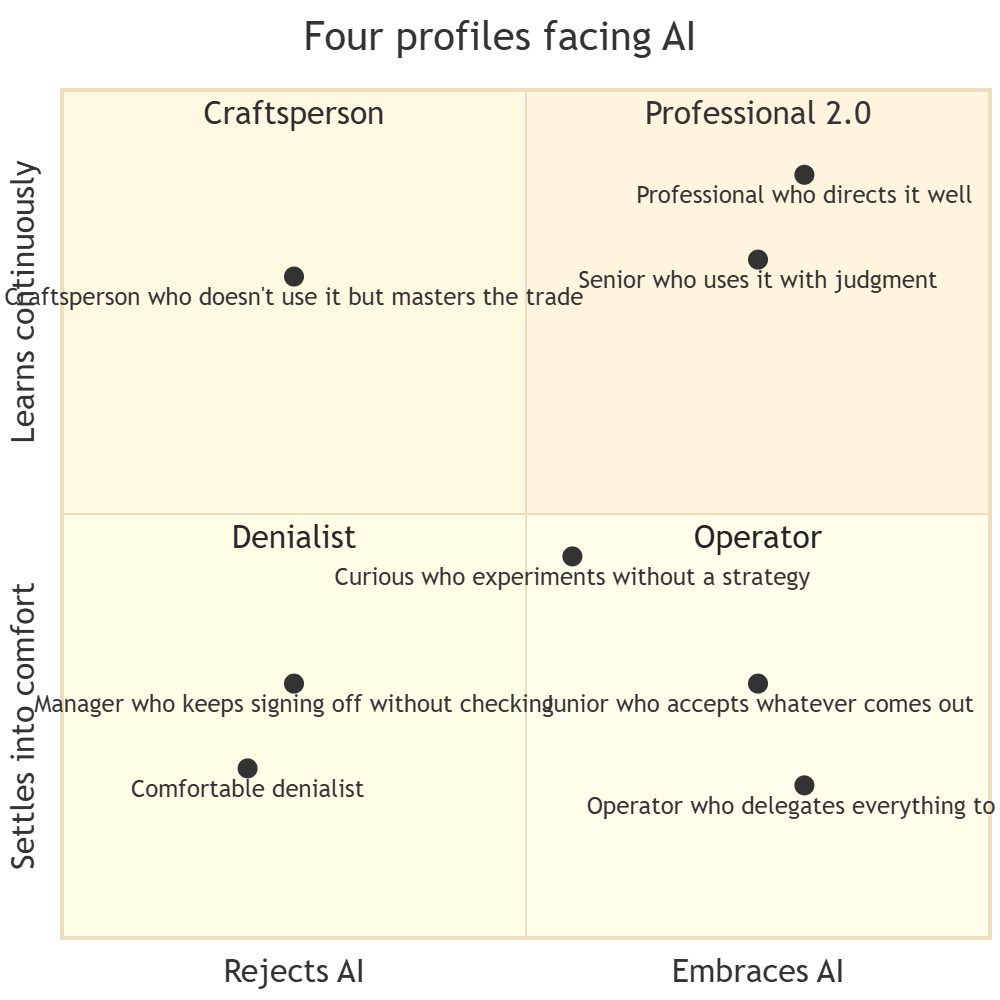
The two upper quadrants are the ones that survive. The upper right (the professional who embraces AI and keeps learning) is the most valued by today’s market of constant change and evolution. The upper left (the craftsperson who does not use it but preserves their judgment) remains viable in trades where the human product sells on its own: arts, high-end specialties, premium work. The two lower quadrants are the ones that lose: the comfortable denialist because they become obsolete, the AI operator because any person with the same tool — or the tool itself without them — can replicate their work. Labor market data confirms this: according to ManpowerGroup (Talent Shortage 2026, covering 39,063 companies across 41 countries), AI skills are the hardest-to-find hard skills in the job market, ahead of engineering, manufacturing, and marketing. The upper-right quadrant is scarce precisely because most people never reach it.
The honest exercise here is to assess where you actually are, and use that as a starting point for moving toward where it really matters. This is only a diagnostic. Not everyone needs to make the same move — it depends on many factors — but we can all work on those that are within our reach.
There is, however, one nuance the quadrant does not capture, and it is worth keeping in mind: the horizontal axis (“rejects / embraces AI”) treats adoption as a binary switch, on or off. In practice, it is a dimmer switch, and the intensity level matters a great deal. Within the upper-right quadrant, some people use AI as an enhanced search engine, some use it to draft text, some use it in agent mode to automate entire workflows, and some build evaluation pipelines on top of it. The difference between the first and the last is not whether they use AI — all of them do — but how deeply they have explored the tool.
This pattern is predictable and has a name: satisficing (Herbert Simon, 1956). People adopt the first “good enough” solution and stop exploring, even when better options exist. This has been documented in complex-tool environments: the Mind the Product Benchmarks report (2024) — based on data from 6,800 applications and 2,500 companies — found that only 6.4% of features account for 80% of all clicks: the rest exist, but barely get used. In development environments, features like automatic refactoring, code inspection, and test generation have been available in IDEs for years and are still used by a minority compared to basic autocomplete. Users reach the level that solves their usual task and stop there, even when a different button would handle the same task considerably better and in far less time. The same thing happens with AI — and the cost of staying at that first level is today much higher than the cost of never learning conditional formatting in Excel.
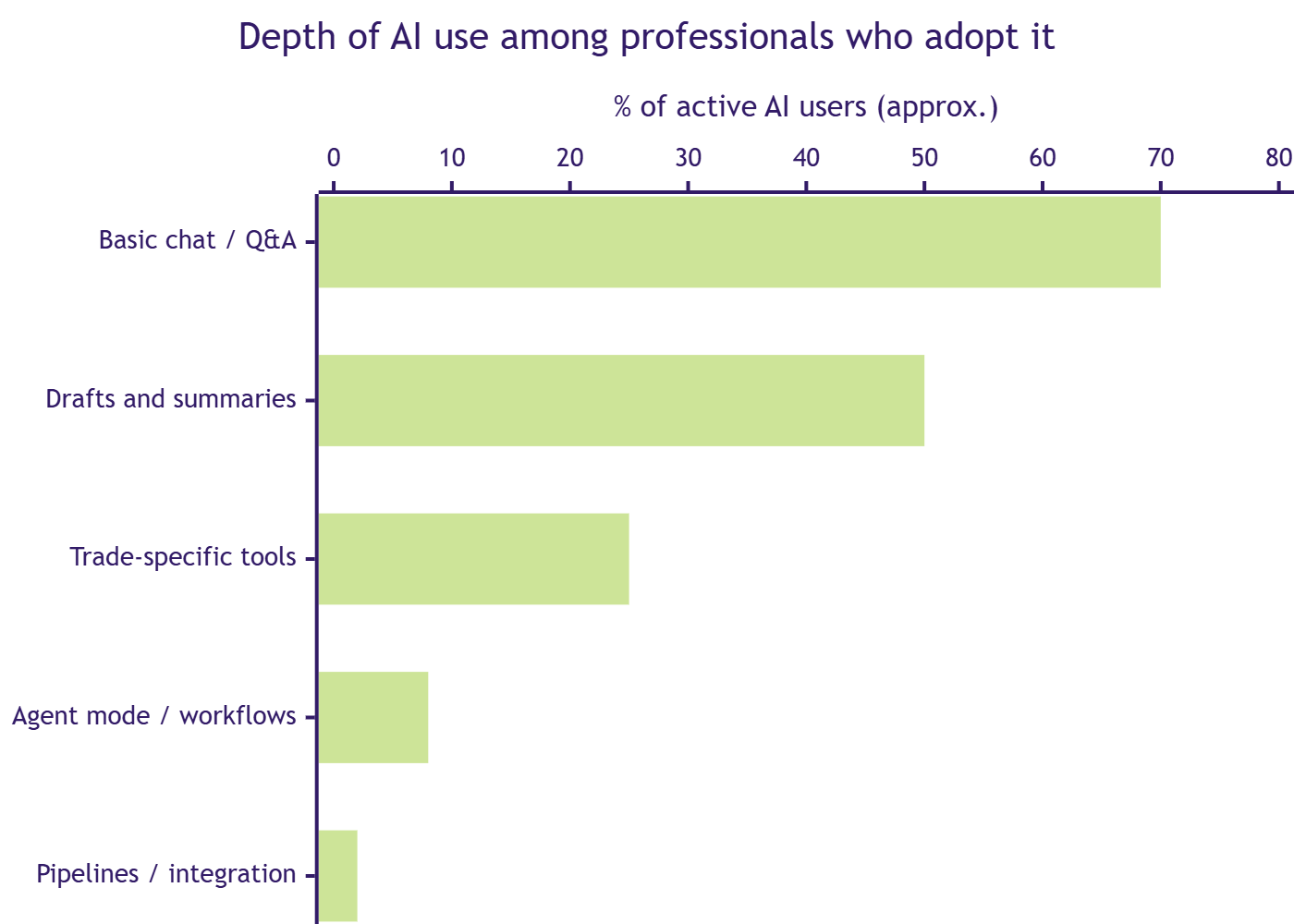
Estimated values based on documented adoption patterns (ManpowerGroup 2026, GitHub Copilot usage data, feature utilization studies in enterprise software). These do not correspond to any single study; they illustrate the satisficing effect: each step up carries a perceived learning cost that stops most users before they reach it.
2023 and What Happened Next: The Map Inverted
In 2023, the dominant narrative about employment was fairly clear: companies would hire one junior with AI instead of one senior, AI would multiply the junior’s productivity to compensate for the experience gap, and the veteran professional would be exposed. The argument was intuitive and was repeated widely.
What happened was different — and harder on those just starting out.
Companies did not replace seniors with junior + AI. What they did was stop hiring juniors at all. The tasks that typically filled the first years of a career — routine data analysis, first drafts of contracts, scaffolding or boilerplate code, standard reports, basic market research — are precisely what language models do well. The result: the entry door to the market closed. Since the launch of ChatGPT in November 2022, employment of workers aged 22–25 in occupations with high AI exposure began to fall; employment of more experienced profiles grew in that same period (Dominski & Lee, arXiv:2507.08244).
At scale, Hosseini and Lichtinger (Harvard, 2026) studied data from 65 million workers in more than 280,000 companies — LinkedIn plus Revelio Labs, 2015–2025 — and confirmed the mechanism: from late 2022 onward, junior employment at companies that had adopted generative AI fell systematically relative to companies that had not, while senior employment showed no comparable break. After six quarters of adoption, the gap reaches a ~9% drop in junior employment relative to senior.
In the technology sector, the data is starker: the Stanford AI Index 2026 documents that the share of tech jobs requiring three years of experience or fewer fell from 43% in 2018 to 28% in 2024, and employment of software developers aged 22–25 has accumulated a decline of between 16% and 20% from its late-2022 peak; labor market analysts with more granular data report falls of 73% year-on-year in entry-level positions, alongside a +88% growth in AI-linked jobs in the same period. The English-language literature already has a name for this effect: the “missing rung” — if AI automates exactly the tasks that trained young professionals, the step they used to climb to the next level disappears.
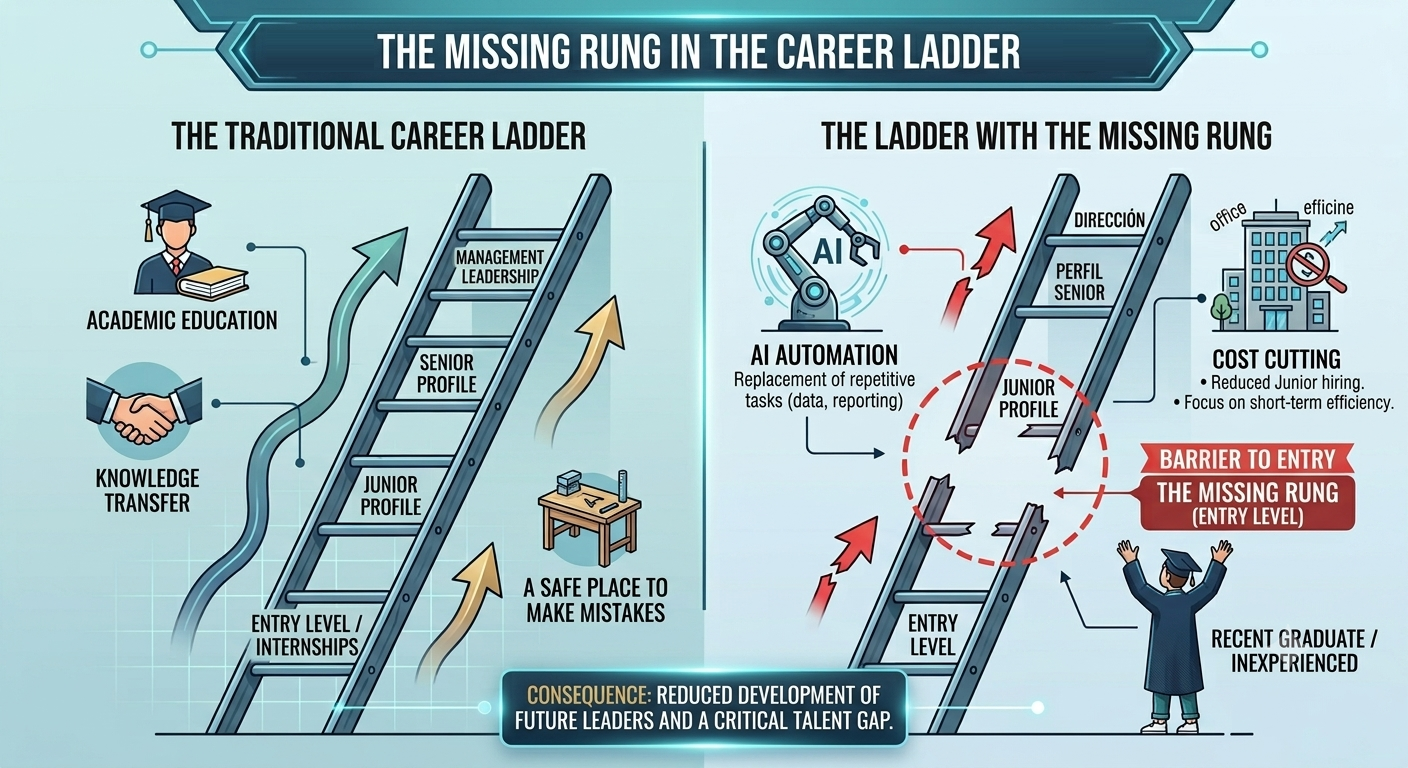
The debate about exact causality is not settled: a study from the LSE (Lambert & Schindler, “The Broken Ladder,” May 2026) argues that remote work may be the more robust predictor — it raises the cost of supervising and training junior employees remotely more than it does for seniors — and that the GenAI coefficient weakens when both variables are controlled for simultaneously. Whether the cause is AI, remote work, or their combination, the practical consequence is the same: the entry step into the market is harder to climb today for those just starting out.
The same Atlanta Fed survey lets us be more specific about which profiles face substitution versus which are complemented. The study constructs a negative-exposure index (substitution mentions / complementation mentions) from CFO open-text responses:
| Profile | Index (>1 = more substitution) |
|---|---|
| Administration and office support | 2.0 → AI substitutes more than it complements |
| Finance and accounting | 0.8 → balanced |
| Sales | 0.3 → more complementation |
| Software development / IT | 0.6 → more complementation |
| Management | 0.1 → most complemented |
The pattern is one in which AI substitutes at the administrative base — the most routine and most automatable roles — and complements where context, judgment, and relationships are required.
The senior survived because they have something the junior does not yet have, and that AI cannot replicate: judgment built through their own mistakes. They know when AI output contains a subtle logic error that violates no formal rule but is wrong in this specific context. They know when the client who asks for X actually needs Y. They know when the “correct” report leads to the wrong decision. That kind of knowing is not learned by reading; it is learned by doing and making mistakes, and AI is taking it away from the next generation before they develop it.
If there are no juniors today, there will be no seniors in the future. Organizations optimizing costs right now are accumulating a judgment debt that whoever manages those organizations a decade from now will have to pay. AWS CEO Matt Garman called it “one of the dumbest ideas” he had heard: if you eliminate the base of the pyramid, “at some point the whole thing explodes.” A junior is not just output; they are the future senior in training.
The effect is not limited to technology. Dario Amodei, CEO of Anthropic, warned in late 2025 that AI could eliminate much of the entry-level work in law, finance, and consulting within five years — precisely the sectors in which junior work (document review, basic analysis, data research) is what language models execute best.
For those starting their career, this landscape is more demanding today than it was in 2023, not less. The path now requires demonstrating judgment from the beginning, not just execution.
The practical consequence is that a portfolio of real projects is worth more than most certifications. A journalist who has connected a transcription API for a personal project knows when the output has context errors; an analyst who has built a notebook with real data knows what it costs to clean a badly structured source; a developer who has deployed something on a cloud provider — even on the free tier — has worked through configurations, permissions, and production errors that no classroom exercise covers. That experience, however modest, is exactly what differentiates two apparently identical CVs.
There is a real risk here: cloud services and AI model subscriptions carry costs that can spike if spending limits are not controlled, and not everyone can afford them. There are intermediate paths — free tiers, student credits, contributions to open-source projects — but what matters is not the specific tool: it is having solved something with it, even something small, and being able to explain what went wrong in the process.
One caveat: domestic experience does not equal professional experience. In a real environment there are security constraints, team dependencies, deadline pressure, and decisions with real consequences that do not exist at home. But someone who arrives at an interview having genuinely used the tool starts from a completely different place than someone who has only watched tutorials.
The Productivity Trap: The Time You Save Is Not Yours
One idea circulated widely when generative AI entered workplaces: AI was going to free up hours that professionals could dedicate to more creative, more strategic work — or simply to rest. It was a comfortable idea, and it turned out to be wrong in most workplace contexts. The idea that AI would lay off people en masse was already limping from the start: if it had been the real cause, the workers who stayed would have absorbed the load of those who left — and workdays would have ballooned, not free time.
The Federal Reserve Bank of St. Louis quantified in a 2025 working paper that workers who use generative AI report saving an average of 5.4% of their working hours (roughly 2.2 hours in a 40-hour week). The question is why only 2.2 hours out of 40 — given how dramatic the promised gains were.
There is a structural reason why that saving is so modest. Amdahl’s Law, formulated to understand the theoretical limits of speedup in computing systems, applies with precision to knowledge work: if the tasks AI can execute — drafting, structuring, generating code, summarizing — represent 25–35% of actual working time, the theoretical maximum systemic improvement is 15–25%, even if AI covered that entire fraction at 100%. The rest of the workday — making decisions that require implicit organizational context, managing the client relationship with a person who never quite defines what they want, checking whether what the model produced makes sense for this specific project, coordinating with people — does not fit any model. That is not a limitation a more powerful model will fix; it is the architecture of the work.
Empirical numbers confirm that ceiling. More than 80% of developers actively use AI tools — half of them daily — yet measurable organizational gains are minimal: a global survey of executives in four countries (NBER WP 34836, Nov. 2025–Jan. 2026) found that 89% report zero impact on productivity; those who do detect any improvement put it at an average of 0.3%. The most counterintuitive result came from the METR study (2025), which used a controlled experimental design: experienced developers who used AI took 19% longer to complete real tasks than those who did not — while simultaneously believing they had been 20% faster. A perception gap of 39 points between what they felt and what the stopwatch measured.
| Indicator | Change vs. work without AI |
|---|---|
| Developer self-report (perception) | +20% |
| Actual time measured (controlled experiment) | −19% |
| Real organizational gain (executives, global survey) | +0.3% |
Sources: METR (2025) — randomized controlled experiment, 16 developers, 246 tasks (METR blog) — for the first two values. NBER WP 34836 (2026) — survey of executives in four countries, Nov. 2025–Jan. 2026 — for the third.
At this point, it is worth quoting directly what the ManpowerGroup Future of Work Trends Report — The H Factor: The Human Contribution in the AI Era 2026 says: “Today it is more common for productivity to decline, as workers struggle to adapt new systems to already established processes.”
The same pattern appears at the organizational level. The Atlanta Fed survey of 750 CFOs (executives across all sectors, December 2025) found that CFOs report a labor productivity improvement of 1.8% in 2025 attributed to AI, but the real implied improvement — calculated from the revenue and employment changes those same CFOs report — is only 0.6%: three times less. The same gap between what is perceived and what appears in the numbers, this time from the perspective of the decision-maker allocating the investment.
A Dun & Bradstreet executive put it precisely: “I got the eight hours to two hours, but now I can get 20 hours of work, because the work came down… it goes back to productivity.” When a worker’s efficiency rises, organizations don’t reduce the load: they raise expectations of what that worker can now deliver. The workday doesn’t shorten; it fills with tasks that were previously impractical due to lack of time.
This has a name in economics: the Jevons paradox, which we explore in depth in the article on why you lose with AI. When something becomes cheaper or faster to do, demand for that thing grows until it absorbs the efficiency gain. Applied to work: if you can write a report in two hours instead of eight, the company does not give you six free hours; it asks for three additional reports.
This pattern predated generative AI. The Microsoft Work Trend Index documented that knowledge workers receive an average of 117 emails per day, exchange 153 chat messages, and experience an interruption every two minutes — roughly 275 interruptions per day. 48% describe their workday as chaotic and fragmented. The proliferation of productivity tools did not reduce the workload: it increased it. The same cycle is now playing out with AI, but at higher speed.
The opposite scenario exists, but is a minority: a Korean study (Kim et al., 2026) involving more than 50,000 AI users found that time saved was mostly captured as “work leisure” — working at lower intensity during the same hours — with near-zero correlation between time saved and output increase. That scenario occurs when the worker controls their own pace, typically in freelance work or in organizations that measure results rather than hours.
The practical consequence has two sides:
- If AI makes you faster but you get reassigned more work, your situation has not improved in terms of well-being, but it has in terms of visibility: you produce more, and that has value as long as the work exists.
- If AI can do directly what you used to do, your hands fall out of the circuit. You have not been replaced by AI; you have quietly been bypassed by your own inertia.
The distinction between “I am the one directing AI to do this work” and “I am the step the company will skip when it connects AI directly to the process” is what determines whether productivity protects you or exposes you.
From Prototype to Production: The Real Cost Surprise
The substitution narrative almost always omits one concrete detail: the distance between a prototype and a solution that actually works in production.
Any team can have an AI demo running within days. What happens next is a different story. Gartner estimates that most AI projects will fail to meet expected outcomes, primarily due to failures in data governance (G00821153, March 2026). Not because the technology fails in the lab, but because moving to a real environment demands what the prototype does not need: integration with existing systems, handling of the cases the demo did not anticipate, governance of the data entering the model, observability of production behavior, latency and cost control at scale, and someone who understands both the business process and the AI architecture well enough to make the system reliable when real users run it under real conditions. That person is scarce.
The Atlanta Fed survey of CFOs (December 2025) identified the two most-cited obstacles among companies that had not yet invested in AI: 42% considered the technology too immature, and 36% acknowledged that their workforce was not trained to use it. Those two data points are exactly the failure points that appear when a prototype tries to become production: the technology that seemed mature in the demo reveals its limits with real data, and no one on staff knows how to sustain it.
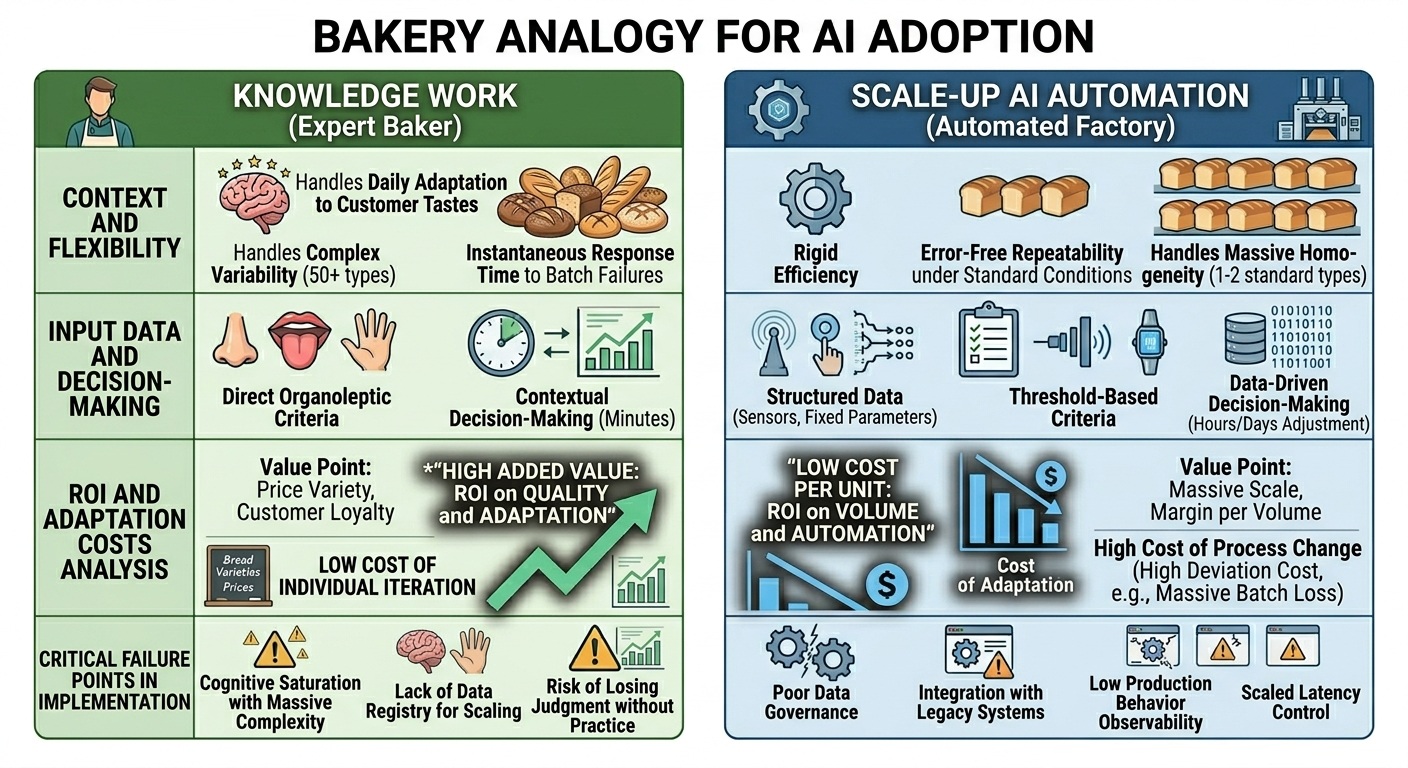
An analogy that clarifies when automation makes sense — and when it does not: a small artisan bakery with a skilled baker can produce fifty different types of bread, adapt to each day’s customer preferences, recover from a failed batch, and decide when the dough needs more time. An industrial oven can produce ten million loaves a day — but only if they are the same loaf, with the same ingredients, under the same conditions. The ROI of automation depends on whether the process is homogeneous, repeatable, and large enough in scale. In most knowledge work, the value delivered is specific and contextual, not reproducible in series. AI automation pays off in processes that resemble industrial bread production; in those that resemble the artisan loaf that varies every day, the cost of adaptation exceeds the benefit.
The real cost is also rarely visible through the right lens. An individual professional experimenting pays $20/month. A team that integrates AI into production seriously faces a different picture: a frontier model at volume sufficient for the real load, observability tools to monitor production behavior, automatic evaluation pipelines to catch regressions before they reach users, and infrastructure for extended context and vector storage. In serious enterprise environments, the total comes to $200–$600/month per person — ten to thirty times the basic plan — before counting the engineering time needed to make everything work. For a team of ten, that is $2,000–$6,000/month in tools, plus the profiles who know how to integrate them.
The table below compares salary ranges by market with the real AI stack cost — which is the same everywhere because model pricing is global in dollars:
| Market | Junior (gross/year) | Senior (gross/year) | AI production stack/year per person |
|---|---|---|---|
| US | $75k–$90k (€66k–€79k) | $160k–$200k (€140k–€175k) | $2,400–$7,200 (€2,100–€6,300) |
| Northern Europe (SE/DK/NO/NL) | $46k–$63k (€40k–€55k) | $97k–$137k (€85k–€120k) | $2,400–$7,200 (€2,100–€6,300) |
| Western Europe (DE/FR/UK) | $44k–$63k (€38k–€55k) | $74k–$115k (€65k–€100k) | $2,400–$7,200 (€2,100–€6,300) |
| Spain | $29k–$46k (€25k–€40k) | $63k–$103k (€55k–€90k) | $2,400–$7,200 (€2,100–€6,300) |
| Southern Europe (PT/IT/GR) | $23k–$34k (€20k–€30k) | $52k–$74k (€45k–€65k) | $2,400–$7,200 (€2,100–€6,300) |
| LATAM average (MX/CO/AR/BR/CL) | $15k–$30k (€13k–€26k) | $40k–$70k (€35k–€61k) | $2,400–$7,200 (€2,100–€6,300) |
| India | $8k–$15k (€7k–€13k) | $20k–$45k (€17k–€39k) | $2,400–$7,200 (€2,100–€6,300) |
Production stack: GitHub Copilot Enterprise ($39/user/month) + GitHub Enterprise ($21/user/month) + frontier model access + observability + vector infrastructure. The AI cost represents 3–9% of a junior’s annual salary in the US and 20–60% in India, which completely changes the cost-benefit analysis of substitution depending on region. Salary sources: Stack Overflow Developer Survey 2025 · Glassdoor 2026 · levels.fyi 2026 · Howdy.com LATAM 2026 · PayScale India 2026 · Manfred Spain Salary Guide 2026. AI stack cost: github.com/features/copilot/plans. Data compiled: June 2026. Figures are indicative ranges; they vary by company, city, and specific profile. Exchange rate: 1 EUR = 1.145 USD (ECB reference rate, 21 Jun 2026); EUR figures in parentheses are approximate rounded equivalents.
And this is the map of where AI wins and where it needs the professional, by phase of the development cycle:
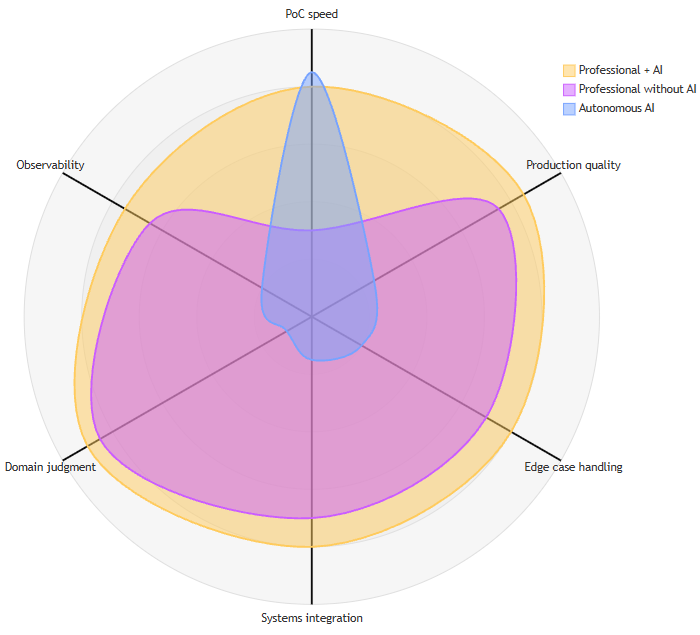
Indicative scores synthesizing the patterns observed in the literature on AI performance in real production environments. These are not measured benchmarks; they illustrate the relative distribution of strengths across each phase.
The consequence for professional decisions is the opposite of what the substitution narrative suggests: the organizations that extract real value from AI are not those that replaced people with models — they are those that invested in people who know how to make models work in production. The profile the market needs is not “either AI or human”: it is the professional who knows which part of a real process can be automated reliably, how to build the integration, and how to sustain it when the system fails in production two weeks later.
The Floor Has Risen: The Average Has Lost Value, Excellence Has Not
While the debate focused on layoffs, AI did something different and harder to see: it raised the floor of quality across almost every knowledge-based trade.
Before today’s generative models, there was a real and economically valuable difference between someone who could write clearly and someone who could not, between someone who could produce a coherent analysis and someone who could not, between someone who could put together a structured presentation and someone who could not. That difference existed because basic communication and cognitive structuring skills were not evenly distributed. AI has compressed it: today, anyone with access to a decent model can produce passable text, a basic analysis, a coherent draft.
What has not compressed is the difference between “passable” and “excellent.” The gap between work that is good enough and work that is truly good — with the right nuance, the non-obvious interpretation, the contextual judgment that no prompt can produce — remains human. And in many contexts, that gap is worth more than before, precisely because “good enough” work has become cheaper, and the client who wants something better knows they have to pay for it.
What this has inverted is the logic of 2023. At that point, the argument was: “Learn to use AI and you’ll have an advantage.” That argument was true in 2023 and false in 2026. In 2026, knowing how to use AI is the entry condition for the market, not the advantage. The advantage lies in the combination: deep domain knowledge plus AI. The PwC 2026 Global AI Jobs Barometer — covering more than 1 billion job postings across 27 countries — quantifies it: roles with AI skills pay 62% more than equivalent roles without AI (56% the year before), and grow at a rate eight times faster than the overall market. But the most relevant data point is not the average: the barometer documents a two-lane labor market. “Professionalized” roles — those that require domain judgment on top of tool mastery, such as radiologists or systems architects — show twice the employment growth and 42% greater salary increases than “democratized” roles, where AI executes the bulk of the work and any user with access can do them. The first group combines AI with expertise the model cannot replicate; the second group is exactly the floor that has risen.
The profile the market does not yet know how to value fully — but is beginning to recognize — is the professional with years in a specific field who also understands how to integrate AI into that field operationally. Not the one who knows everything about AI in the abstract, but the lawyer who knows which legal questions make sense to ask a model and which do not; the doctor who knows when the model’s diagnostic suggestion lacks the clinical context they possess; the systems architect who knows why an automatically generated proposal cannot be taken to production in this specific infrastructure.
The most striking example of how deep domain expertise revalues those who hold it comes from philosophers. A discipline that for decades accumulated some of the lowest employment rates among university graduates has become one of the most sought-after profiles by the very companies building AI. The mechanism is the same: questions about consciousness, ethics, and values — which philosophy has been addressing for centuries — turn out to be exactly what a model that speaks with millions of people each day needs. Anthropic hired Amanda Askell — a philosopher with a doctorate in ethics from NYU — to lead the team that defines the model’s character; her work produced, in January 2026, the Claude’s Character, a document of more than 20,000 words used directly in training. Google DeepMind created, in May 2026, a role literally titled “Philosopher” for Henry Shevlin, a specialist in artificial consciousness from Cambridge. And academic market data confirms it: postings on PhilJobs that mentioned AI rose from 1% in 2013 to 16% in 2025. The caveat comes from Daniel Fogal, a bioethicist at NYU: some philosophers orient themselves toward AI out of labor pressure rather than vocation, and the risk is mediocre work at the pace an industry demands when it ships models every few months. “Good philosophy takes time, and rarely emerges as a direct market response.” The same risk applies to any professional who embraces AI without a clear sense of what they contribute that others cannot contribute equally.
The floor has risen. The ceiling has not. The rational strategy is to aim for the ceiling, not to settle for standing on top of the new floor.
Personal Strategies for Continuous Improvement
1. Learn to Use AI Well in Your Specific Trade
Knowing “ChatGPT exists” is not enough. You need to know what it does well in your specific field, what it does badly, where it invents things, which types of instruction work best, and which tools are better than others for your particular task. This is not learned in a weekend course: it is learned by using it for many hours in your real work.
If you work in journalism, you need to learn to transcribe interviews, generate first drafts, and verify sources with AI. If you work in finance, you need to learn to build quick models, validate data, and generate first drafts of reports. If you work in law, you need to learn to write first versions of standard contracts, research case law, and validate citations. And in every case, you need to learn when not to trust it — because that is where your value lies.
A warning signal: according to ManpowerGroup (2026), only 44% of workers globally received training in new skills in the past six months, while AI skills already occupy the top two positions among the hardest-to-find competencies. Using without understanding is exactly the scenario of the “devalued AI operator” in the earlier quadrant.
The gap between use and mastery has a precise cognitive explanation: it is the same satisficing described in the earlier section, applied here. It is the same reason many people still color cells manually even though Excel has had automatic conditional formatting for decades, or ignore 80% of their IDE’s features even though they are one keyboard shortcut away. The tool exists, the user learns just enough to “get something out of it,” and the perceived cost of learning the next level exceeds the perceived benefit. So they stop there.
With AI, the most visible step today is the one separating basic chat from agent mode or orchestrated workflows. Asking ChatGPT a question and getting an answer has a near-zero learning cost. Configuring an agent that accesses external tools, manages a multi-step flow, and returns a composite result requires understanding how agent mode works, which tools it can invoke, how calls chain together, when to intervene to correct, and even deep knowledge of the model version being applied. The potential benefit is enormous; the initial learning cost seems equally large — and that is where most people stop. What used to differentiate “knowing how to use AI” from “not knowing” was whether you used it at all. What will differentiate in the coming years is whether you reach the level where the tool does things that would otherwise be impossible — not just things that used to take longer.
2. Preserve Your Cognitive Muscle
There is a well-documented phenomenon in cognitive psychology: cognitive offloading (Risko & Gilbert, 2016). When we offload a cognitive task to an external tool, we stop practicing that skill, and it atrophies. It is what happens when relying on GPS erodes our ability to navigate.
The same thing happens with AI, amplified. If you delegate the writing, you stop writing. If you delegate the construction of an argument, you stop constructing arguments. If you delegate the review, you stop reviewing. The technical term that has gained traction for this is metacognitive laziness (Fan et al., British Journal of Educational Technology 56(2), 2025): when AI handles the “how” as well as the “what,” the user loses the ability to critically evaluate their own processes. An independent study published in April 2026 (Liu, Christian, Dumbalska et al., arXiv:2604.04721) confirms this with concrete numbers: after just 10–15 minutes of interaction with GPT-5, the 191 participants in the AI group gave up more often on subsequent problems without assistance than the 163 in the control group (resolution rate 0.57 vs. 0.73; abandonment rate 0.20 vs. 0.11) — even though both groups were equally capable beforehand. The effect replicated in reading comprehension, suggesting a general mechanism rather than one specific to math. The mechanism they identify is “productive struggle”: the effortful struggle that builds not just knowledge but the metacognitive calibration that sustains persistence when things get hard. If a brief exposure already produces that measurable effect, the cumulative effects of daily use are potentially deeper and harder to reverse.
A strategy that seems to work: delegate the mechanical “what,” but keep the reflective “how.” Let AI write the first draft, but before accepting it, write two sentences of your own about why you accept or reject it. That practice keeps the capacity alive. It is also what distinguishes you from the “AI operator” who accepts the first thing that comes out: deliberate review, not just final output.
3. Move Your Mix Toward What Requires Judgment
The productivity trap described above has an individual way out: shift your workload toward the tasks that require the judgment AI does not have. Do not wait to be assigned them; ask for them actively.
In practice, this takes three forms:
- Work on projects with high ambiguity. Those that require decisions without complete data, relationships with difficult people, or unwritten organizational context. They are the ones nobody wants, and the ones that build you the most.
- Document what you know that is not written down. Your lived context within the organization — why that decision was made two years ago, how the process really works even though the manual says otherwise — has more value when it is acknowledged. Turn it into notes, documented decisions, and internal post-mortems.
- Make yourself visible outside the organization. Your signature, your name, your face. Whoever knows you exist calls you; whoever does not know you exist replaces you.
This connects directly to the judgment gap that the elimination of junior roles is creating. Whoever accumulates that kind of judgment today — the type of knowing that used to be acquired gradually over years — holds an asset that is scarce and that organizations will urgently need.
We saw in the article on what you have that AI doesn’t how to approach this with the M-Shaped model, where we go deeper into it.
4. Build a Non-Automatable Asset
AI can replicate what already exists in the internet corpus. What is not on the internet, it cannot replicate:
- A professional network built over years (AI has no LinkedIn).
- A personal brand with a recognizable voice (AI’s voice sounds like the average or unnatural; yours does not).
- Unique experience in a hard domain (AI did not go to the workshop, did not operate on patients, did not try cases in court).
- A community that follows you (AI can generate content, but not relationships — and it cannot show up physically at events).
- A specific way of thinking that synthesizes things nobody else synthesizes in quite the same way.
Building any of these assets takes time and cannot be automated. It is also the asset that protects against the other face of the productivity trap: if what you do can be disconnected from your participation, you need something that makes people want it to be you doing it.
Why There Is No Miracle Solution
It is worth closing with a point nobody mentions, but that is honest: no strategy guarantees you will not fall behind. AI is changing fast, today’s benchmarks will be irrelevant in months, and this year’s top tools will be displaced by something new next year. Anyone who offers you “the method” — a perfectly numbered set of steps that only they can reveal — is selling smoke. Doesn’t this article fall into that trap? That is for you to judge: if I claimed otherwise, I would be exactly that type. The numbered points in the sections above are reasoned strategies applicable as you see fit — not magic obligations of any particular method.
What does work, and that you probably already know, is maintaining an active attitude: try, learn, discard, adjust. Do not embrace everything; do not reject everything. Form your own view regularly about what is happening, based on having used the thing, not merely having read about it. Be willing to change your mind when the data changes.
One concrete example of how fast this all shifts: in 2023, the most sought-after skill on the market was “knowing how to write good prompts” (prompt engineering). By 2026, that is no longer an advantage — models understand intent without elaborate prompts, and all users of a given tool have access to the same capabilities. It is now expected as a given (in development, it is considered as basic as touch-typing). In three years, the competitive edge rotated completely. Whoever had built their edge on that single skill had to rebuild from scratch — or, if they have not done so, may need to rethink their strategy.
The price of models shows the same pattern that other technologies follow as they mature: cheap entry to capture the market, consolidation, and then differentiation into premium versus mid-range tiers:
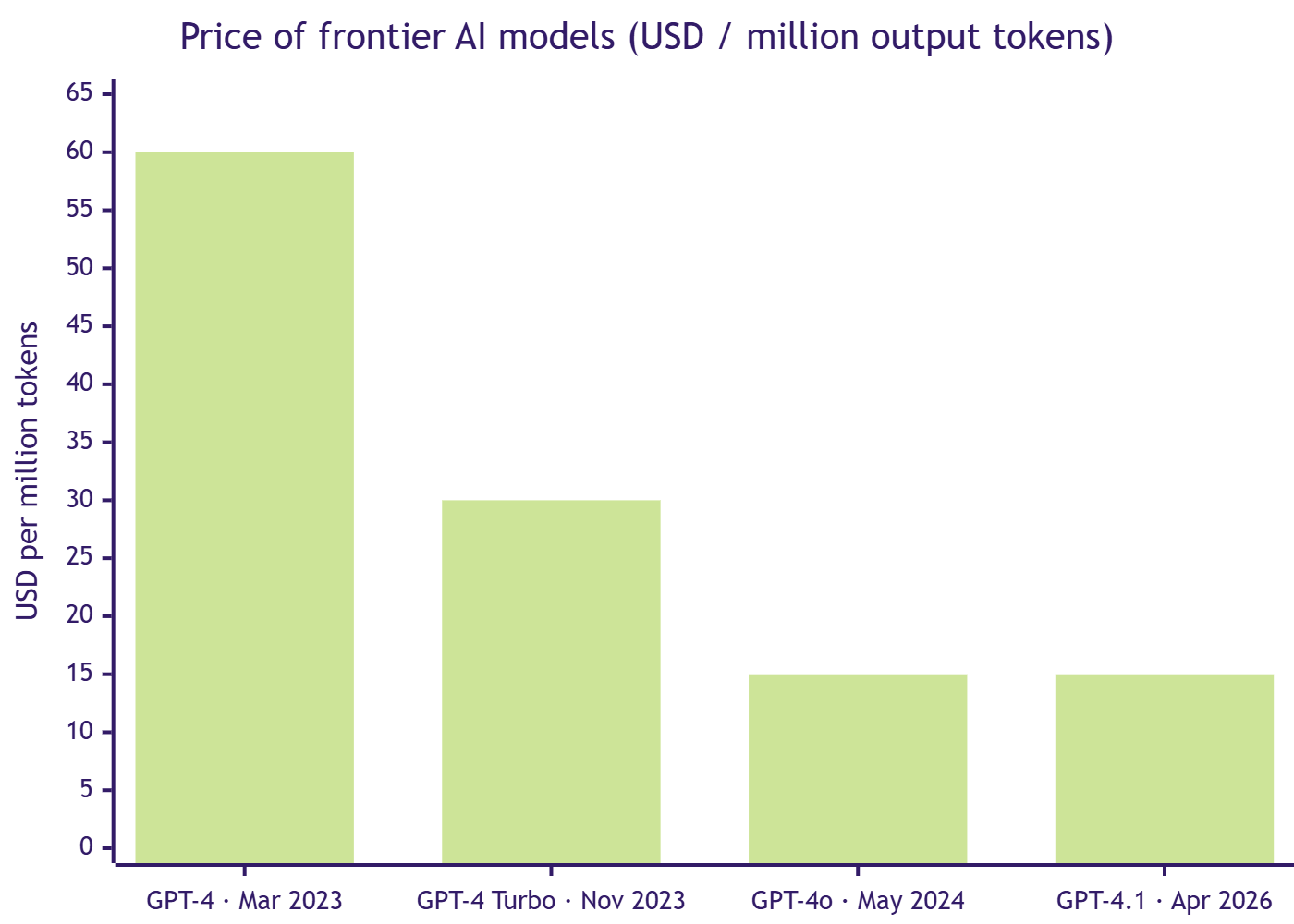
Frontier models have held at around $15/M: GPT-4o launched there in May 2024, and GPT-4.1 — its April 2026 successor — maintains that price. The real differentiation is at the access tier: GPT-3.5 Turbo launched in 2023 at ~$1.50/M output; GPT-4.1 Nano (2026) costs $0.40/M but performs at the level only the frontier model reached in 2023. Access costs fall, capability rises, and what was once the ceiling becomes the new floor. Source: official pricing announcements from OpenAI, documented in March 2023, November 2023, and May 2024.
The field’s own technological trajectory adds another layer of uncertainty. The industry has for years built on the assumption that larger models would keep producing more capable models indefinitely. Data from 2025–2026 challenges that linearity: improvements on reference benchmarks have slowed — MMLU, the standard for years, became saturated in 2025 when virtually every frontier model surpassed it at 88–90%, forcing the design of more complex evaluations — and 76% of AI experts surveyed by AAAI in March 2025 (475 researchers) considered it “unlikely” or “very unlikely” that scaling current approaches would be enough to reach AGI. Ilya Sutskever — co-founder of OpenAI — said it publicly at NeurIPS 2024: “Pre-training, as we know it, will unquestionably end.”
The industry’s response is the one engineers have always given when a general component hits its ceiling: specialization. CPUs hit a power wall around 2004 — Intel canceled Tejas, the planned successor to the Prescott, whose prototype was already consuming 150W at just 2.8 GHz (EE Times, May 2004) — and the sector responded with multi-core CPUs and with repurposing GPUs, which already existed for graphics, for massively parallel computation:
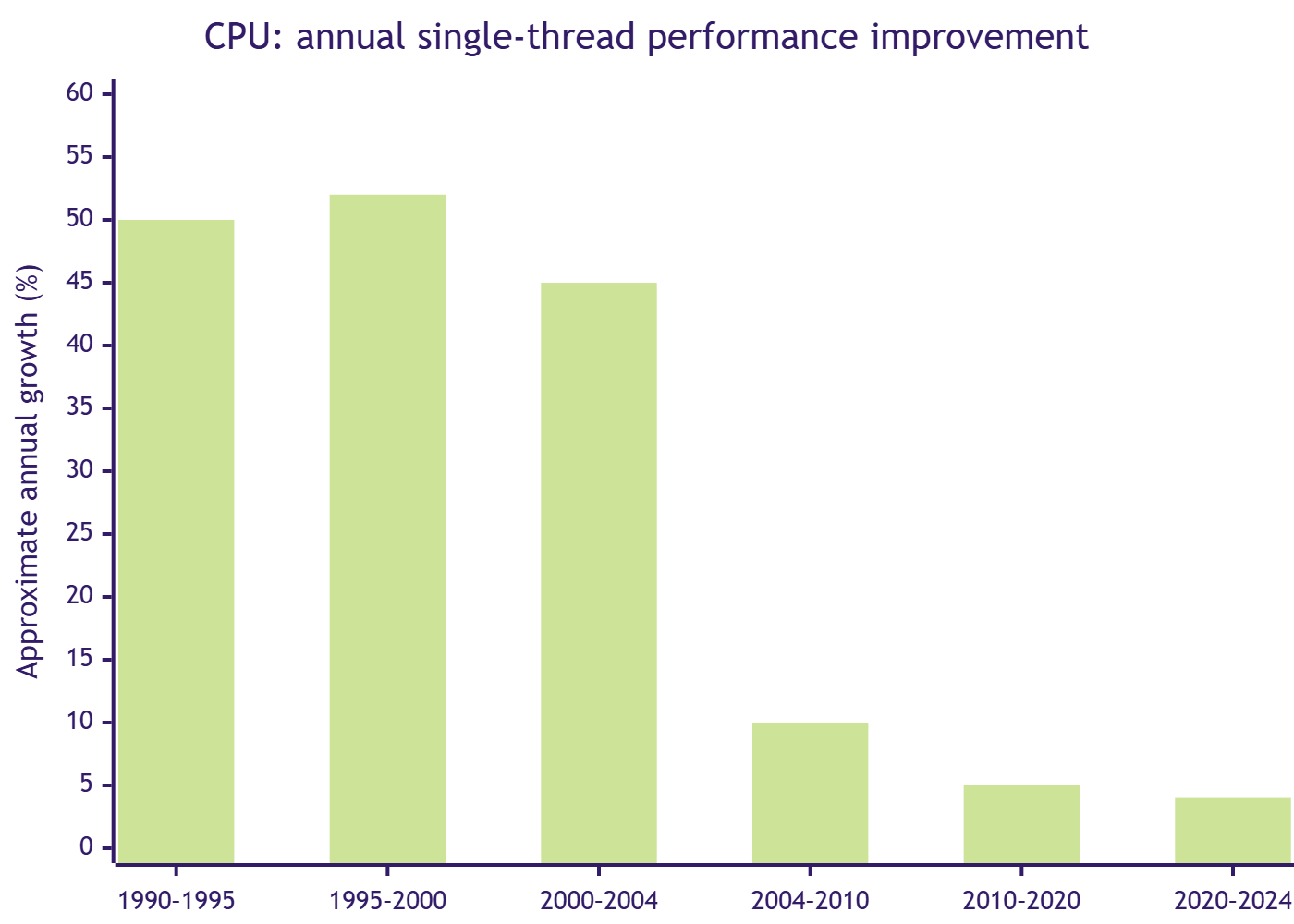
Approximate annual rates of CPU single-thread performance improvement (SPECint). The 2004 power wall is clearly visible: improvement dropped from ~45–50%/year to ~10%/year between consecutive periods. At the same time, consumer GPU compute grew from ~0.3 TFLOPS (GeForce 8800 GTX, 2006) to ~82 TFLOPS (RTX 4090, 2022) — 270× more in 16 years. Source: Karl Rupp, 42 Years of Microprocessor Trend Data (2023).
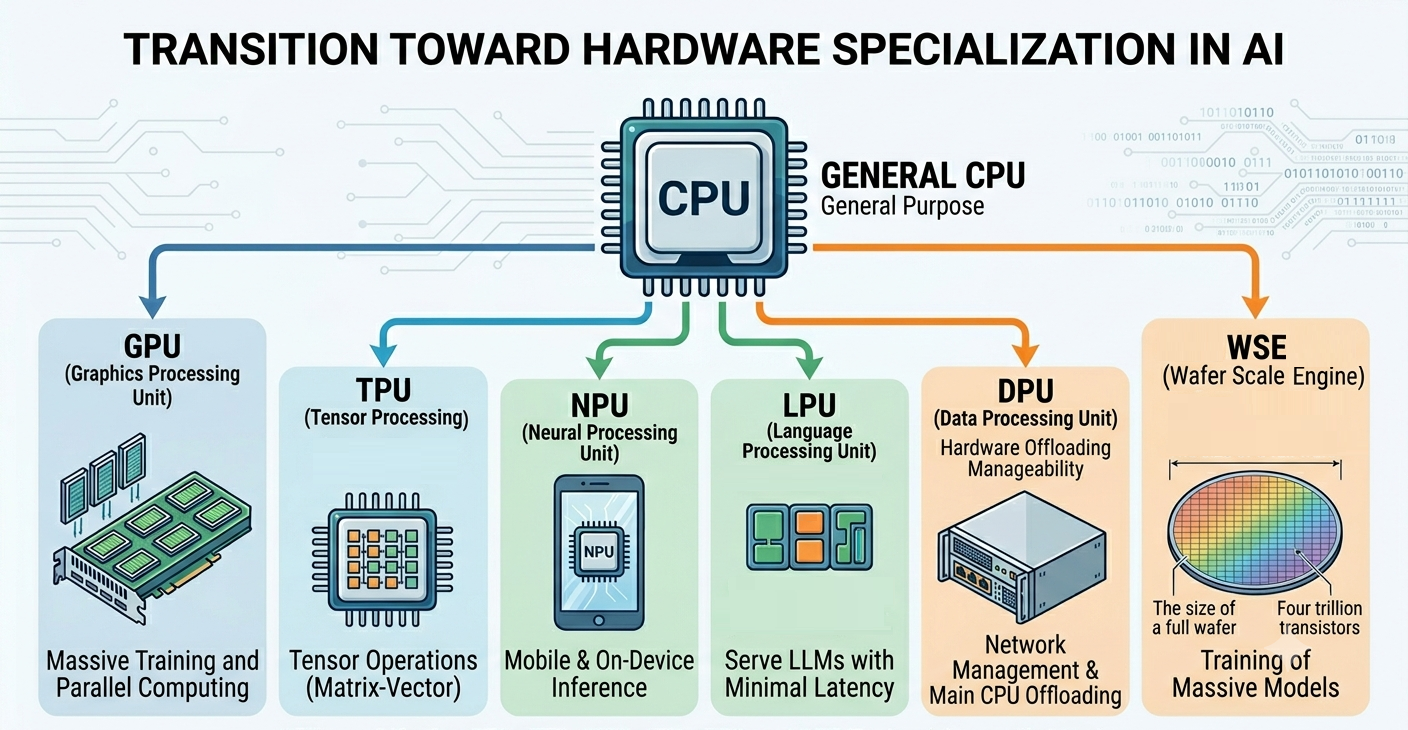
General-purpose algorithms ceded ground to specialized implementations optimized for each type of problem. This pattern has already played out in AI hardware itself: where a general-purpose CPU once sufficed, today there are GPUs for massive training, TPUs (Google) for tensor operations, NPUs integrated into phones for offline inference, LPUs for serving LLMs with minimal latency, DPUs to offload network management from the main processor, and, at the most striking extreme, Cerebras’s WSEs (Wafer Scale Engines): the largest chip ever manufactured, literally the size of a full silicon wafer, with four trillion transistors, designed exclusively for training massive models.
The same transition is happening in language models: from the generalist model that does everything, toward architectures of domain-specialized models — medicine, law, engineering, finance — orchestrated together. The first signs are already visible: Mixture of Experts, reasoning models distinct from generative ones, domain-specific coding models that are beginning to outperform generalists in their specific niches.
What this implies for career decisions runs counter to the usual narrative: if AI specializes by domain, the domain expert who knows how to integrate it has even more value. Not the one who knows “a lot about AI” in the abstract, but the one who knows when to apply it in their specific field and when not to. The advantage is not in knowing AI as a discipline; it is in being the professional who understands how AI behaves in their specific context. Nobody knows what architectures will come after the transformer, when theoretical scaling ceilings will be reached, or which models will be relevant in a few years. Deep domain skills do not become obsolete with an architecture change; bets on a specific model or tool do.
And above all, protect the muscle that makes you valuable: judgment, sustained attention, the ability to think slowly when it matters, and your professional trust network. AI can save you tasks; it cannot save you from the deliberate practice of the skills that justify your salary.
What to Take Away
Ask yourself: “What am I going to do in the coming years so that neither my own obsolete version nor my version turned into a judgment-free tool operator replaces me?”
The 2026 market has already produced some empirical answers, not speculative ones: the professionals who are coming out of this transition stronger are those who combine deep domain judgment with active use of the tool, and who maintain non-automatable assets — a network, a voice, an experience that is not replicated in any corpus. Those at greatest risk are those who occupied the middle ground: good enough to do routine work, not expert enough to provide the judgment AI still cannot deliver.
If I had to pick one sentence to put on the wall, it would be: use AI for what frees you to think more, not for what saves you from thinking. If, at the end of a workday, you have used a lot of AI and thought more, you are on the right track. If you have used a lot of AI and thought less, you are not.
Those who don’t use it lose speed. Those who use it without judgment lose value. Only those who learn both things at once survive in the middle.
Verified Sources
- AAAI (2025). AAAI 2025 Presidential Panel on the Future of AI Research. American Association for Artificial Intelligence, March 2025. Survey of 475 AI experts: 76% consider it “unlikely” or “very unlikely” that scaling current approaches (LLMs) would produce AGI. Cited in “Why There Is No Miracle Solution” to document the research consensus on the limits of scaling. aaai.org (PDF)
- Gartner (Seth, Sicular et al., March 2026). A Journey Guide to Manage AI Governance, Trust, Risk and Security. ID G00821153. Strategic prediction: “Through 2027, most AI projects will fail to meet expectations due to their failure to focus on data governance.” Cited in “From Prototype to Production” to document the gap between expectation and reality in enterprise AI projects. gartner.com/doc/reprints (access restricted to subscribers)
- Risko, E.F. & Gilbert, S.J. (2016). Cognitive Offloading. Trends in Cognitive Sciences, 20(9), 676–688. DOI: 10.1016/j.tics.2016.07.002 · PubMed 27542527. Conceptual basis for cognitive offloading in “Preserve Your Cognitive Muscle.”
- Fan, Tang, Le, Shen et al. (2025). Beware of metacognitive laziness: Effects of generative artificial intelligence on learning motivation, processes, and performance. British Journal of Educational Technology 56(2), 489–530. DOI: 10.1111/bjet.13544 · arXiv:2412.09315 (open access). Coins the term “metacognitive laziness”: when AI handles the “how” as well as the “what,” the user loses the ability to critically evaluate their own cognitive processes. Conceptual basis for “Preserve Your Cognitive Muscle.”
- Liu, Christian, Dumbalska, Bakker & Dubey (2026). AI Assistance Reduces Persistence and Hurts Independent Performance. arXiv:2604.04721 (open access, April 2026). Controlled experiment with 354 participants (191 AI group + 163 control): solving 12 fraction problems with/without GPT-5 access, followed by 3 additional problems without assistance to measure independent performance. Results: lower resolution rate in the AI group (0.57 vs. 0.73; p < 0.001, d = −0.42) and higher abandonment rate (0.20 vs. 0.11; p = 0.031). The effect replicated in reading comprehension. Identifies “productive struggle” as the mechanism AI eliminates — the mechanism that builds both knowledge and the metacognitive calibration that sustains persistence. Cited in “Preserve Your Cognitive Muscle.”
- Federal Reserve Bank of Atlanta — Working Paper 2026-4, March 2026. Artificial Intelligence, Productivity, and the Workforce: Evidence from Corporate Executives. Survey of 750 CFOs (Duke University + Atlanta Fed + Richmond Fed, Dec. 2025): reported productivity improvement by executives = 1.8% (2025); implied improvement measured from revenue/employment = 0.6%. Negative Exposure Index by occupation: admin/office 2.0 (substitution), software/IT 0.6 (complementation), management 0.1 (most complemented). Adoption barriers: 42% technology “too immature,” 36% workforce not trained. atlantafed.org
- Federal Reserve Bank of St. Louis — Working Paper 2024-027C, revised February 2025. The Rapid Adoption of Generative AI. Workers using generative AI report saving an average of 5.4% of their working hours per week, implying a productivity increase of 1.1% for the workforce as a whole. Cited in “The Productivity Trap.” stlouisfed.org
- NBER Working Paper 34836 (Yotzov, Barrero, Bloom, Davis et al., 2026). Firm Data on AI. Global survey of executives in the US, UK, Australia, and Germany (Nov. 2025–Jan. 2026). 89% report zero impact on productivity in the past 3 years; those who do detect any improvement put it at an average of +0.3%. Enterprise adoption: 69% globally, 78% in the US. Three-year projection: +1.4% productivity, −0.7% employment. Source for the third value in the perception-vs-reality table. nber.org/papers/w34836 · NBER Digest May 2026
- Kim et al. (2026). Generative AI and the Reallocation of Time: Productivity, Leisure, and Fulfilling Work. arXiv:2602.12695. Study with 51,800 Korean workers: 3.8% average reduction in work time with AI; correlation between time saved and output increase near zero — time saved is captured as work leisure in contexts where the worker controls their own pace.
- Dominski & Lee (2026). Advancing AI Capabilities and Evolving Labor Outcomes. arXiv:2507.08244. Analysis of AI’s impact on employment (October 2022–March 2025): greater AI exposure associated with lower employment and lower work intensity in some profiles. The effect is differential by age: employment drop in workers aged 22–25 in high-exposure occupations; stability or growth in more experienced profiles during the same period. Cited in “2023 and What Happened Next.”
- ManpowerGroup (2026). The H Factor: The Human Contribution in the AI Era (2026 Future of Work Trends Report) and Talent Shortage 2026. Surveys of more than 12,000 professionals and 39,063 companies in 41 countries. Data cited: only 44% of workers globally received training in new skills in the past 6 months (Global Talent Barometer, Jan. 2026); AI skills are the hardest-to-find hard skills, both in Spain (78% talent shortage, +3 points vs. 2025) and globally. The report warns that “true AI literacy will involve thinking more, not less.” manpowergroup.es/estudios/el-valor-h-la-aportacion-humana-en-la-era-de-la-ia · manpowergroup.es/estudios/desajuste-de-talento-2026
- Garman, M. (AWS CEO, December 2025). Statements on the risk of eliminating junior employees in favor of AI: “one of the dumbest ideas”; “at some point the whole thing explodes.” Basis for the judgment-debt and talent-pipeline argument in “2023 and What Happened Next.” fortune.com
- Hosseini, S.M. & Lichtinger, G. (Harvard University, 2026). Generative AI as Seniority-Biased Technological Change: Evidence from U.S. Résumé and Job Posting Data. First version: August 2025; version cited: June 2026. Data: LinkedIn + Revelio Labs, 65 million workers, more than 280,000 companies in the US, 2015–2025, ~200 million job postings. Result: junior employment at companies that adopted GenAI falls ~9% relative to senior employment after 6 quarters; in occupations with high AI exposure, ~7% relative to low-exposure ones. Senior employment shows no comparable break. ssrn.com/abstract=5425555
- El Diario / Olías & del Castillo (30 Apr 2026). La inteligencia artificial irrumpe con despidos en el mercado de trabajo con muchas dudas sobre su impacto real. Source for the Ravio analysis (compensation firm): entry-level positions in tech −73% year-on-year, AI-linked jobs +88% (no primary link verified); and for statements by Dario Amodei (CEO Anthropic, late 2025) on eliminating entry-level roles in law, finance, and consulting within five years. eldiario.es
- PwC (2026). Global AI Jobs Barometer 2026. Analysis of more than 1 billion job postings across 27 countries. Roles with AI skills pay 62% more than equivalents without AI in 2026 (56% in 2025 per the same barometer, 25% the year before). AI-skill jobs grow eight times faster than the overall market (69% vs. 9%). Documents a two-lane market: “professionalized” roles (2× employment growth, 42% greater salary growth) versus “democratized” roles (lower gains on both dimensions). Basis for the salary premium and the two-lane concept in “The Floor Has Risen.” pwc.com (official press release 2026)
- The National News / PwC — Hidden cost of replacing junior talent with AI, April 2026. The share of companies planning to reduce junior roles jumped from 17% to 43% in one year. Most affected sectors: marketing, communications, law, banking, accounting. thenationalnews.com
- Slok, T. (Apollo Global Management). A 160-year-old paradox explains why AI will create more lawyers and accountants — not fewer. Fortune, April 2026. Application of the Jevons paradox to the labor market: efficiency does not reduce demand for work; it redirects it toward more work of the same type or work at a higher level. fortune.com
- Fortune — The AI productivity paradox: More work, not less, March 2026. Documentation of the workload reallocation phenomenon: Dun & Bradstreet case (“I got the eight hours to two hours, but now I can get 20 hours of work”), AES Corporation (14-day audit → 1 hour), BCG (12% more mental fatigue in workers supervising multiple AI tools). fortune.com
- Stanford AI Index 2026 — Stanford HAI. Data on employment, headcount-reduction expectations, and organizational adoption. Specific data on junior talent market: share of tech jobs requiring three years of experience or fewer fell from 43% in 2018 to 28% in 2024; software developer employment among workers aged 22–25 has accumulated a decline of 16–20% since the late-2022 peak. Cited in “2023 and What Happened Next.” Full report PDF
- Hassabis, D. / WIRED (May 2026). Exclusive interview with the CEO of Google DeepMind. Statements on the crossed incentives of tech leaders proclaiming “the end of programming” to inflate valuations. WIRED article
- METR (2025). Measuring the Impact of Early-2025 AI on Experienced Open-Source Developer Productivity. Becker, Rush, Barnes, Rein. Randomized controlled experiment: 16 experienced developers across open-source repositories, 246 tasks (~2h each), Cursor Pro + Claude 3.5/3.7 Sonnet. Developers took 19% longer to complete real tasks than those not using AI, while estimating they had been 20% faster (a 39-point perception gap). Additional finding: before the experiment, developers expected +24% gains; external experts (economists, ML specialists) predicted +38–39%. arXiv:2507.09089 · metr.org/blog
- Faros AI (2025). AI Engineering Report 2025: The AI Productivity Paradox. Telemetry from 10,000+ developers across 1,255 teams. Verified metrics: +21% individual tasks completed; +98% more PRs merged; +91% more PR review time; +154% in PR size; +9% bugs per developer. The report’s own conclusion: “AI coding assistants are making individual developers faster. They are not making companies more productive” — no significant correlation between AI adoption and company-level improvements. faros.ai/research
- Sutskever, I. (December 2024). Statement at a NeurIPS 2024 side event: “Pretraining as we know it will end.” Reference to the transition from pure scaling toward model specialization, developed in “Why There Is No Miracle Solution.”
- Stack Overflow Developer Survey 2025 — Survey of 49,000+ developers worldwide. Reference for salary ranges by region used in the comparison table. survey.stackoverflow.co/2025
- Howdy.com (2026). LATAM Software Engineer Cost Benchmarks 2026. Verified salary data by country in Latin America (AR/BR/CL/CO/MX). howdy.com/blog/latam-software-engineer-cost-benchmarks-2026
- GitHub (June 2026). Copilot Plans & Pricing. GitHub Copilot Enterprise: $39/user/month; GitHub Enterprise Cloud (required): $21/user/month additional. github.com/features/copilot/plans
- OpenAI — Documented pricing history: GPT-4 (Mar. 2023) $60/M output tokens → GPT-4 Turbo (Nov. 2023) $30/M → GPT-4o (May 2024) $15/M → maintained at ~$15/M in 2026. Source for the model price evolution chart. openai.com/pricing
- Mind the Product Benchmarks (2024). Powered by Pendo data. Based on data from 6,800 applications and 2,500 companies: only 6.4% of features account for 80% of all clicks; at benchmark companies it rises to 15.6%. Empirical basis for the satisficing phenomenon applied to software tools, developed in “Four Profiles.” pendo.io/product-benchmarks
- Microsoft Work Trend Index — Breaking Down the Infinite Workday. Analysis of work patterns in organizations: average of 117 emails/day, 153 chat messages/day, ~275 daily interruptions, 48% of workers describe their day as chaotic. Documents how productivity tool proliferation expands the workload rather than reducing it. microsoft.com/worklab
- Daily Nous (3 Jun 2026). AI in the Philosophy Job Market (guest post). Analysis of postings published on PhilJobs — the academic philosophy portal — since 2013: those mentioning AI rose from 1% in 2013 to 16% in 2025, including junior-profile positions. Cited in “The Floor Has Risen” as empirical evidence of the rise of philosophers as a profile in demand by the AI industry. dailynous.com
Opinion Pieces
- Despedidos o millonarios: la nueva fractura invisible entre desarrolladores — Enrique Dans, May 2026. Link (article in Spanish)
- AI vs Gen Z: How AI has changed the career pathway for junior developers — Stack Overflow Blog, December 2025. Documentation of the shift in the junior tech employment market following mass adoption of generative AI. stackoverflow.blog
- Will AI replace juniors? The false debate that’s only the tip of the iceberg — Bertrand Duperrin, November 2024. Analysis of the 2023 “junior + AI replaces senior” debate and why it was the wrong question. duperrin.com
- If AI takes the junior work, who becomes the next senior? — Tash Willcocks, Medium / Bootcamp, June 2026. The talent pipeline problem: without junior training, there will be no seniors in 5–7 years. medium.com
- Reuters Institute — Generative AI and News Report 2025. Public comfort with AI-only news (12%) vs. human-led (62%). Official PDF
- CEOs Say Layoffs Are AI’s Fault, But Some Experts Think Companies Are Lying — Mary Roeloffs, Forbes, May 2026. Experts argue that AI is the preferred scapegoat for justifying layoffs caused by pandemic over-hiring: Sam Altman, Babak Hodjat (Cognizant), and Marc Andreessen agree that some Big Tech companies have between 25% and 75% excess staff. forbes.com
- La inteligencia artificial irrumpe con despidos en el mercado de trabajo con muchas dudas sobre su impacto real — Laura Olías and Carlos del Castillo, El Diario, 30 Apr 2026. Analysis of Big Tech layoffs (Meta, Amazon, Microsoft, Block), the “AI washing” phenomenon, the Harvard study on junior hiring in 285,000 companies, Ravio data on the fall of entry-level positions in tech (−73%), and AI-linked job growth (+88%). Includes union perspectives and Eurostat data on enterprise adoption. eldiario.es (article in Spanish)
- Intel cancels Tejas, moves to dual-core designs — EE Times, May 2004. Real-time coverage of the cancellation of the Tejas processor (Prescott successor) and Intel’s pivot to multi-core; documents the power wall that ended frequency scaling. Source for the CPU/GPU analogy in “Why There Is No Miracle Solution.” eetimes.com
- The Broken Ladder: AI, Remote Work, and Early-Career Hiring — Lambert & Schindler (LSE, May 2026). Study analyzing the decline in junior hiring while controlling simultaneously for AI exposure and remote work. Result: the GenAI coefficient weakens to statistical insignificance when both variables are controlled for; remote work exposure remains a robust predictor. Proposed mechanism: remote work raises the cost of supervising and on-the-job training for juniors more than for seniors, discouraging entry-level hiring. Cited as a causality caveat in “2023 and What Happened Next.” Covered in hcamag.com and builtin.com.
- Efectos perjudiciales de la inteligencia artificial (IA) — Ignacio Morgado Bernal, El País, 22 Jun 2026. Dissemination of Liu et al. (arXiv:2604.04721, 2026): the 10–15 minute GPT-5 experiment that measurably reduces persistence. Explains the concept of productive struggle and the risk of cumulative dependence. elpais.com (article in Spanish)
- Head of Microsoft Rages at His Fellow CEOs for Admitting What They’re Actually Doing to Society With AI — Futurism, June 2026. Coverage of Satya Nadella’s WSJ interview in which he criticized his competitors’ tone: “You can’t say all white-collar jobs are going to disappear and at the same time use every watt of power available to build data centers.” The article also contextualizes Microsoft’s strategic position: with no frontier model of its own, a distributed, affordable-pricing market serves Nadella’s interests. futurism.com
- Creator of Claude Code Fears This Could Be the Last Year That Software Engineers Are Employable — Futurism, February 2026. Boris Cherny, creator of Claude Code, predicts that “the software engineer title is going to start disappearing” and that “everyone is going to be a product manager and everyone codes”; describes not having edited “a single line by hand since November.” Complements his Platformer interview (June 2026), where he adds there will be “100 times more engineers than today, though they won’t be called that.” A first-person perspective from inside the industry, more extreme than what the empirical junior-hiring data reflects. futurism.com · platformer.news
- Cómo la IA está destruyendo la carrera de programación que una vez amé — El Salto, July 2026. First-person testimony from a self-taught developer who reached the middle class through programming and now sees their career become precarious: AI multiplied demands without raising salaries, and the combination of FAANG layoffs and AI-generated CVs makes re-employment nearly impossible. The tone is political and the register is different from the other sources, but the pattern it describes — the productivity trap from the individual worker’s perspective — is supported by the Faros AI and METR data cited in this article. elsaltodiario.com (article in Spanish)
- Más de 500 millones de dólares para preparar a los trabajadores estadounidenses ante la revolución de la inteligencia artificial — El País, 25 Jun 2026. The bipartisan RAISE US initiative — backed by OpenAI, Anthropic, Amazon, and Microsoft — targets $1 billion for workforce retraining in the US. Most significant: the same companies accelerating automation also finance the adaptation, confirming that the labor transition is real and requires active policy, not just individual adaptation. Still pilot-stage in four states. elpais.com (article in Spanish)
- Why AI firms are turning to philosophers — The Week, 2026. Analysis of philosopher hiring at major AI companies: Anthropic (Amanda Askell), Google DeepMind (Henry Shevlin as “Philosopher” in May 2026), and OpenAI. Documents both the phenomenon and Daniel Fogal’s (NYU) warning about the risk of mediocre work when labor pressure replaces vocation in an industry that demands paces incompatible with good philosophy. theweek.com
“How to Avoid Being Replaced Without Selling Out to AI” by Ramón Invarato at jarroba.com, licensed under Creative Commons Attribution-NonCommercial-ShareAlike 3.0. Registered at Safe Creative.

You may also like

How to Adopt AI in Your Organization Without Making the Most Common Mistakes
Failure and success patterns in AI adoption, a practical decision framework, safe use cases, and minimum viable governance for development teams.

The Real Cost of AI: From the Democratic Promise to the Enterprise Model
Copilot moves to token billing, JetBrains cuts quotas, Claude raises costs with new tokenizer. Analysis of the economic divide AI is opening in 2026.

AI in Business: Expectations vs. Reality — Who Benefits, and at What Cost?
Article series on what each stakeholder gains and loses from enterprise AI: CEO, developers, managers, and users. Informed opinion, no hype.

What AI Can and Cannot Do Today in Software Development
what AI actually does well in software development, what it can't do yet, and why. The 5 integration levels and the junior developer paradox.
Leave a comment