
What You Have and AI Lacks
Biographical memory, sensory context, lived context, functional emotion, and accountability. The five LLM shortcomings and why they are your value.
Series: AI and You part 3 of 9
- Introduction
- 1“I don’t want anything made with AI” – The consumer paradox
- 2Why You Lose With (and Against) AI
- 3What You Have and AI Lacks
- 4The Free Agent Trap
- 5At Machine Speed: How AI Has Broken the Cybersecurity Balance
- 6AI Regulation: The Dilemma Between Protecting and Falling Behind
- 7How to Avoid Being Replaced Without Selling Out to AI
- 8Tricks for Using AI Well
- 9“If It Works, Don’t Touch It” and Other Excuses That No Longer Hold

Biographical memory, lived context, and why they matter
Standalone article from the series “AI and You”.
A modern AI knows that water boils at 100 degrees Celsius at sea level. It knows this because it has read it a million times. But it has never burned itself by putting its hand in a boiling pot. That difference, seemingly trivial, is the core of this article.
People who have been working with generative AI for a while experience something curious: at first, they are amazed by how much it knows. After a few weeks, they discover there are things it structurally cannot do. We will call these the model’s shortcomings or structural limitations. They are not bugs that will be fixed next year with a new version. Knowing what they are and where they appear is one of the skills that produces the most economic value today in any knowledge-based profession.
What AI Is and What It Is Not
Before discussing limitations, we should briefly review what exactly a Large Language Model (LLM) is. A modern LLM is a statistical system trained on massive amounts of data (text, image, voice, video, depending on the model) that learns to predict the next token based on the previous ones. It has no persistent internal states between conversations (except for explicit memory added on top of it), it has no physical sensors, it has no biography, it has no proprioception (the sensation of occupying a body), and it has no functional emotions in the human sense. It does, however, have an enormous capacity to combine patterns learned from millions of data points.
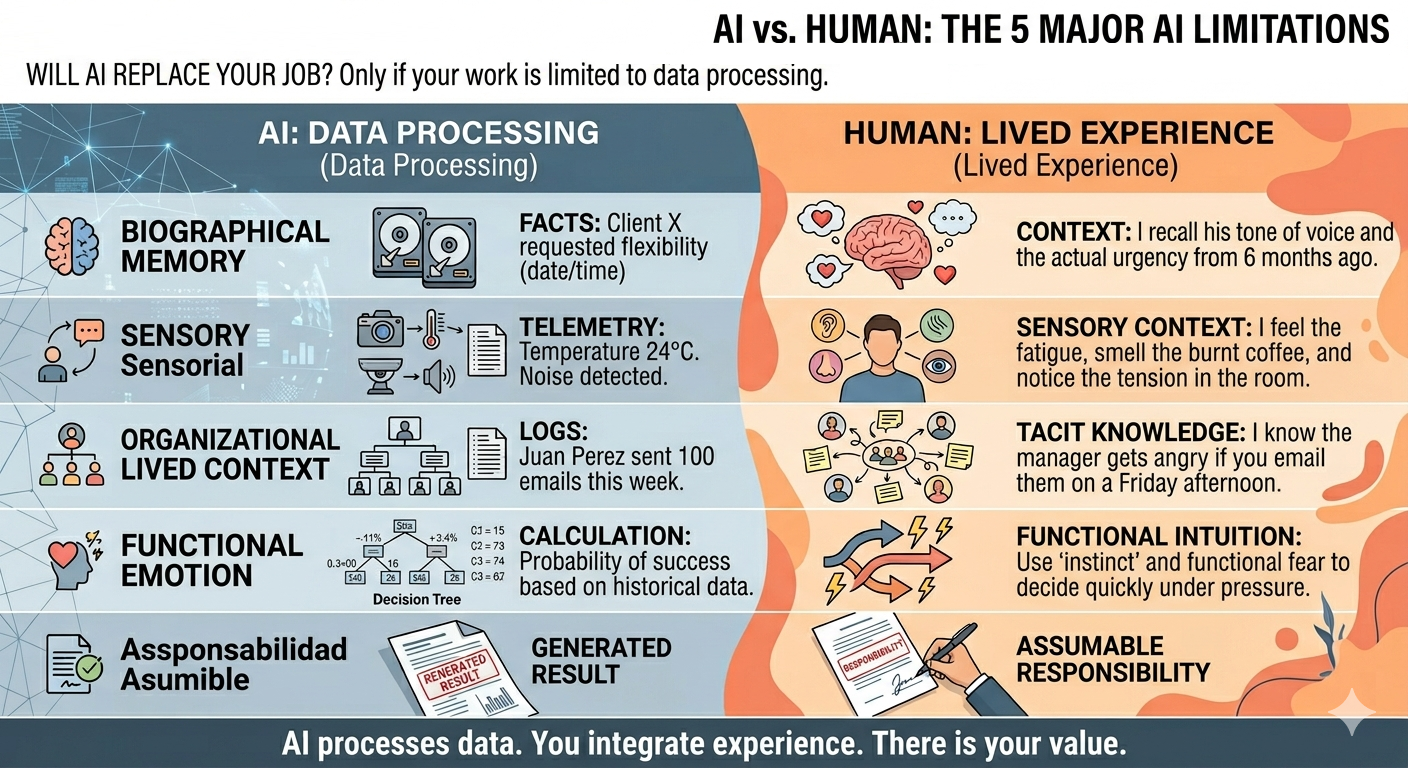
This distinction matters because many people believe AI possesses a “cheap version” of what a human has. This is not the case. AI has something else: an enormous textual and statistical processing capability. What the human has are five distinct capacities that the system does not replicate, and it is crucial to clearly identify them because that is where your value lies.
As Carme Artigas (Co-Chair of the UN AI Advisory Body) bluntly reminded us at the Magnifica humanitas forum in 2026: “AI is not learning; it is taking data to make massive patterns and statistical calculations.” Demystifying the tool is the first step to avoiding being narcotized by its commercial narrative.
Limitation 1: Biographical Memory
You remember, in detail, specific conversations you had months ago. You remember where you were when your boss gave you that important news. You remember the smell of the hospital waiting room when you were there. You remember the song playing in the car on the day of your trip. That memory is biographical: episodic, anchored to a body, a place, a time, and loaded with associated emotion.
AI has nothing like this. Even if you give it memory (context windows, caches, vector databases, semantic indexes, MCPs, etc.), that memory is a database of facts that the system queries, not a lived experience. The difference is important because human biographical memory does something the database does not: it selects what is important through emotional mechanisms, compresses it into narrative, and rescues unexpected associations when a new situation resonates with an old one.
At work, this translates into very concrete things: you know that when a client says “I need flexibility,” what they really want is something specific they mentioned six months ago in another meeting. Or when a manager asks you to move forward on a project with ambiguous guidelines because not even they have defined the goal, and you manage to decipher and accurately execute what was required thanks to accumulated intuition. AI lacks this arc; you have to tell the AI the entire story for it to process it.
Limitation 2: Sensory Context and Proprioception
AI has no body. It does not feel fatigue, it does not feel hunger, it does not feel the temperature of the office, it does not feel the weight of its arm. It does not smell the burnt coffee in the kitchen, nor does it notice the metallic smell of a server that is starting to fail before the alarm triggers. It does not hear the difference between the noise of a departing bus and an engine with problems.
The amount of information a professional processes through non-textual channels is enormous and almost always invisible to themselves (those little everyday ‘superpowers’ based on perception). The building concierge who knows “something isn’t right” before anything fails. The doctor who detects a patient is paler than their last visit. The teacher who perceives a student has a problem at home by how they sit. The engineer who hears a strange sound and suspects a specific part. None of this appears in any log that an AI can read.
Even if the AI has cameras and microphones (multimodal models do), what it receives are textualized data from those sensors, not the integrated experience of having a body in a space.

The Illusion of Robotic Embodiment
Many tech giants argue that this physical limitation is temporary and will be solved through embodiment (providing artificial intelligence models with a physical robotic body). The clearest example is the deployment of large-scale learning platforms for humanoid robots, such as NVIDIA’s Project GR00T, designed for machines to understand space and emulate human movements by observing the environment.
However, a cognitive and insurmountable barrier hides here: an android covered in advanced cameras and haptic pressure sensors does not experience space; it only processes telemetry. If a servomotor in its robotic arm begins to overheat from exertion, the central AI system receives an alert log or a numerical error code; lacking a real sense of self-preservation, the machine will continue executing the instruction blindly until physical self-destruction unless a software parameter or a human shuts it down. In contrast, if your biological arm is exhausted after hours of work, your brain activates homeostasis: an evolutionary, uncomfortable, and urgent signal intimately linked to survival that forces you to stop to protect the organism. AI translates the environment into stable vector data; the human being translates the environment into subjective organic experience.
Limitation 3: Lived Organizational Context
When you have been at a company for years, you know things that are not written down anywhere. You know that a certain boss gets angry if you email them on a Friday afternoon. You know the sales rep from a specific region always exaggerates their forecasts. You know that a project from years ago was canceled not for technical reasons, but because two directors were not speaking to each other. You know the billing system is the way it is because a botched migration a decade ago left some quirks.
That knowledge is not documented. It cannot be documented because it changes, relies on people, and has nuances that are not written down. When you leave a company, that knowledge goes with you, and the company takes years to rebuild it, if it ever truly can. AI cannot reproduce it even if you talk to it for hours, because that knowledge wasn’t even whole in your head: you construct it in each situation from fragments.
For an organization with a long history, this tacit knowledge is worth more than any source code. That is why mass layoffs of senior profiles, justified by “AI can do their job,” often turn out to be very expensive twelve months later. AI couldn’t do their job. It could do a mechanical part; the rest left with the worker.
Limitation 4: Functional Emotion
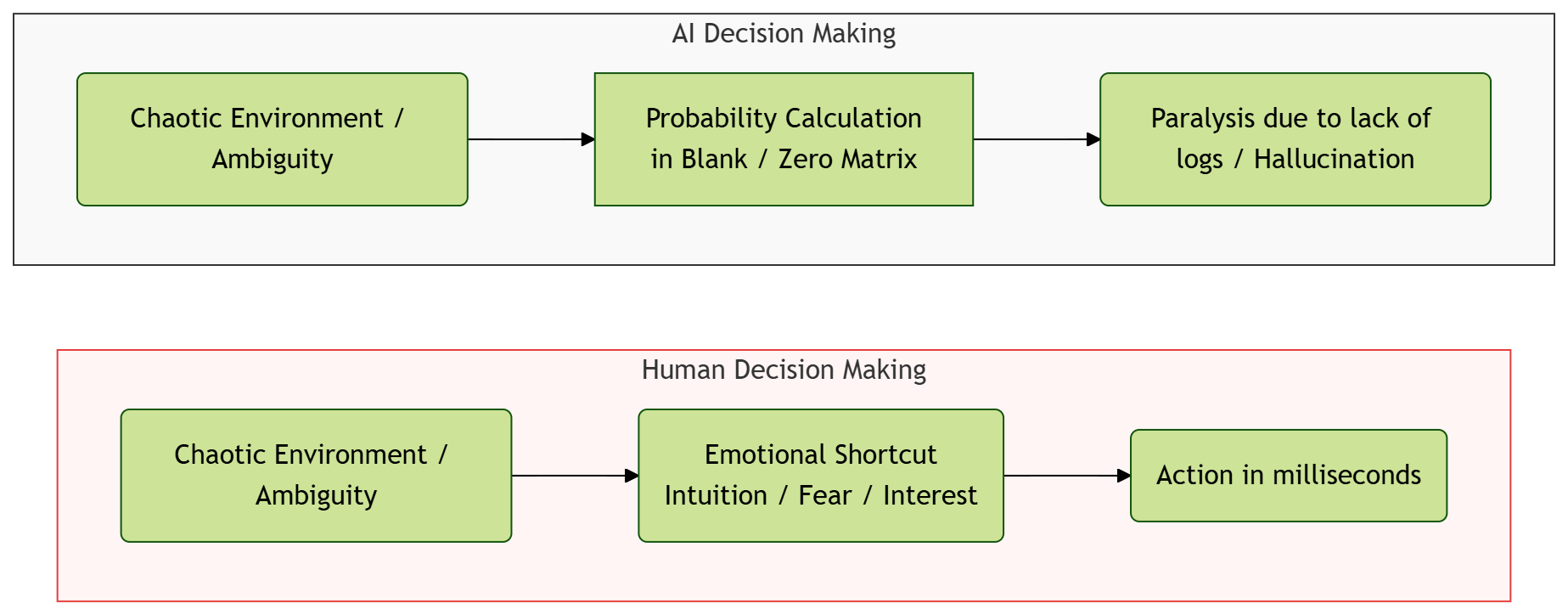
Talking about emotions in AI always tangles the conversation a bit. Some say AI “simulates” emotions, some say it “doesn’t have them,” and some say they “are exactly like human ones” precisely because it is fed on human data, even if internally it arrives at them differently (functional isomorphism). In reality, human emotions are a function that serves to make rapid decisions with incomplete information. Fear makes you pull your hand away from the fire before reasoning. Interest orients you toward novelty. Fatigue tells you when to stop. Disgust keeps you away from spoiled food.
AI lacks this functional system. It can describe fear, it can generate text that sounds scared, it can analyze the emotions of others, but it does not make decisions out of fear. There is no internal emotional mechanism that guides it, stops it, or pushes it. This has practical consequences: when you ask an AI to decide in a highly ambiguous situation, it lacks the emotional shortcut you use to avoid paralysis. It either chooses randomly within its statistics, invents a reason, or throws the question back at you. None of the above equates to “deciding well under pressure.” One could argue here that if we force an AI with certain data, it is steered toward a certain output “simulating fear” (it indeed has biases). However, AI starts from a blank canvas during its training (a zero-initialized matrix or an empty memory); the system is strictly limited to the data we choose to feed it at that moment. The human being, conversely, does not start with a blank canvas (from the very beginning, their brain knows how to make their heart beat, at the very least); during our growth, we receive stimuli that go beyond simple data input (wrestling or feeling the rain, for example). What we experience daily with other people socially, what we go through emotionally during our lives—all of this prepares us to make the human decisions we make.
For professionals who make many rapid decisions with little information (medical emergencies, trading, incident management, live coaching), functional emotion remains a tool. And AI does not have it.
A 35-year meta-analysis published by the American Psychological Association (APA) in 2026 found a critical increase in what psychologists call “perfectionistic concerns”: an acute fear in younger generations of making mistakes and being judged due to the hostility of the labor market. This creates a dangerous temptation: using AI’s “perfect” statistics as a painkiller to avoid the anxiety of deciding. But professional decision-making involves tolerating ambiguity and assuming risk; if you delegate the choice to protect yourself from failure, you are surrendering the core of your market value.
Limitation 5: Accountability
There is one last element that is more sociological than technical, but equally important. When something goes wrong in a professional job, someone has to answer for it: legally, professionally, or morally. A doctor answers for their diagnosis. An architect signs their blueprints. A lawyer puts their name on the contract. A journalist signs their article.
AI signs nothing. It cannot be sued, it cannot be fired, it cannot be sanctioned. This means that in any profession where a signature is relevant, AI can do a good part of the work but it cannot take the seat. The human who signs is still necessary, and therefore keeps getting paid.
This is important because some companies are learning the hard way that letting AI decide autonomously is incredibly expensive when something fails and there is no one to point a finger at. That is why the European regulatory framework (EU AI Act) and professional frameworks (colleges, associations) are heavily reinforcing the obligation of significant human oversight for AI systems in high-impact decisions. Whoever oversees will have accountability. Whoever holds accountability holds value.
This need for human control has triggered historic sociological milestones, such as the joint manifesto gathered in the Magnifica humanitas treaty (2026), where traditionally opposed sectors—employers’ associations, major unions, and social leaders—aligned in a common global front: demanding a social pact so that machines never replace the sovereignty of judgment and human accountability in the workplace.
The Professional Shield: From Hyperspecialization to Polymathy (M-Shaped Profiles)
We are living in a historical paradox. During the Renaissance, polymathy (Wikipedia: The knowledge of many arts and sciences) was the norm because accumulated human knowledge could be grasped by a single mind. The 20th century penalized the polymath and created “silos” because the information explosion forced people to lock themselves into hyperspecialized niches. Today, the 21st century demands polymathy again, but for the opposite reason: since AI already processes the data overload of each niche, human value reverts to the Renaissance ability to connect the dots between them.
If we combine these five structural limitations of AI, we arrive at an inevitable conclusion that is transforming the global labor market: value has shifted from hyperspecialization to polymathy.
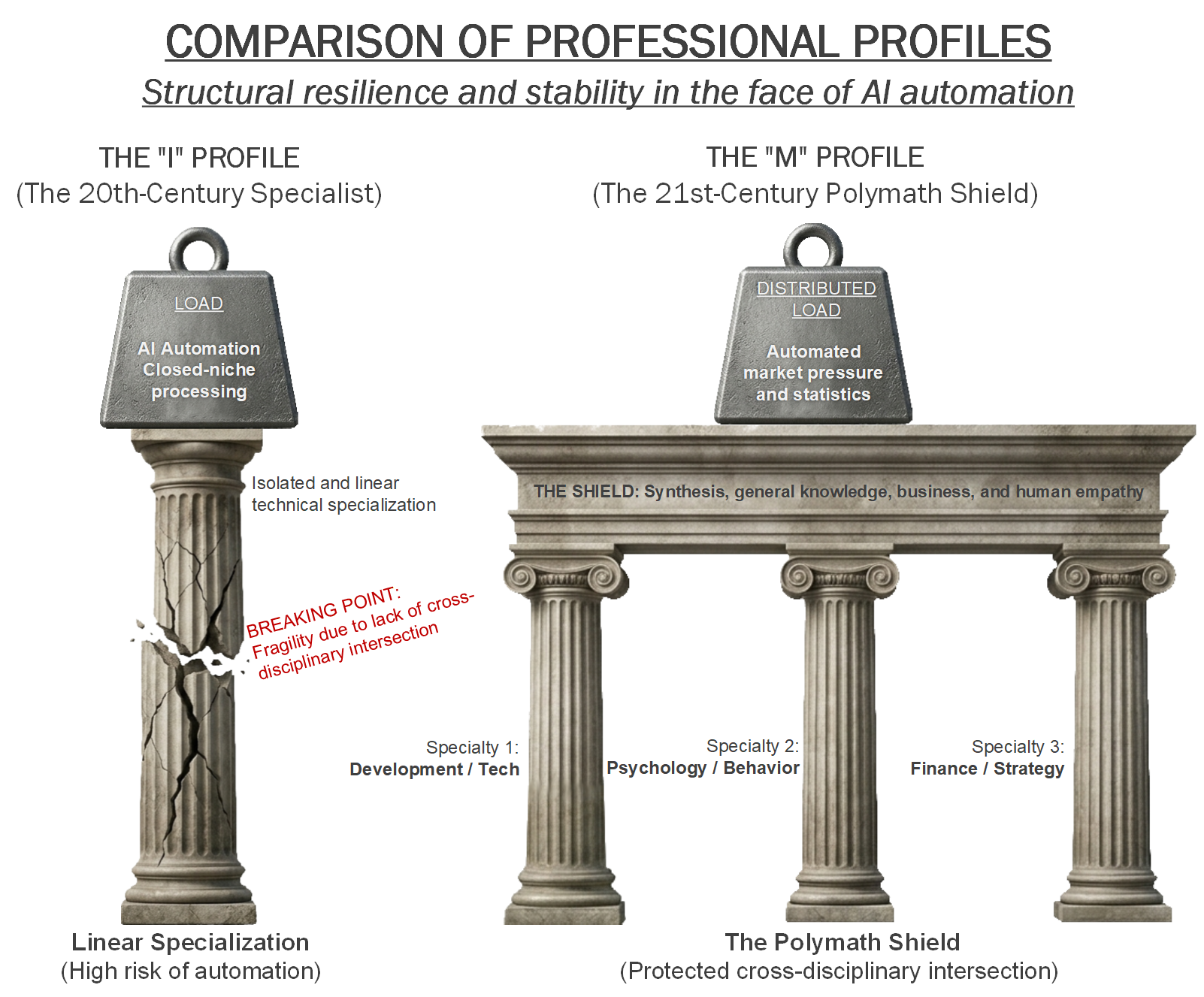
During the 20th century, the economy rewarded the “I-shaped” profile: the pure specialist who knew “everything about almost nothing.” However, a hyperspecialized and linear technical track is the perfect terrain for an LLM. AI is unbeatable at processing stable rules within a single closed niche.
Where does it fail? At the intersections. Connecting two completely different worlds requires lived context, biographical memory to find subtle analogies, and the accountability to take a leap of faith with a new idea. This is where the concept of the “M-Shaped” or “Comb-Shaped” profile comes in.
It is not about being a “shallow generalist” (an ocean of knowledge with an inch of depth). It is about having several pillars of deep specialization connected by a horizontal bar of general culture, business acumen, and empathy.
A software developer who deeply understands behavioral psychology, or a systems architect who masters financial narratives and team management, is a polymath profile. AI can write the code or calculate the balance metric for each pillar separately, but the transversal synthesis—the glue that binds both disciplines under real pressure—only happens in a human mind with a biography.
What This Means for Your Day-to-Day
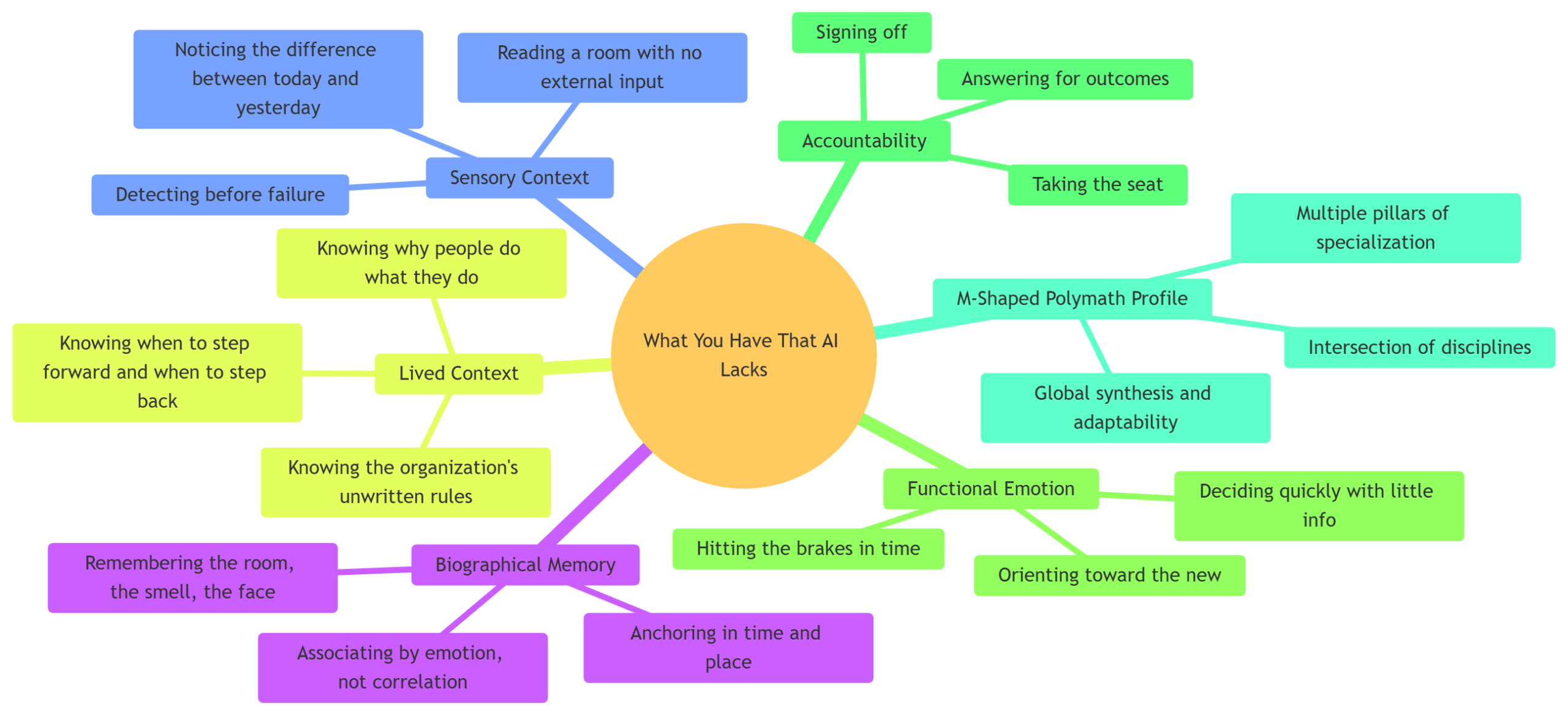
These five limitations are not a comforting list. They are where your residual economic value lies, increasingly concentrated in these vectors as AI absorbs the mechanical parts. They should be read as a map of where we need to be strong in the coming years.
| Your Human Limitation | How AI Can Mitigate It | What AI Cannot Replace |
|---|---|---|
| Limited memory for data | Yes (retrieval, summarization, search) | — |
| Slowness in processing large volumes | Yes (speed reading, synthesis) | — |
| Spelling and stylistic errors | Yes (human text linter) | — |
| Rewriting the same email a thousand times | Yes (dynamic templates) | — |
| Lived context in a new company | — | New human or veteran with judgment |
| Seeing what fails without logs | — | Professional with intuition |
| Deciding under moral pressure | — | The one who assumes accountability |
| Combining highly disconnected niches | Yes (translating terms between areas) | Synthesizing and creating polymath value |
The left half is where you lean on AI. The right half is where you, or someone like you, must be. Professional mastery consists of knowing to which column everything in front of you belongs.
Key Takeaways
AI has enormous capabilities in a very specific dimension: statistical processing of text and patterns at scale. But it has no biography, it has no body, it has no history with your clients, it has no emotional shortcuts, and it cannot assume accountability. These five limitations are not mere details: they are where human work continues to hold value, and they should be at the center of your day-to-day.
If you are an active professional, ask yourself which of the five human limitations you use most in your work, and whether you are reinforcing them or letting them atrophy. If you are just starting out, ask yourself which of the five you are going to develop as a competitive advantage over the next few years. The answer shouldn’t be “none,” because no alternative works.
AI knows that water boils at 100 degrees. You have been burned. Subtract one from the other, and the difference is your salary.
Verified Sources
- Bender & Koller (2020). Climbing towards NLU: On Meaning, Form, and Understanding in the Age of Data. One of the most rigorous defenses of the difference between processing language and understanding it. ACL Anthology
- EU AI Act — Official text of the European AI Regulation. The obligation of significant human oversight is in Article 14. Consolidated text
- Risko & Gilbert (2016). Cognitive offloading. Trends in Cognitive Sciences. Conceptual basis on how humans offload memory onto external tools, which connects to what is delegated and what is not. Cognitive Offloading
- Araki & Cotellessa (2020). Creative Polymathy and the COVID-19 Crisis. Frontiers in Psychology. Research that redefines modern polymathy not as dilettantism, but as the conjunction of breadth, depth, and cognitive integration in the face of high uncertainty and complexity. Frontiers in Psychology
- World Economic Forum (2023). Future of Jobs Report. Global employability reports that consistently place systems thinking, cognitive flexibility, and transversal competencies above isolated and automatable technical skills. Future of Jobs Report
- Curran, T., Pose, P. M., & Hill, A. (2026). Perfectionism is accelerating over time: A cross-temporal meta-analytic review of 35 years of college student data. Psychological Bulletin, American Psychological Association (APA). Global meta-analysis demonstrating the rise of fear of failure and perfectionism-induced paralysis in the current economic environment. American Psychological Association
- Pope Leo XIV (2026). Encyclical Letter Magnifica Humanitas: On the custody of the human person in the age of artificial intelligence. The official document setting global moral guidelines to demand that technology never replaces the sovereignty of judgment and the human face over mere algorithmic function. Official Text – Vatican
- NVIDIA Corporation (2024-2026). Project GR00T: Humanoid Robot General Purpose Foundation Model. Official documentation of the research and development platform on “embodiment” in AI and the processing of physical telemetry in real environments. NVIDIA Developer
Opinion Reads
- El Mundo (05/22/2026) — Human doubling, machine doubling: the frontier of creative work in the AI era (in Spanish). Link
- El Economista (06/01/2026) — Polymathy: The key to employability in the future of work (in Spanish). An approach to how the labor market rewards profiles capable of connecting disciplines instead of closing themselves off in isolated technical niches. Link
- El Economista (05/28/2026) — A British psychological study suggests today’s young people are more perfectionist than those of a previous generation (in Spanish). Journalistic analysis on the rise of the fear of making mistakes and work anxiety analyzed by the APA. Link
- Cinco Días / El País (05/30/2026) — Resistance to AI gains strength among young people, and even more among young women (in Spanish). Reflection on the cultural rejection by new generations to yield their professional autonomy to algorithms. Link
- La Vanguardia (06/01/2026) — Church, unions, and tech sector employers advocate acting united against AI (in Spanish). Chronicle of the common institutional front to protect the sovereignty and labor accountability of the worker. Link
“What You Have and AI Lacks” by Ramón Invarato at jarroba.com, licensed under Creative Commons Attribution-NonCommercial-ShareAlike 3.0. Registered at Safe Creative.

You may also like
What AI Can and Cannot Do Today in Software Development
what AI actually does well in software development, what it can't do yet, and why. The 5 integration levels and the junior developer paradox.

“If It Works, Don’t Touch It” and Other Excuses That No Longer Hold
Four corporate excuse-phrases, why the calculus has changed with AI, and what to do if you're stuck in an inertia-bound organization.
Leave a comment