
CI/CD and AI: From Theory to Practice — Series Index
Guía de navegación para la serie completa sobre CI/CD moderno con Inteligencia Artificial. Descubre qué artículos te interesan y en qué orden leerlos.
Series: CI/CD and AI: From Theory to Practice Introduction · 11 parts
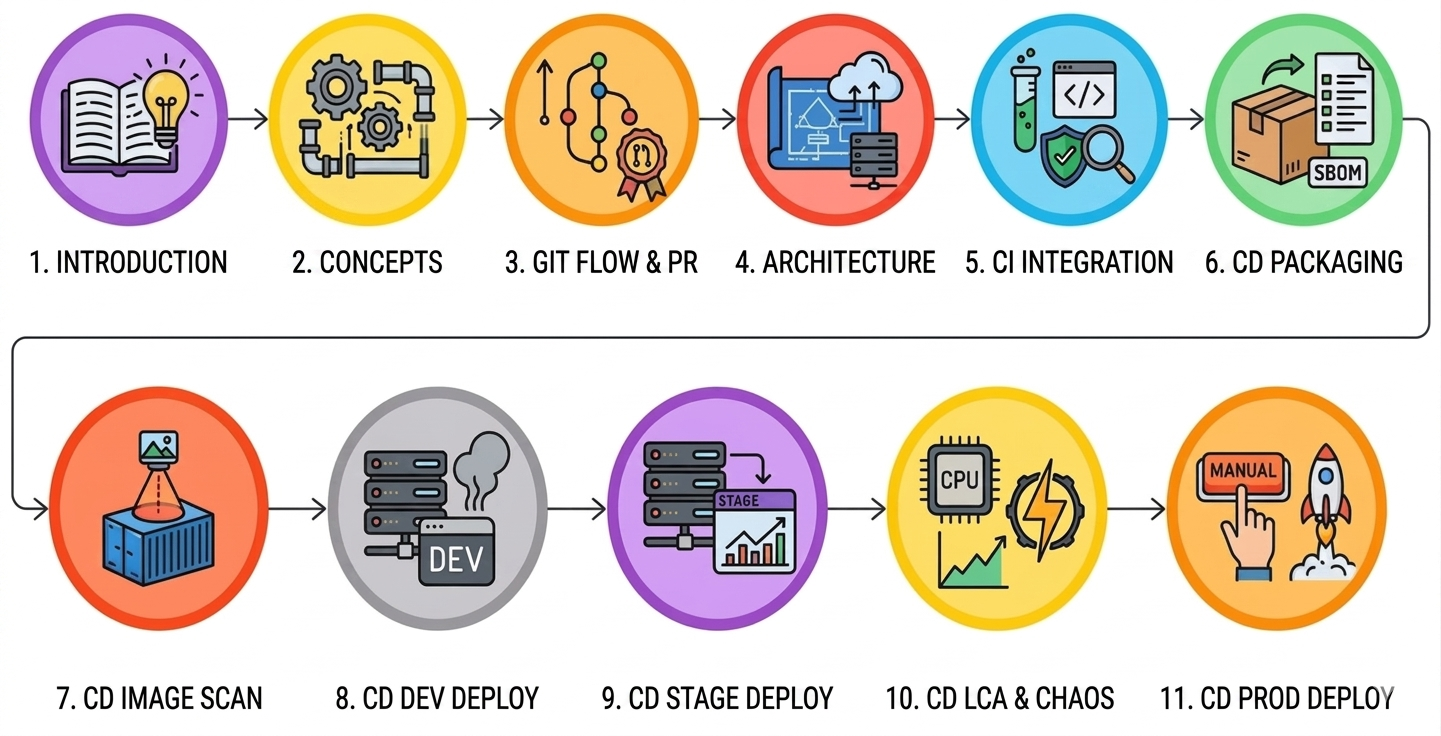
- Introduction
- 1CI/CD: Introduction — What It Is, Why It Matters, and Who Does It
- 2CI/CD: Core Concepts — pipeline, job, stage, step, and gates
- 3CI/CD: Branching, Git Flow, and Pull Requests
- 4Pre-CI: General CI/CD Pipeline Architecture and Pre-checks
- 5CI (Continuous Integration): analysis, tests, quality, and security
- 6CD (Continuous Delivery) — Part 1: packaging, SBOM, and remediation
- 7CD (Continuous Delivery) — Part 2: Image Scan and Service Tests
- 8CD (Continuous Delivery) — Part 3: Deploy to Dev and Smoke Tests
- 9CD (Continuous Delivery) — Part 4: Deploy to Staging and Performance Smoke Tests
- 10CD (Continuous Delivery) — Part 5: LCA — Load, Stress, and Chaos Engineering
- 11CD (Continuous Delivery) — Part 6: Final validations, Manual Approval, and Deploy to Production
This series covers everything from CI/CD fundamentals (Continuous Integration and Continuous Delivery) to its integration with Artificial Intelligence, including the role of the human team, modern tooling, and production deployment patterns. It is written from the perspective of an architect with AI as a co-pilot, not as a replacement.
What is this series about?
Modern software development demands automation, continuous quality, and frequent releases. CI/CD is not just a set of tools — it is a culture and a working architecture. And AI, far from replacing the technical team, is changing the role of every person in that process.
This series answers questions like:
- What exactly is a CI/CD pipeline and how do you design it well?
- What does each person (DevOps, Architect, QA, Dev) do in this system?
- In which parts of the pipeline can AI help, and in which parts can it not?
- How do you implement testing, security, and quality without blocking delivery speed?
- Which tools to use and when?
Target audience
- Developers who want to understand CI/CD beyond “copy a YAML from Stack Overflow”
- DevOps / Platform Engineers looking for structured references and tool comparisons
- Architects and Tech Leads who need to design or review pipelines in their teams
- Any technical person curious about how AI fits into the software lifecycle
Prerequisites: Basic knowledge of Git and software development. No prior CI/CD experience required.
Block — CI/CD: From Fundamentals to Production
How to read this series?
If you are new to CI/CD: Read in order from 4 to 9. Each article builds on the previous one.
If you already know CI/CD: You can go directly to the article that interests you. Each one is independent and has its own internal index.
If you are looking for AI’s role: The articles in Block I (coming soon) and Block III (coming soon) cover this in depth. In the meantime, each article in Block II includes an “AI in this phase” section at the end of each stage.
Structure of most article sections
I have tried to maintain a reasonably consistent structure throughout the series, especially with the goal of resolving doubts (that even I have encountered both in direct business practice and while learning). I created and followed the pattern below (although it was a goal, not a constraint, so it appears where it made sense — some sections have more applicable points than others):
- Description (introduction)
- Diagram (focused and detailed for this part)
- Steps included in that stage
- Best practices (ideas)
- Recommendations
- Advantages
- Disadvantages (risks/challenges)
- Types
- Examples (code, commands, prompts, etc.)
- AI: whether it replaces, improves, or recommended uses
Author’s note in the interest of honesty and accuracy
These articles were written with the help of AI as a co-pilot due to the magnitude of the subject covered, but the professional experience, every architectural decision, every tool selection, and every quality criterion was reviewed, questioned, and validated by the author (very much human). I want to emphasize that they were created from my personal experience and knowledge with AI assistance (for corrections, recommendations, improvements, and ideas), though always directed by me, and the bulk of the work was manual (since at every edge case in technology the AI was not good enough, regardless of model or prompt). I must acknowledge the considerable time I dedicated to putting these articles together — gathering information, organizing it, summarizing it, filtering it, structuring it, etc. In other words, while AI helped me on very specific points, it never can (and could not) do the heavy lifting. So I can say with a fair degree of confidence that, at least for now, AI alone is nowhere near capable of producing all of this, and there are parts where it arguably should never do so — as will be explained (it will always be better to have “human architects” nearby with complete know-how, who are not limited the way AI is).
Likewise, the code examples, commands, etc. in this series are scripts that are not meant to be 100% functional, but rather to illustrate concepts, since each part has an endless number of available options, many of which are constantly changing.
“CI/CD and AI: From Theory to Practice — Series Index” by Ramón Invarato at jarroba.com, licensed under Creative Commons Attribution-NonCommercial-ShareAlike 3.0. Registered at Safe Creative.

You may also like

AI and You: the Complete Series for Getting an Edge Without Losing Yourself
How to use AI well in your work and your life without turning into an evangelist or a denier. A complete ten-article series, no hype.

“If It Works, Don’t Touch It” and Other Excuses That No Longer Hold
Four corporate excuse-phrases, why the calculus has changed with AI, and what to do if you're stuck in an inertia-bound organization.
Leave a comment