
What Is Innovation? Part III (Types of Innovation)
Learn the types of innovation through the famous innovation matrix: incremental, semi-radical and radical, with real examples from the technology world.
English › What Is Innovation? part 3 of 4
In this new post, where we keep talking about innovation applied to the context of technology, we are going to talk about the types of innovation, and to do that we will show the famous innovation matrix. To refresh our memory a bit and be able to introduce new concepts: in the first post "What Is Innovation? Part I (Concepts and Examples)" we defined what innovation is and said that:
“Innovation is an invention that is implemented as a product, service or procedure, and that is taken to market in order to find a successful application in it”
Given this definition and the tablet example we gave, the word "invention" is probably quite confusing, since many of you may think an invention means "inventing something from scratch." That’s true, but it’s also true that modifying something or adding a new feature to a product or service is also inventing something that complements an invention, and therefore it is another invention. Homer Simpson already said it to his brother Herb in an episode: "You should have taken something that already existed and put a little clock on it or something". Even though the example sounds silly, if you take something that is already invented and add "a little clock or something" and it succeeds in the market, it should be considered (to a greater or lesser degree) an innovation. Of course, if you add "a little clock or something" to something already invented, it will most likely fail, but if you take something already invented that hasn’t succeeded in the market, add a very simple new feature and it succeeds, you have turned a new product or service into an innovation.
That said, you’re probably thinking that inventing something from scratch is not the same as adding a new feature (or a little clock or something) to something already invented. That’s why there are different "degrees or levels" of inventions, and that’s where the so-called "Innovation Matrix" comes in. The Innovation Matrix is just a two-axis representation of how "new or different" the invention is, using as reference the "Technological" and "Business Model" differences that the invention has compared to what already exists in the market. Here is the "Innovation Matrix":
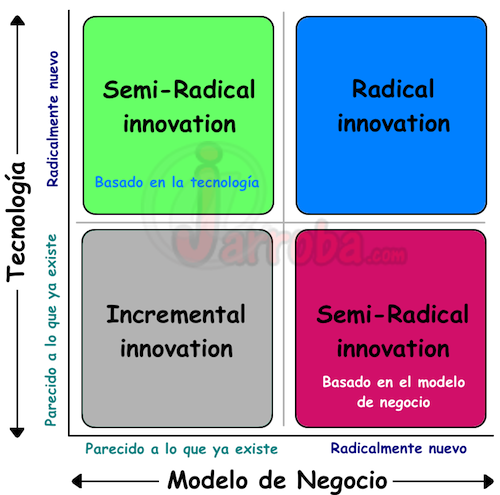
As you can see, the Innovation Matrix represents on the 'x' axis how different the invention is in terms of business model compared to what already exists, and on the 'y' axis how much the invention differs from existing technology. That’s why this matrix divides innovations into 4 groups: "Incremental Innovation", "Semi-Radical Innovation" (Business model based), "Semi-Radical Innovation" (Technology based) and "Radical Innovation". You can probably imagine the characteristics of these types of innovation, but let’s go through them:
- Incremental Innovation: These are products of "limited creativity" where small improvements have been introduced. Of the four types of innovation, it is the most common (as you’d expect), since success is almost guaranteed because it builds on something that is already successful. A good example is the new iPhone versions, which add small improvements or new technologies, but the base of the product is the same and the business model is practically the same.
- Semi-Radical Innovation (Business model based): To launch this type of invention, you need significant knowledge of the dynamics of the market the product or service will enter, and you need to know your competitors’ behavior very well. The technology barely changes. An example of "Semi-Radical Innovation" based on the business model is Google’s smartphones (the Nexus), which cost considerably less than competing smartphones with similar features (practically half the price), making it almost impossible to compete on price with these devices. However, Google doesn’t base its business on selling smartphones, but on how users will use Google’s services with that smartphone (Gmail, Android, Google Maps, advertising, etc.).
- Semi-Radical Innovation (Technology based): These inventions undergo major technological changes (better performance, architecture, etc.). To create them you need a deep knowledge of the technology, and in some circumstances you can patent the new inventions to hold the intellectual property and everything that comes with it. An example of this type of invention is "Bluetooth", invented by Ericsson engineer Jaap Haartsen; this invention could have been patented, although Ericsson decided to donate the technology.
- Radical Innovation: This type of innovation involves very significant changes in both the business model and the technology. These are the inventions that succeed the least, so there are hardly any innovations of this type. Since very few dare to bring inventions of this kind to market, it is very hard to give examples.
Now that we’ve explained the types of innovation, many of you will have asked yourselves: how do you "measure" how different an invention is from what already exists? Honestly, answering that question is very hard, since everyone sets the "bar" for how different an invention is at a different height. So it should be the companies’ innovation departments who set those "bars", taking the competition’s inventions and innovations as a reference. It’s true that this is very hard and also depends on how optimistic or pessimistic each company is, but as I say, it’s the innovation departments’ job to know what kinds of inventions are out there. As you may have noticed throughout this post, I’ve tried to distinguish an invention from an innovation, since I’ve talked about classifying inventions and not innovations, because an invention becomes an innovation once it succeeds in the market.
On the other hand, I haven’t ventured to give too many examples of the types of innovation, since that classification can be very subjective. But to really understand this post, it would be good for you to think about where you would classify innovations such as Facebook, WhatsApp, the iPhone, Google’s smartphones (the Nexus) and, although I don’t consider them innovations at the moment, where would Samsung’s smartwatches or Google Glass fit?
To finish (just as I started), here’s a video from The Simpsons where I want to give an example (although obviously all fictional) of how an invention ("The baby translator") succeeds in the market and becomes an innovation, based on customers’ opinions, and you can share your thoughts on what type of innovation the "baby translator" is:
References:
[1] Part of this knowledge was taught in the course “Innovation as a tool for software product development” of the Master’s in “Computer Science and Technology” at the UPM, taught by Professor Juan Garbajosa.
[2] Rogers, E. M. (1962, latest edition 2003). Diffusion of innovations (5th ed.). New York: Free Press.
[3] Part of this knowledge was acquired through the "Technology Management & Innovation" seminars given at the Escuela Universitaria de Informática of the UPM by Manuel Lorenzo (Head of Technology & Innovation at Ericsson Spain).
“What Is Innovation? Part III (Types of Innovation)” by Ricardo Moya at jarroba.com, licensed under Creative Commons Attribution-NonCommercial-ShareAlike 3.0. Registered at Safe Creative.

You may also like

How to Adopt AI in Your Organization Without Making the Most Common Mistakes
Failure and success patterns in AI adoption, a practical decision framework, safe use cases, and minimum viable governance for development teams.

The Real Cost of AI: From the Democratic Promise to the Enterprise Model
Copilot moves to token billing, JetBrains cuts quotas, Claude raises costs with new tokenizer. Analysis of the economic divide AI is opening in 2026.
Leave a comment